
Bryq vs. TestGorilla
Which Assessment Platform Fits Your Hiring?
Updated July 2026.


Bryq vs. TestGorilla
Which Assessment Platform Fits Your Hiring?
Updated July 2026.
Bryq vs. TestGorilla
Which Assessment Platform Fits Your Hiring?
Updated July 2026.
TestGorilla review: screening tests, pricing, and how Bryq compares
TestGorilla review: screening tests, pricing, and how Bryq compares
TestGorilla is a strong choice if you want a large library of standalone skills tests to check what a candidate knows today. Bryq is the talent assessment platform that measures the full picture, cognitive ability, behavioral traits, and hard skills including AI fluency, in one integrated candidate profile validated by I/O psychologists. The core difference is simple: skills-only tests tell you what someone knows right now; Bryq measures whether they will succeed in the role, not just whether they can pass a test. Teams using Bryq see a 3x improvement in quality of hire, 47% lower attrition, and 2x faster hiring. Here is an honest side-by-side.
TestGorilla is a strong choice if you want a large library of standalone skills tests to check what a candidate knows today. Bryq is the talent assessment platform that measures the full picture, cognitive ability, behavioral traits, and hard skills including AI fluency, in one integrated candidate profile validated by I/O psychologists. The core difference is simple: skills-only tests tell you what someone knows right now; Bryq measures whether they will succeed in the role, not just whether they can pass a test. Teams using Bryq see a 3x improvement in quality of hire, 47% lower attrition, and 2x faster hiring. Here is an honest side-by-side.
TestGorilla is a strong choice if you want a large library of standalone skills tests to check what a candidate knows today. Bryq is the talent assessment platform that measures the full picture, cognitive ability, behavioral traits, and hard skills including AI fluency, in one integrated candidate profile validated by I/O psychologists. The core difference is simple: skills-only tests tell you what someone knows right now; Bryq measures whether they will succeed in the role, not just whether they can pass a test. Teams using Bryq see a 3x improvement in quality of hire, 47% lower attrition, and 2x faster hiring. Here is an honest side-by-side.
At a Glance: Bryq vs TestGorilla
At a Glance: Bryq vs TestGorilla
Bryq
Bryq
Bryq
TestGorilla
TestGorilla
TestGorilla
Core approach
Core
approach
Core approach
One integrated candidate profile: cognitive + behavioral + hard skills including AI fluency
One integrated candidate profile: cognitive + behavioral + hard skills including AI fluency
One integrated candidate profile: cognitive + behavioral + hard skills including AI fluency
A library of separate skills tests
A library of separate skills tests
A library of separate skills tests
What it tells you
AI
proficiency
What it tells you
Whether a candidate will succeed in the role
Whether a candidate will succeed in the role
Whether a candidate will succeed in the role
What a candidate knows today
What a candidate knows today
What a candidate knows today
Scientific validation
Candidate
experience
Scientific validation
Continuously validated by I/O psychologists
Continuously validated by I/O psychologists
Continuously validated by I/O psychologists
Test library
Test library
Test library
AI fluency
AI fluency
AI fluency
One AI Fluency Assessment built on six peer-reviewed research sources
One AI Fluency Assessment built on six peer-reviewed research sources
One AI Fluency Assessment built on six peer-reviewed research sources
Separate AI skills tests on a proprietary framework
Separate AI skills tests on a proprietary framework
Separate AI skills tests on a proprietary framework
Measurable result
Reference
checks
Measurable result
3x quality of hire, 47% lower attrition, 2x faster hiring
3x quality of hire, 47% lower attrition, 2x faster hiring
3x quality of hire, 47% lower attrition, 2x faster hiring
(varies)
(varies)
(varies)
Setup
Setup
Setup
ATS-integrated in under a week
ATS-integrated in under a week
ATS-integrated in under a week
(varies)
(varies)
(varies)
What Is TestGorilla?
What Is TestGorilla?
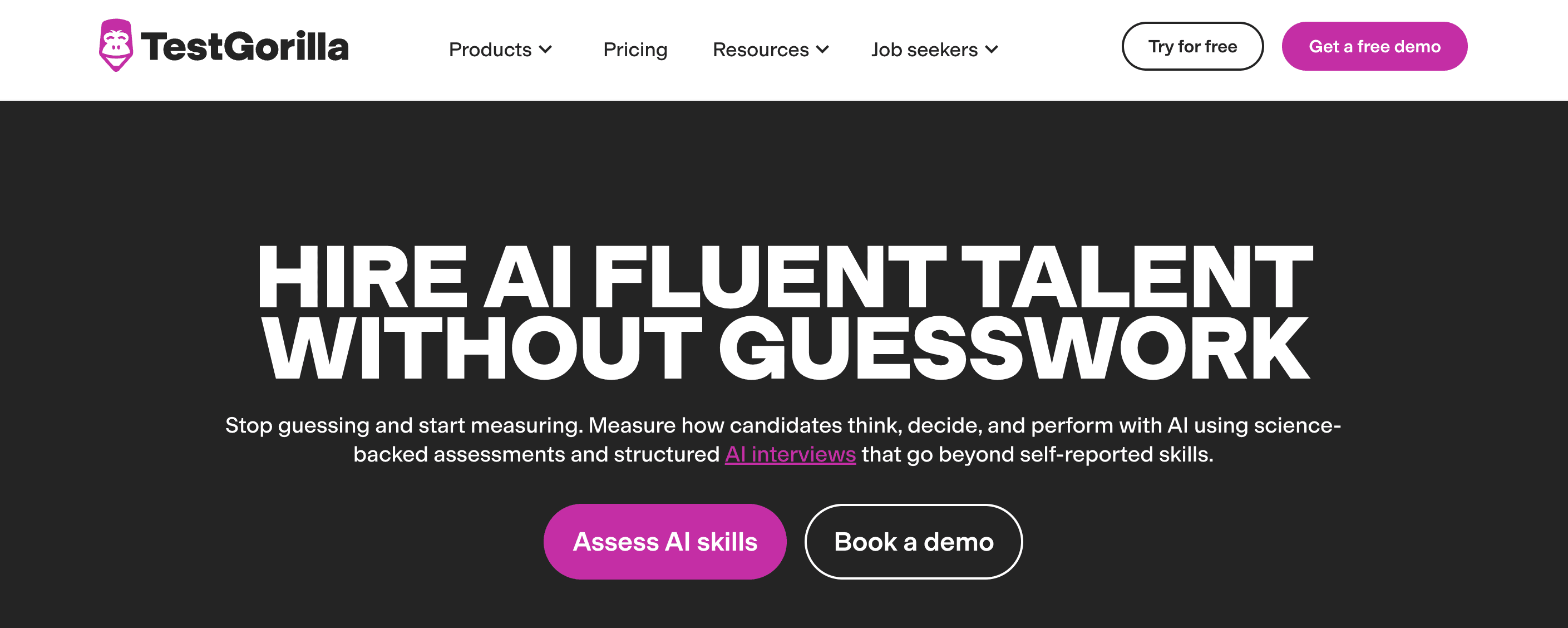
TestGorilla is an online assessment platform built around breadth. Over 400 validated tests cover everything from Python to customer support workflows to Big 5 personality assessments. Hiring managers pick the tests. Recruiters get scores on individual competencies.
The test library is the selling point, and it's a real one. Need to confirm someone can write SQL, manage a Google Ads campaign, or troubleshoot cloud infrastructure? There's a skills assessment for it. Tests are developed with I-O psychologists, and question banks rotate to keep content fresh.
The platform has also invested in AI. An AI Job Builder generates a custom battery from job descriptions. Conversational video features replicate live back-and-forth. A sourcing product taps into over 2 million pre-tested candidates.
Where friction shows up is the candidate side. A recommended multi-test battery runs 45 to 60 minutes. Proctoring includes webcam snapshots every 30 seconds. Tab switching and paste detection stay active throughout. User reviews on G2 describe the experience as high-pressure, and some report declining the assessment before speaking with a recruiter.
The platform answers a specific question well: does this candidate have the discrete skills listed in the job description? For a broader look at how assessment costs work across the category, see our skills assessment tools cost guide.
TestGorilla is an online assessment platform built around breadth. Over 400 validated tests cover everything from Python to customer support workflows to Big 5 personality assessments. Hiring managers pick the tests. Recruiters get scores on individual competencies.
The test library is the selling point, and it's a real one. Need to confirm someone can write SQL, manage a Google Ads campaign, or troubleshoot cloud infrastructure? There's a skills assessment for it. Tests are developed with I-O psychologists, and question banks rotate to keep content fresh.
The platform has also invested in AI. An AI Job Builder generates a custom battery from job descriptions. Conversational video features replicate live back-and-forth. A sourcing product taps into over 2 million pre-tested candidates.
Where friction shows up is the candidate side. A recommended multi-test battery runs 45 to 60 minutes. Proctoring includes webcam snapshots every 30 seconds. Tab switching and paste detection stay active throughout. User reviews on G2 describe the experience as high-pressure, and some report declining the assessment before speaking with a recruiter.
The platform answers a specific question well: does this candidate have the discrete skills listed in the job description? For a broader look at how assessment costs work across the category, see our skills assessment tools cost guide.
TestGorilla is an online assessment platform built around breadth. Over 400 validated tests cover everything from Python to customer support workflows to Big 5 personality assessments. Hiring managers pick the tests. Recruiters get scores on individual competencies.
The test library is the selling point, and it's a real one. Need to confirm someone can write SQL, manage a Google Ads campaign, or troubleshoot cloud infrastructure? There's a skills assessment for it. Tests are developed with I-O psychologists, and question banks rotate to keep content fresh.
The platform has also invested in AI. An AI Job Builder generates a custom battery from job descriptions. Conversational video features replicate live back-and-forth. A sourcing product taps into over 2 million pre-tested candidates.
Where friction shows up is the candidate side. A recommended multi-test battery runs 45 to 60 minutes. Proctoring includes webcam snapshots every 30 seconds. Tab switching and paste detection stay active throughout. User reviews on G2 describe the experience as high-pressure, and some report declining the assessment before speaking with a recruiter.
The platform answers a specific question well: does this candidate have the discrete skills listed in the job description? For a broader look at how assessment costs work across the category, see our skills assessment tools cost guide.
What Is Bryq?
What Is Bryq?

Hiring is still mostly guesswork. Companies scan resumes for keywords, run unstructured interviews, and hope for the best. Then they wonder why nearly half their new hires wash out.
Bryq is a talent assessment platform that measures what actually drives job performance: cognitive abilities, behavioral traits, and hard skills, including how effectively candidates work with AI. All of that lives inside one integrated psychometric assessment, i.e. 1 candidate experience and 1 science-backed profile.
The AI-powered engine builds a role profile for every position and scores each applicant against it. That's not a skills report card. It's a data-driven fit prediction: cognitive ability, behavioral alignment, soft skills, and problem-solving capability combined into a view that tells hiring teams who's most likely to perform and stay.
The newest module is the AI Fluency Assessment. 75% of knowledge workers already use AI at work, but most organizations can't tell whether someone uses it well or badly. This module is scenario-based, tool-agnostic, and built on 6 peer-reviewed research frameworks. It evaluates real-world capability with AI, not definitions or trivia. All it takes is 15 minutes. Five scored dimensions on a 0-100 scale. No pass/fail binary and it's included in all plans.
Teams report an 80% reduction in screening time, a 3x improvement in quality of hire, and a 47% lower attrittion. The assessment respects candidate time, there's no webcam surveillance, and no hour-long test marathons!
Hiring is still mostly guesswork. Companies scan resumes for keywords, run unstructured interviews, and hope for the best. Then they wonder why nearly half their new hires wash out.
Bryq is a talent assessment platform that measures what actually drives job performance: cognitive abilities, behavioral traits, and hard skills, including how effectively candidates work with AI. All of that lives inside one integrated psychometric assessment, i.e. 1 candidate experience and 1 science-backed profile.
The AI-powered engine builds a role profile for every position and scores each applicant against it. That's not a skills report card. It's a data-driven fit prediction: cognitive ability, behavioral alignment, soft skills, and problem-solving capability combined into a view that tells hiring teams who's most likely to perform and stay.
The newest module is the AI Fluency Assessment. 75% of knowledge workers already use AI at work, but most organizations can't tell whether someone uses it well or badly. This module is scenario-based, tool-agnostic, and built on 6 peer-reviewed research frameworks. It evaluates real-world capability with AI, not definitions or trivia. All it takes is 15 minutes. Five scored dimensions on a 0-100 scale. No pass/fail binary and it's included in all plans.
Teams report an 80% reduction in screening time, a 3x improvement in quality of hire, and a 47% lower attrittion. The assessment respects candidate time, there's no webcam surveillance, and no hour-long test marathons!
Hiring is still mostly guesswork. Companies scan resumes for keywords, run unstructured interviews, and hope for the best. Then they wonder why nearly half their new hires wash out.
Bryq is a talent assessment platform that measures what actually drives job performance: cognitive abilities, behavioral traits, and hard skills, including how effectively candidates work with AI. All of that lives inside one integrated psychometric assessment, i.e. 1 candidate experience and 1 science-backed profile.
The AI-powered engine builds a role profile for every position and scores each applicant against it. That's not a skills report card. It's a data-driven fit prediction: cognitive ability, behavioral alignment, soft skills, and problem-solving capability combined into a view that tells hiring teams who's most likely to perform and stay.
The newest module is the AI Fluency Assessment. 75% of knowledge workers already use AI at work, but most organizations can't tell whether someone uses it well or badly. This module is scenario-based, tool-agnostic, and built on 6 peer-reviewed research frameworks. It evaluates real-world capability with AI, not definitions or trivia. All it takes is 15 minutes. Five scored dimensions on a 0-100 scale. No pass/fail binary and it's included in all plans.
Teams report an 80% reduction in screening time, a 3x improvement in quality of hire, and a 47% lower attrittion. The assessment respects candidate time, there's no webcam surveillance, and no hour-long test marathons!
Test Library vs Integrated Profile
Test Library vs Integrated Profile
This is the fork in the road.
That platform works like a menu. You select from 400+ tests, build a battery, and candidates get scored individually. That works when you know precisely which job-specific skills the role demands and want validation at scale.
Bryq works differently. Instead of assembling separate tests, it runs one integrated assessment that captures cognitive, behavioural, and practical dimensions together. The AI scores every applicant against the role profile. Hiring managers aren't reading five separate scores and triangulating. They're looking at one fit picture.
The research on why hires fail supports this. Most people don't wash out because they couldn't pass a skills assessment. They leave because of poor role fit, misaligned motivation, or friction with how the team actually operates. An approach that only tests discrete skills catches the first problem. It misses the other two.
This is the fork in the road.
That platform works like a menu. You select from 400+ tests, build a battery, and candidates get scored individually. That works when you know precisely which job-specific skills the role demands and want validation at scale.
Bryq works differently. Instead of assembling separate tests, it runs one integrated assessment that captures cognitive, behavioural, and practical dimensions together. The AI scores every applicant against the role profile. Hiring managers aren't reading five separate scores and triangulating. They're looking at one fit picture.
The research on why hires fail supports this. Most people don't wash out because they couldn't pass a skills assessment. They leave because of poor role fit, misaligned motivation, or friction with how the team actually operates. An approach that only tests discrete skills catches the first problem. It misses the other two.
This is the fork in the road.
That platform works like a menu. You select from 400+ tests, build a battery, and candidates get scored individually. That works when you know precisely which job-specific skills the role demands and want validation at scale.
Bryq works differently. Instead of assembling separate tests, it runs one integrated assessment that captures cognitive, behavioural, and practical dimensions together. The AI scores every applicant against the role profile. Hiring managers aren't reading five separate scores and triangulating. They're looking at one fit picture.
The research on why hires fail supports this. Most people don't wash out because they couldn't pass a skills assessment. They leave because of poor role fit, misaligned motivation, or friction with how the team actually operates. An approach that only tests discrete skills catches the first problem. It misses the other two.
Candidate Experience and Ease of Use
Candidate Experience and Ease of Use
Your recruitment process is part of your employer brand, whether you frame it that way or not.
The integrated assessment is thorough without being punishing. The AI Fluency module takes about 15 minutes of scenario work. No proctoring cameras. No monitoring pop-ups. The functionality is straightforward: candidates complete 1 assessment, not a patchwork of separate tests.
The other platform's recommended approach stacks multiple tests into a single session. A typical battery runs 30 to 60 minutes with webcam snapshots every 30 seconds. Strict per-test time limits add pressure. User reviews consistently flag assessment length as a source of candidate discomfort.
For organisations competing for top talent in tight markets, that friction is a cost. Every candidate who drops off is one a competing talent acquisition team might pick up. Assessment fatigue is real. People who power through a lengthy evaluation and then hear nothing share those experiences publicly.
Your recruitment process is part of your employer brand, whether you frame it that way or not.
The integrated assessment is thorough without being punishing. The AI Fluency module takes about 15 minutes of scenario work. No proctoring cameras. No monitoring pop-ups. The functionality is straightforward: candidates complete 1 assessment, not a patchwork of separate tests.
The other platform's recommended approach stacks multiple tests into a single session. A typical battery runs 30 to 60 minutes with webcam snapshots every 30 seconds. Strict per-test time limits add pressure. User reviews consistently flag assessment length as a source of candidate discomfort.
For organisations competing for top talent in tight markets, that friction is a cost. Every candidate who drops off is one a competing talent acquisition team might pick up. Assessment fatigue is real. People who power through a lengthy evaluation and then hear nothing share those experiences publicly.
Your recruitment process is part of your employer brand, whether you frame it that way or not.
The integrated assessment is thorough without being punishing. The AI Fluency module takes about 15 minutes of scenario work. No proctoring cameras. No monitoring pop-ups. The functionality is straightforward: candidates complete 1 assessment, not a patchwork of separate tests.
The other platform's recommended approach stacks multiple tests into a single session. A typical battery runs 30 to 60 minutes with webcam snapshots every 30 seconds. Strict per-test time limits add pressure. User reviews consistently flag assessment length as a source of candidate discomfort.
For organisations competing for top talent in tight markets, that friction is a cost. Every candidate who drops off is one a competing talent acquisition team might pick up. Assessment fatigue is real. People who power through a lengthy evaluation and then hear nothing share those experiences publicly.
AI Fluency: Integrated vs Separate Tests
AI Fluency: Integrated vs Separate Tests
Both providers use AI. For very different things.
TestGorilla's AI is a workflow automation layer. The AI Job Builder generates a battery from job descriptions. Resume scoring pre-filters the funnel. Conversational video interviews ask dynamic follow-ups. Useful, but they don't change what the platform fundamentally measures.
Bryq's AI is structural. The matching engine builds the role profile, scores applicants on fit, and surfaces the best candidates most likely to succeed. It's the core of the product, not a bolt-on.
Then there's the AI Fluency Assessment. 50% of employers cite AI skills gaps as a top barrier to adoption. One provider offers seven separate AI assessments on a proprietary framework. The other delivers one integrated proficiency profile built on 6 peer-reviewed research frameworks (UNESCO, SFIA, OECD, and others). Scenario-based. Tool-agnostic. Five dimensions. For organisations that need real-time visibility into how their people actually work with AI, the difference in research validation matters.
Both providers use AI. For very different things.
TestGorilla's AI is a workflow automation layer. The AI Job Builder generates a battery from job descriptions. Resume scoring pre-filters the funnel. Conversational video interviews ask dynamic follow-ups. Useful, but they don't change what the platform fundamentally measures.
Bryq's AI is structural. The matching engine builds the role profile, scores applicants on fit, and surfaces the best candidates most likely to succeed. It's the core of the product, not a bolt-on.
Then there's the AI Fluency Assessment. 50% of employers cite AI skills gaps as a top barrier to adoption. One provider offers seven separate AI assessments on a proprietary framework. The other delivers one integrated proficiency profile built on 6 peer-reviewed research frameworks (UNESCO, SFIA, OECD, and others). Scenario-based. Tool-agnostic. Five dimensions. For organisations that need real-time visibility into how their people actually work with AI, the difference in research validation matters.
Both providers use AI. For very different things.
TestGorilla's AI is a workflow automation layer. The AI Job Builder generates a battery from job descriptions. Resume scoring pre-filters the funnel. Conversational video interviews ask dynamic follow-ups. Useful, but they don't change what the platform fundamentally measures.
Bryq's AI is structural. The matching engine builds the role profile, scores applicants on fit, and surfaces the best candidates most likely to succeed. It's the core of the product, not a bolt-on.
Then there's the AI Fluency Assessment. 50% of employers cite AI skills gaps as a top barrier to adoption. One provider offers seven separate AI assessments on a proprietary framework. The other delivers one integrated proficiency profile built on 6 peer-reviewed research frameworks (UNESCO, SFIA, OECD, and others). Scenario-based. Tool-agnostic. Five dimensions. For organisations that need real-time visibility into how their people actually work with AI, the difference in research validation matters.
ATS Integration: Under a Week
ATS Integration: Under a Week
TestGorilla has broad integration coverage: 30+ ATS connections, HRIS systems, and tools like Zapier. It also offers an API for custom setups. If your HR stack is complex and legacy based, you'll likely find a connector.
Bryq connects to the platforms mid-market and enterprise teams actually run: Greenhouse, Lever, Workday, iCIMS, and 20+ other ATS connections. Setup takes days, not weeks. No IT project. The connector is designed to streamline the recruiter's workflow, not add to it.
The deeper difference is what flows through the integration. One platform sends individual test scores. The other sends a fit profile. One gives your recruiter data points to interpret. The other gives them a recommendation.
TestGorilla has broad integration coverage: 30+ ATS connections, HRIS systems, and tools like Zapier. It also offers an API for custom setups. If your HR stack is complex and legacy based, you'll likely find a connector.
Bryq connects to the platforms mid-market and enterprise teams actually run: Greenhouse, Lever, Workday, iCIMS, and 20+ other ATS connections. Setup takes days, not weeks. No IT project. The connector is designed to streamline the recruiter's workflow, not add to it.
The deeper difference is what flows through the integration. One platform sends individual test scores. The other sends a fit profile. One gives your recruiter data points to interpret. The other gives them a recommendation.
TestGorilla has broad integration coverage: 30+ ATS connections, HRIS systems, and tools like Zapier. It also offers an API for custom setups. If your HR stack is complex and legacy based, you'll likely find a connector.
Bryq connects to the platforms mid-market and enterprise teams actually run: Greenhouse, Lever, Workday, iCIMS, and 20+ other ATS connections. Setup takes days, not weeks. No IT project. The connector is designed to streamline the recruiter's workflow, not add to it.
The deeper difference is what flows through the integration. One platform sends individual test scores. The other sends a fit profile. One gives your recruiter data points to interpret. The other gives them a recommendation.
Pricing: Predictable vs Per-Candidate
Pricing: Predictable vs Per-Candidate
Pricing is where many teams feel the gap most clearly.
Bryq charges a flat-rate subscription with unlimited assessments. Your cost doesn't change whether you assess 200 candidates or 2,000. The fluency module is included in every plan at no additional charge. The cost structure is transparent.
The other platform uses a credit-based model. The Core plan starts around $142 per month and includes 250 credits. Standard assessments cost 1 credit each. Video features cost 2. Some configurations trigger a 1:3 evaluation ratio, meaning one full assessment can consume three credits. Credits don't roll over.
For a company running 1,000 assessments annually, credit-based costs add up fast. There's also administrative overhead: tracking balances, forecasting spikes, managing top-ups. For a deeper look at how costs compare across the category, see our complete cost comparison.
Pricing is where many teams feel the gap most clearly.
Bryq charges a flat-rate subscription with unlimited assessments. Your cost doesn't change whether you assess 200 candidates or 2,000. The fluency module is included in every plan at no additional charge. The cost structure is transparent.
The other platform uses a credit-based model. The Core plan starts around $142 per month and includes 250 credits. Standard assessments cost 1 credit each. Video features cost 2. Some configurations trigger a 1:3 evaluation ratio, meaning one full assessment can consume three credits. Credits don't roll over.
For a company running 1,000 assessments annually, credit-based costs add up fast. There's also administrative overhead: tracking balances, forecasting spikes, managing top-ups. For a deeper look at how costs compare across the category, see our complete cost comparison.
Pricing is where many teams feel the gap most clearly.
Bryq charges a flat-rate subscription with unlimited assessments. Your cost doesn't change whether you assess 200 candidates or 2,000. The fluency module is included in every plan at no additional charge. The cost structure is transparent.
The other platform uses a credit-based model. The Core plan starts around $142 per month and includes 250 credits. Standard assessments cost 1 credit each. Video features cost 2. Some configurations trigger a 1:3 evaluation ratio, meaning one full assessment can consume three credits. Credits don't roll over.
For a company running 1,000 assessments annually, credit-based costs add up fast. There's also administrative overhead: tracking balances, forecasting spikes, managing top-ups. For a deeper look at how costs compare across the category, see our complete cost comparison.
Assessment Science: Validated by I/O psychologists
Assessment Science: Validated by I/O psychologists
Both platforms take this seriously. The approaches differ.
One approach centres on standardisation: every candidate gets the same test, scored the same way, with rotating question banks. TestGorilla reports 91% of organisations using skills-based hiring see increased diversity.
Bryq builds unconscious bias reduction into the model itself. Psychometric assessments validated by I-O psychologists for no adverse impact across demographics. EEOC and OFCCP compliance standards met. Because the platform doesn't rely on resumes, job titles, or university credentials as inputs, it sidesteps many of the bias vectors that testing alone can't address.
For organizations in the EU, there's an additional angle. The EU AI Act (Article 4) requires organizations to ensure staff AI literacy. The AI Fluency Assessment provides documented, auditable evidence of candidate evaluation against that requirement.
Both platforms take this seriously. The approaches differ.
One approach centres on standardisation: every candidate gets the same test, scored the same way, with rotating question banks. TestGorilla reports 91% of organisations using skills-based hiring see increased diversity.
Bryq builds unconscious bias reduction into the model itself. Psychometric assessments validated by I-O psychologists for no adverse impact across demographics. EEOC and OFCCP compliance standards met. Because the platform doesn't rely on resumes, job titles, or university credentials as inputs, it sidesteps many of the bias vectors that testing alone can't address.
For organizations in the EU, there's an additional angle. The EU AI Act (Article 4) requires organizations to ensure staff AI literacy. The AI Fluency Assessment provides documented, auditable evidence of candidate evaluation against that requirement.
Both platforms take this seriously. The approaches differ.
One approach centres on standardisation: every candidate gets the same test, scored the same way, with rotating question banks. TestGorilla reports 91% of organisations using skills-based hiring see increased diversity.
Bryq builds unconscious bias reduction into the model itself. Psychometric assessments validated by I-O psychologists for no adverse impact across demographics. EEOC and OFCCP compliance standards met. Because the platform doesn't rely on resumes, job titles, or university credentials as inputs, it sidesteps many of the bias vectors that testing alone can't address.
For organizations in the EU, there's an additional angle. The EU AI Act (Article 4) requires organizations to ensure staff AI literacy. The AI Fluency Assessment provides documented, auditable evidence of candidate evaluation against that requirement.
Culture Fit, Onboarding, and What Happens After the Hire
Culture Fit, Onboarding, and What Happens After the Hire
Most comparisons stop at the screening stage. But assessment data has a longer shelf life than you'd think.
Skill test results are useful at the point of hire. Once someone starts, those scores age out. The other platform does offer a Culture Add assessment on the Big 5 model, which helps with culture fit at the screening stage. But results lose relevance as tools and frameworks change.
Bryq's cognitive and behavioural profile persists well beyond onboarding. Because it measures how someone thinks and collaborates rather than what specific tools they know, the data stays relevant for talent management, internal mobility, career development, and L&D planning. That turns a one-time screening cost into a lasting talent intelligence asset.
Most comparisons stop at the screening stage. But assessment data has a longer shelf life than you'd think.
Skill test results are useful at the point of hire. Once someone starts, those scores age out. The other platform does offer a Culture Add assessment on the Big 5 model, which helps with culture fit at the screening stage. But results lose relevance as tools and frameworks change.
Bryq's cognitive and behavioural profile persists well beyond onboarding. Because it measures how someone thinks and collaborates rather than what specific tools they know, the data stays relevant for talent management, internal mobility, career development, and L&D planning. That turns a one-time screening cost into a lasting talent intelligence asset.
Most comparisons stop at the screening stage. But assessment data has a longer shelf life than you'd think.
Skill test results are useful at the point of hire. Once someone starts, those scores age out. The other platform does offer a Culture Add assessment on the Big 5 model, which helps with culture fit at the screening stage. But results lose relevance as tools and frameworks change.
Bryq's cognitive and behavioural profile persists well beyond onboarding. Because it measures how someone thinks and collaborates rather than what specific tools they know, the data stays relevant for talent management, internal mobility, career development, and L&D planning. That turns a one-time screening cost into a lasting talent intelligence asset.
Who Should Choose TestGorilla
Who Should Choose TestGorilla
You need to verify specific technical skills (coding languages, software platforms, job-specific knowledge) as the primary filter in your hiring process
Your roles are defined by discrete, testable competencies and you want a broad selection of tests with templates for common roles
You're a small business comfortable managing credit-based costs
You hire mainly for positions where what someone knows today matters more than how they'll adapt tomorrow
You need to verify specific technical skills (coding languages, software platforms, job-specific knowledge) as the primary filter in your hiring process
Your roles are defined by discrete, testable competencies and you want a broad selection of tests with templates for common roles
You're a small business comfortable managing credit-based costs
You hire mainly for positions where what someone knows today matters more than how they'll adapt tomorrow
You need to verify specific technical skills (coding languages, software platforms, job-specific knowledge) as the primary filter in your hiring process
Your roles are defined by discrete, testable competencies and you want a broad selection of tests with templates for common roles
You're a small business comfortable managing credit-based costs
You hire mainly for positions where what someone knows today matters more than how they'll adapt tomorrow
Who Should Choose Bryq
Who Should Choose Bryq
• You want to measure the full picture of fit: cognitive, behavioural, and practical skills in one integrated assessment
• You need to understand how candidates actually work with AI in real-world scenarios
• You want a flat rate that doesn't penalise you for growing your hiring volume
• Candidate experience matters to your brand and you'd rather not put your candidates through 60 minutes of proctored testing
• You're a mid-market or large enterprise that needs validated, no-adverse-impact assessments
• You want assessment data that supports talent management and career development beyond the initial hiring decision
• You want to measure the full picture of fit: cognitive, behavioural, and practical skills in one integrated assessment
• You need to understand how candidates actually work with AI in real-world scenarios
• You want a flat rate that doesn't penalise you for growing your hiring volume
• Candidate experience matters to your brand and you'd rather not put your candidates through 60 minutes of proctored testing
• You're a mid-market or large enterprise that needs validated, no-adverse-impact assessments
• You want assessment data that supports talent management and career development beyond the initial hiring decision
• You want to measure the full picture of fit: cognitive, behavioural, and practical skills in one integrated assessment
• You need to understand how candidates actually work with AI in real-world scenarios
• You want a flat rate that doesn't penalise you for growing your hiring volume
• Candidate experience matters to your brand and you'd rather not put your candidates through 60 minutes of proctored testing
• You're a mid-market or large enterprise that needs validated, no-adverse-impact assessments
• You want assessment data that supports talent management and career development beyond the initial hiring decision
See the Difference for Yourself
See the Difference for Yourself
Feature lists only go so far. The fastest way to understand how Bryq works is to see your own role profile in action.
Book a 30-minute demo and we'll build one together. You'll also see the proficiency module firsthand.
Feature lists only go so far. The fastest way to understand how Bryq works is to see your own role profile in action.
Book a 30-minute demo and we'll build one together. You'll also see the proficiency module firsthand.
Feature lists only go so far. The fastest way to understand how Bryq works is to see your own role profile in action.
Book a 30-minute demo and we'll build one together. You'll also see the proficiency module firsthand.
Measurable impact on hiring outcomes
2x
Faster hiring
47%
Lower attrition
3x
Quality of hire
FAQ
Find answers to the most frequently asked questions about Bryq
Ready to see Bryq in action?
Start hiring based on real data.
Ready to see Bryq in action?
Start hiring based on
real data.
Ready to see Bryq in action?
Start hiring based on real data.
Join our community!
Get the latest HR trends & tips delivered to your inbox.
Join our community!
Get the latest HR trends & tips delivered to your inbox.
Join our community!
Get the latest HR trends & tips delivered to your inbox.
Resources
GDPR
COMPLIANT
AICPA SOC
CERTIFIED
Resources


Resources
GDPR
COMPLIANT
AICPA SOC
CERTIFIED
120