Making the wrong hire can cost your company up to $240,000 for an executive position. Yet many HR teams and recruiters still make hiring decisions within their hiring process based on gut feeling and resumes alone.
Skills assessment tools have emerged as a critical investment to help hiring teams and recruiters reduce these costly mistakes by objectively measuring skill levels and consistently identifying the best candidate. But with pricing models ranging from $1 per candidate to $75,000 annually, choosing the right platform requires careful analysis.
Understanding skills assessment tools pricing isn't just about finding the cheapest option. It's about calculating true value, avoiding hidden costs, and ensuring your investment drives measurable ROI through real-time hiring insights.
This comprehensive guide breaks down everything you need to know about skills assessment pricing in 2026, from budget-friendly options to enterprise solutions.
Understanding Skills Assessment Tools Pricing Models
The skills assessment market offers several distinct pricing approaches, each with advantages, trade-offs in functionality, and potential pitfalls for different business needs.
Per-Candidate vs. Subscription Pricing
Per-candidate pricing charges for each assessment test completed, typically ranging from $1 to $50+ per candidate. This model works well for companies with sporadic hiring needs or those testing the waters with assessment tools.
Platforms like Equip offer straightforward $1-per-candidate pricing, making it easy to predict costs for small-scale hiring.
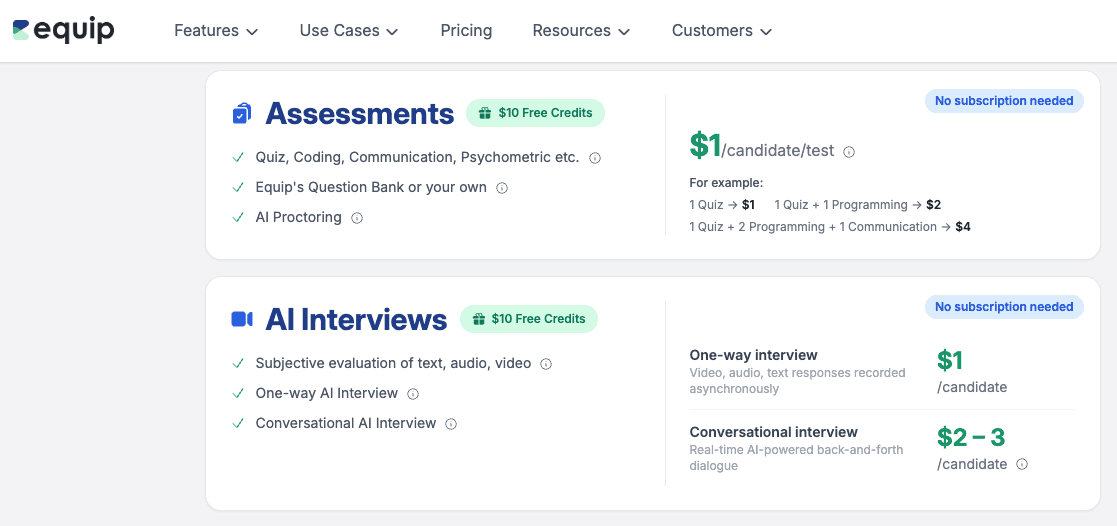
Subscription models involve monthly or annual fees, usually ranging from $50 to $500+ per month for small to medium teams. These plans often include unlimited or high-volume assessments, making them more cost-effective for regular hiring.
However, many subscription plans use hybrid models with credit systems that can create unexpected overage costs.
The Credit Trap: Hidden Costs in Popular Platforms
Many seemingly affordable assessment tools use credit-based systems that become expensive at realistic hiring volumes.
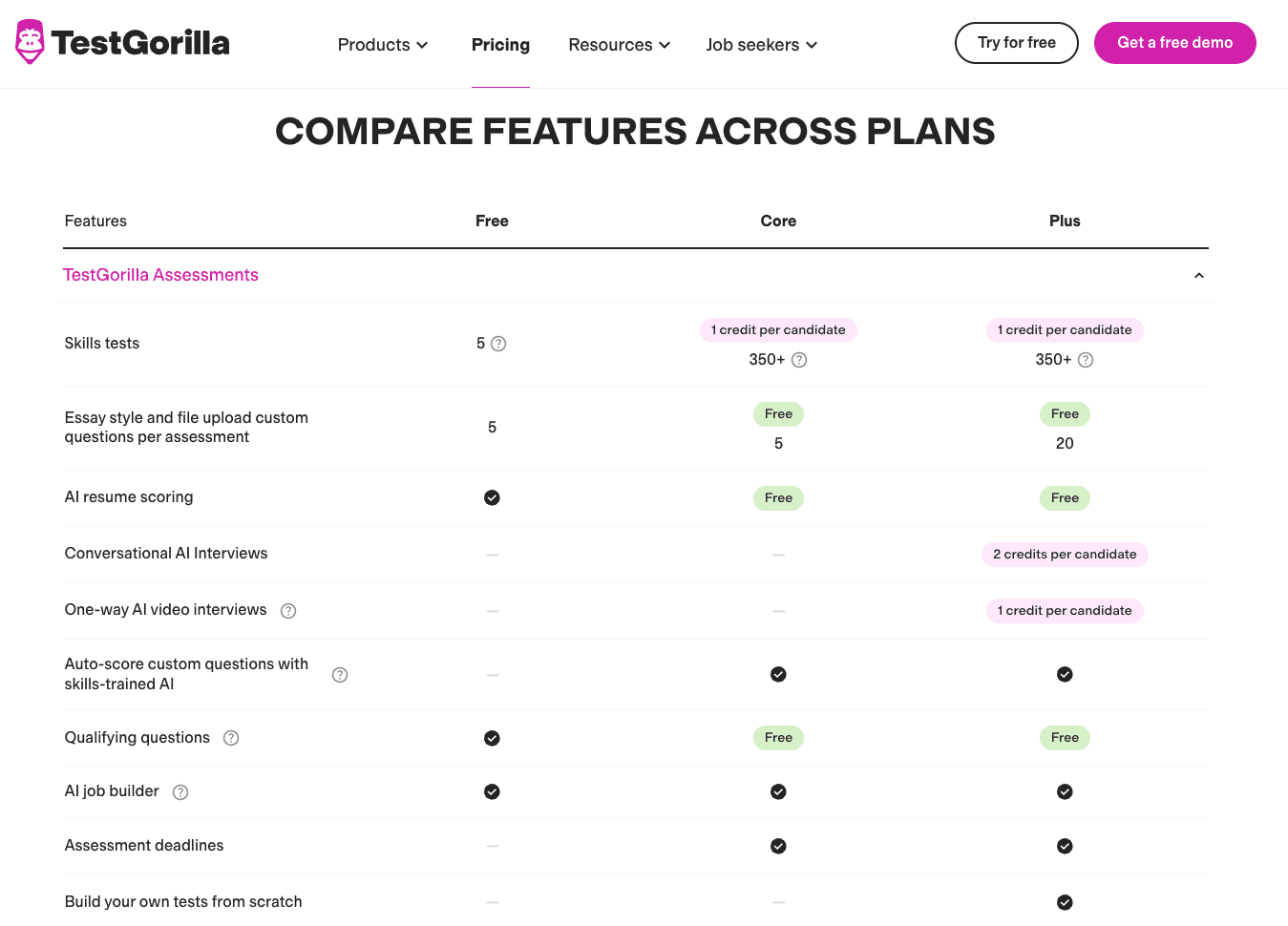
For example, TestGorilla's pricing starts at €84 per month with 250 credits. But a typical 100-employee company conducting 1,000 assessments annually would need to purchase the plan four times over, dramatically increasing actual costs.
Testlify's Premium plan offers 1,000 credits annually for $8,392. This seems reasonable until you realize this covers exactly 1,000 assessments—no buffer for additional hiring or candidate retesting.
Any overage costs $3-5 per additional assessment, or forces an upgrade to their $75,000 unlimited plan.
Annual vs. Monthly Billing Options
Most assessment platforms offer significant discounts for annual billing, typically 10-20% off monthly rates. While this reduces per-assessment costs, annual commitments can be risky for growing companies whose hiring needs may change.
Some platforms, like Criteria Corp, require 12-month minimum contracts, limiting flexibility for seasonal or project-based hiring.
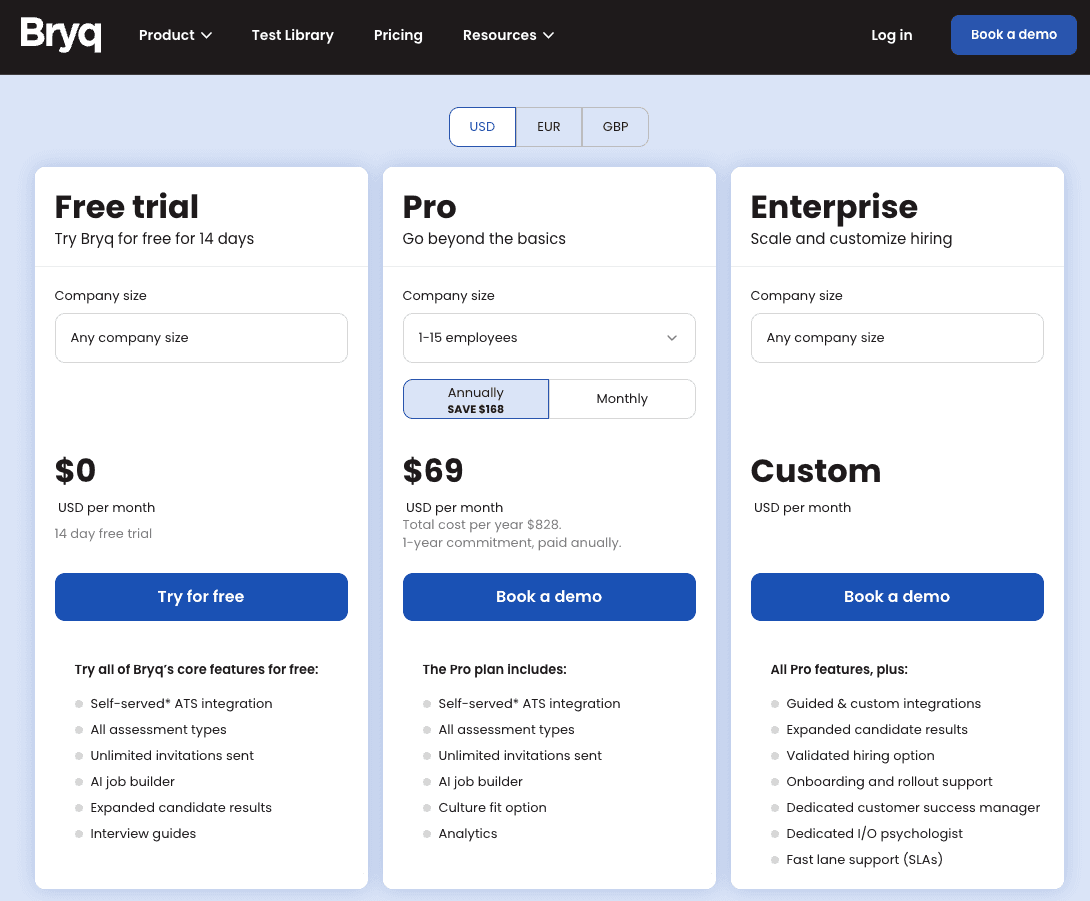
Monthly billing provides flexibility but comes at a premium. Platforms like Bryq offer month-to-month options at competitive rates, allowing companies to scale up or down based on actual hiring needs without long-term commitments.
Key Factors That Impact Assessment Tool Costs
Volume-Based Pricing Realities
The most critical factor in assessment tool pricing is understanding your actual hiring volume. Most companies underestimate their assessment needs by focusing only on final hires rather than total candidates evaluated.
A realistic calculation follows this formula: Annual hires × 100 candidates per hire = Total assessments needed
For example, a 200-employee company with 10% annual turnover needs 20 new hires per year. If they assess 100 candidates per hire (including multiple rounds and different job roles), they'll conduct 2,000 assessments annually—not 20.
At this volume, pricing differences become dramatic:
Bryq: ~$10-11K per year (unlimited assessments included)
Testlify: $75,000 per year (forced to unlimited plan)
iMocha: $21,327 per year (6.7x their Pro plan)
Equip: $2,000 per year (but skills-only, no personality/culture assessment)
Feature Complexity and Add-On Costs
Advanced features significantly impact pricing. Basic hard skills testing might cost $1-5 per candidate. But comprehensive assessments with detailed reports including personality evaluation, culture fit analysis, and AI-powered insights can range from $10-50+ per candidate.
Common premium features include:
Psychometric assessments: Personality tests and cognitive ability
Culture fit evaluation: Mapping candidates’ soft skills and behaviors to company values
AI proctoring: Preventing cheating during remote assessments
Advanced analytics: Predictive hiring insights, bias detection, and benchmarking against role-specific standards
ATS integrations: Seamless workflow with existing hiring tools
Many skill assessment platforms charge separately for these features. Testlify charges an additional $2,388 annually for ATS integrations. TestGorilla requires higher-tier plans for comprehensive reporting that goes beyond basic templates.
Integration and Implementation Costs
Hidden costs often emerge during implementation. Enterprise assessment tools may require:
Setup and onboarding fees: $2,000-$10,000+ for complex implementations
Training costs: Time investment for HR teams to learn new systems
Data migration: Moving candidate information from existing tools
Custom integrations: Additional fees for non-standard ATS connections or API access
Bryq includes setup and training in all plans. Some competitors charge separately for implementation support.
Comprehensive Pricing Comparison: 2025 Market Analysis
Enhanced Quick Reference Pricing Table
Platform | Starting Price | Assessment Model | Tests Offered | ATS Integrations | Best For | Hidden Costs |
|---|---|---|---|---|---|---|
$83/month | Unlimited | Skills, Personality, Cognitive, Culture Fit | 25+ (SAP, Workable, Greenhouse, Lever, etc.) | All company sizes | None | |
$69/month | 100 credits | Skills, Basic Personality | 15+ | Light hiring | ATS: +$2,388/year | |
€84/month | 250 credits | Skills, Personality, Cognitive | 10+ ATS partners | Mid-volume | Credit overages | |
$999/year | 100 attempts | Skills (3,000+ tests), Basic Cognitive | Enterprise tier only | Technical roles | No ATS below Enterprise | |
$1/candidate | Per assessment | Skills only | Limited/Basic | Skills testing only | Limited features | |
Custom | Tier-based | Skills, Cognitive, Personality, Games | 40+ integrations | Enterprise | 12-month minimum | |
Custom | Enterprise-focused | Skills, Personality, Video, Work-from-home | Custom integrations | High volume | No public pricing |
Budget-Friendly Options (Under $100/Month)
Bryq - Starting at $83/month
Unlimited assessments for 2+ team members
Includes skills, personality, and culture fit testing
14-day free trial, monthly billing available
All features included, no hidden fees
25+ ATS integrations included
Testlify - $69/month (100 credits)
Credit-based system with potential overage costs
Strong skills library but limited psychometric assessments
ATS integration costs extra $2,388/year
7-day free trial
Equip - $1 per candidate
Simple skills testing only
No personality assessment or culture fit evaluation
Minimal features but transparent pricing
Good for basic technical screening like coding skills
Limited integration capabilities
Mid-Range Solutions ($100-500/Month)
TestGorilla - €84/month base (250 credits)
Comprehensive test library
Credit system becomes expensive at scale
Recent price increases drove away customers
Limited customization options
Decent ATS integration options
iMocha - $999/year (100 test attempts)
Strong technical skills focus with 3,000+ tests
No ATS integration below Enterprise tier
Limited customer support on lower tiers
Requires multiple plan purchases for realistic volumes
Enterprise Solutions (Custom Pricing)
Harver, HireVue, Criteria Corp - Custom quotes required
Advanced features and dedicated support
Typically $10,000+ annually
12-month minimum commitments common
Designed for high-volume, complex hiring needs
Comprehensive integration suites
The Hidden Cost Analysis
When evaluating pricing, consider the total cost of ownership over realistic hiring volumes. A 100-employee company conducting 1,000 assessments annually faces these actual costs:
Bryq: $6,000/year (fixed, unlimited, all integrations included)
Testlify: $8,392-$10,500/year (Premium + ATS integration + potential overage)
iMocha: $10,663/year (3.3x Pro plan required, no ATS integration)
TestGorilla: $20,000+/year (multiple credit purchases)
This analysis reveals that credit-based systems become prohibitively expensive at realistic hiring volumes. They often cost 2-6x more than transparent subscription pricing.
Calculating ROI and Total Value
The Business Case for Assessment Tools
To justify assessment tool investment, calculate potential savings from improved hiring decisions:
Cost of bad hire = (Salary + benefits + training + productivity loss) × turnover rate
For a $75,000 position, a bad hire typically costs $150,000-$225,000. This includes recruitment, training, lost productivity, and eventual replacement costs.
Assessment tools that improve quality of hire by just 10% by better matching role-specific competencies can save companies hundreds of thousands annually. A tool costing $10,000 per year that prevents two bad hires pays for itself 15-30 times over.
Real-World ROI Examples
Example 1: Mid-Size Software Company
Company: 150 employees, 15 hires annually
Investment: Bryq at $8,000/year
Results: 25% improvement in quality of hire, 30% faster hiring
Savings: Prevented 2 bad hires ($300,000), reduced recruiting costs ($15,000)
Net ROI: 3,838% return on investment
Example 2: Growing E-commerce Business
Company: 80 employees, 20 hires annually (rapid growth)
Investment: Bryq at $6,000/year
Results: Improved cultural fit reduced 6-month turnover by 40%
Savings: Prevented 4 early departures ($200,000), reduced rehiring costs ($25,000)
Net ROI: 3,650% return on investment
Example 3: Professional Services Firm
Company: 200 employees, 25 hires annually
Investment: Bryq at $11,000/year
Results: Better personality matching improved client satisfaction scores
Savings: Retained 2 major clients who cited team quality ($500,000 revenue)
Net ROI: 4,445% return on investment
Measuring Success Metrics
Track these KPIs to measure skills assessment software ROI:
Time-to-hire reduction: High-quality assessments reduce interview rounds
Quality of hire improvement: Better performance reviews and goal achievement
Retention increase: Culture fit assessment reduces early turnover
Interview efficiency: Structured data improves interviewer focus
Hiring manager satisfaction: More confident hiring decisions
Companies using comprehensive assessment tools report:
25-40% faster hiring
20-35% better quality of hire
15-25% improved retention rates
30-50% more confident hiring decisions
Choosing Based on Your Company Size and Needs
Startups and Small Businesses (1-50 employees)
Budget considerations: $500-$2,000 annually
Recommended approach: Per-candidate pricing or small subscription plans
Key features needed: Basic skills assessment, simple reporting, mobile-friendly
Best options:
Bryq ($83/month) - Best overall value with unlimited assessments and full integrations
Equip ($1/candidate) - Minimal features but very affordable for technical roles
Testlify Starter - Limited credits but comprehensive features (watch for ATS costs)
Avoid: Enterprise platforms with minimum commitments or complex feature sets you won't use
Mid-Sized Companies (50-500 employees)
Budget considerations: $2,000-$15,000 annually
Recommended approach: Subscription with unlimited assessments Key features needed: Culture fit, ATS integration, dedicated support, comprehensive reporting
Best options:
Bryq ($6,000-$15,000/year) - Massive cost advantage at realistic volumes with all integrations
iMocha (if technical hiring focus) - Strong skills library despite higher costs and integration limitations
Criteria Corp - Good for established processes with annual commitment flexibility
Avoid: Credit-based systems that become expensive at 1,000+ assessments annually
Large Enterprises (500+ employees)
Budget considerations: $15,000-$100,000+ annually
Recommended approach: Comprehensive platform with dedicated support
Key features needed: Advanced analytics, custom assessments, dedicated customer success, multiple integrations
Best options:
Bryq Enterprise - Predictable costs with IO psychologist support and full integration suite
Harver - Advanced AI features for high-volume hiring with custom integrations
HireVue - Strong video interview integration for comprehensive evaluation
Key consideration: Avoid platforms that charge per assessment at enterprise volumes—costs become unpredictable and potentially massive.
Seasonal and Project-Based Hiring Considerations
Many companies face fluctuating hiring needs that don't fit standard subscription models. Understanding how different platforms handle seasonal variations is crucial for budget planning.
Retail and Hospitality Industries
Companies in retail and hospitality often need to hire 50-200% more staff during peak seasons. Traditional annual contracts can be wasteful during slow periods.
Best approaches:
Monthly billing flexibility: Platforms like Bryq allow scaling up during busy seasons without annual commitments
Per-candidate pricing: Equip's $1-per-assessment model works for predictable seasonal spikes
Credit banking: Some platforms allow purchasing credits in advance for seasonal use
Avoid: Annual contracts that force you to pay for unused capacity during slow periods
Project-Based Industries
Construction, consulting, and event management companies often have irregular hiring patterns tied to project cycles.
Recommended strategies:
Flexible subscription pausing: Ability to pause subscriptions between projects
Quick reactivation: Platforms that allow rapid scaling when new projects begin
No setup fees: Avoid platforms charging implementation costs for each reactivation
Startup Growth Phases
Fast-growing startups may go from 5 hires per year to 50+ as they scale, making long-term pricing predictions difficult.
Key considerations:
Scalable pricing tiers: Platforms that offer smooth transitions between pricing levels
Volume discount planning: Understanding how costs change as hiring volume increases
Feature growth: Ensuring basic plans can upgrade to enterprise features when needed
Getting Maximum Value from Your Investment
Free Trial Strategy
Use free trials strategically to make informed decisions:
Test with real hiring scenarios, not demo data
Involve actual hiring managers in the evaluation
Assess candidate experience by having team members take assessments
Evaluate customer support responsiveness during trial period
Calculate costs at your realistic hiring volume before committing
Test integrations with your existing ATS and HR tools
Review reporting quality with actual assessment data
Negotiation Opportunities
Most assessment platforms offer flexibility beyond published pricing:
Annual payment discounts: 10-20% off monthly rates
Volume commitments: Better per-assessment rates for guaranteed usage
Multi-year contracts: Additional savings for 2-3 year commitments
Feature bundling: Include premium features at lower incremental cost
Pilot program pricing: Reduced rates for initial implementation periods
Non-profit discounts: Special pricing for educational and charitable organizations
Implementation Best Practices
Maximize your investment through proper implementation:
Train hiring managers on interpreting assessment results effectively
Integrate with existing ATS to streamline workflows and reduce manual work
Establish clear assessment protocols for different roles and seniority levels
Regular review and optimization based on hiring outcomes and feedback
Candidate communication about assessment purpose and process to improve experience
Data analysis setup to track ROI metrics from day one
When to Upgrade or Switch
Consider platform changes when:
Hiring volume increases significantly - Credit-based systems become expensive
Feature needs evolve - Simple tools may no longer meet requirements
Poor customer support impacts your hiring timelines
Pricing model changes make current solution cost-prohibitive
Integration issues create workflow inefficiencies
Competitor offers better value - Market evolves, better options emerge
Company culture shifts - Need different assessment focus areas
The True Cost of "Cheap" Assessment Tools
While budget constraints are real, the cheapest talent assessment tool often delivers poor value. Consider these hidden costs of low-price options:
Limited Assessment Quality
Basic skills tests miss personality and culture fit factors that drive long-term success. Research shows skills account for only 40% of job performance. The rest comes from personality traits, motivation, and cultural alignment.
Companies using skills-only assessments report higher turnover rates and lower employee satisfaction scores compared to those using comprehensive evaluation.
Poor Candidate Experience
Clunky interfaces and technical issues create negative impressions of your company. In competitive talent markets, candidate experience directly impacts your ability to attract top performers.
Studies show 60% of candidates report negative impressions after poor assessment experiences. This damages your employer brand and reduces offer acceptance rates.
Lack of Scientific Validity
Unvalidated assessments may introduce bias or fail to predict job performance. This potentially exposes your company to discrimination claims while providing little hiring value.
Scientifically validated assessments, backed by industrial-organizational psychology, provide legally defensible hiring decisions and better predictive accuracy.
Integration Headaches
Cheap tools often lack proper ATS integration, creating manual work that costs more in HR time than assessment savings.
Calculate the true cost: If manual data entry takes 15 minutes per candidate and you assess 1,000 candidates annually, that's 250 hours of HR time. At $50/hour loaded cost, you're spending $12,500 in labor—more than most assessment tools cost.
Making Your Final Decision
Choosing the right skills assessment tool requires balancing cost, features, and long-term value. Here's a practical decision framework:
Step 1: Calculate Your Real Assessment Volume
Use this formula: (Annual hires × 100 candidates per hire) = Total assessments needed
Include multiple rounds of assessment, different role requirements, and potential growth.
Step 2: Evaluate Total Cost at Your Volume
Request pricing for your actual usage, not the minimum plan. Include potential overage costs and required add-ons.
Create a 3-year projection including potential hiring growth to understand long-term costs.
Step 3: Assess Feature Completeness
Ensure the online assessment platform provides comprehensive, skills-based candidate evaluation aligned to specific job roles, with clear visibility into skill gaps, not just generic skills testing. Look for:
Personality assessment
Culture fit evaluation
Cognitive ability testing
Bias detection and prevention
Scientific validation
Comprehensive ATS integration
Step 4: Test with Real Hiring Scenarios
Use free trials with actual job openings to evaluate candidate experience and result quality.
Involve hiring managers and candidates in the evaluation process for comprehensive feedback.
Step 5: Calculate ROI Potential
Estimate savings from:
Improved hiring decisions
Reduced time-to-hire
Better retention rates
Enhanced candidate experience
Workflow efficiency from proper integrations
Compare these potential savings against total platform cost over 2-3 years.
Why Transparent Pricing Wins
The pre-employment assessment market suffers from pricing opacity. Many vendors hide costs behind "contact sales" requirements and complex credit systems.
This lack of transparency creates problems for HR teams trying to budget talent acquisition effectively and compare options fairly.
Platforms with clear, published pricing demonstrate confidence in their value proposition and respect for buyers' time. When vendors hide pricing, they're often hiding:
Expensive credit systems
Mandatory add-ons
Complex implementation costs
Surprise overage fees
Integration charges
These emerge during sales processes, creating budget surprises and implementation delays.
Bryq's Commitment to Transparency
Bryq's transparent pricing reflects our commitment to honest partnerships with HR teams. You can:
See exact costs upfront
Understand what's included (all assessment types, all integrations)
Make informed decisions without sales pressure
Avoid pricing surprises during implementation
Scale predictably as your hiring grows
This transparency extends to our feature development, customer support, and scientific methodology. We believe better hiring decisions start with better vendor relationships.
Your Next Steps
Skills assessment tools represent a strategic investment in your company's future talent quality. The right platform reduces hiring risks, improves candidate experience, and delivers measurable ROI through better hiring decisions.
Action plan:
Calculate your realistic assessment volume using the formula provided
Evaluate platforms based on total cost of ownership rather than entry-level pricing
Consider integration requirements - factor ATS connectivity into your decision
Take advantage of free trials to test real hiring scenarios
Don't settle for basic skills testing when comprehensive candidate evaluation with specific skills testing is available at competitive prices
Plan for growth - choose platforms that scale with your hiring needs
The assessment tool market will continue evolving, but the fundamentals remain constant: invest in platforms that provide comprehensive candidate insights, transparent pricing, extensive integrations, and measurable value for your specific hiring needs.
Ready to see how the right assessment platform can transform your hiring decision-making and help you find top talent? Experience the difference that comprehensive, science-based evaluation of candidates’ skill makes in helping teams automate hiring decisions at scale.
——————
Frequently Asked Questions
How much do skills assessment tools cost?
Skills assessment tools typically range from $1 per candidate to $75,000+ annually, depending on the pricing model and features. Per-candidate pricing ranges from $1-50 per assessment, while subscription models start around $69-83 per month for basic plans. Enterprise solutions often require custom pricing starting at $10,000+ annually.
For realistic hiring volumes, expect to pay:
Small businesses (1-50 employees): $500-$2,000 annually
Mid-sized companies (50-500 employees): $2,000-$15,000 annually
Large enterprises (500+ employees): $15,000-$100,000+ annually
The key is calculating your actual assessment volume using this formula: Annual hires × 100 candidates per hire = Total assessments needed.
What is the best free skills assessment tool?
Most "free" skills assessment tools have significant limitations that make them unsuitable for serious hiring decisions. Free options typically offer:
Very limited test attempts (5-10 assessments)
Basic skills testing only (no personality or culture fit)
No ATS integration
Minimal reporting and analytics
Poor candidate experience
While platforms like TestGorilla and Bryq offer free trials (not truly free tools), these trial periods allow you to test with real hiring scenarios before committing. For ongoing hiring needs, investing in a proper assessment platform delivers far better ROI than attempting to rely on limited free options.
Is TestGorilla worth the price?
TestGorilla's value depends heavily on your hiring volume. At their starting price of €84/month for 250 credits, they can work for light hiring needs. However, their credit-based system becomes expensive at realistic volumes:
For 1,000 assessments annually: ~$20,000+ (requires multiple plan purchases)
No flexibility for monthly billing
Additional costs for advanced features
Companies conducting more than 500 assessments annually often find better value in unlimited subscription models like Bryq ($83/month unlimited) or per-candidate options like Equip ($1/candidate for basic skills testing).
What are the best hiring assessment tools for small businesses?
The best hiring assessment tools for small businesses offer flexible pricing without long-term commitments:
Top choices:
Bryq ($83/month): Unlimited assessments, comprehensive testing (skills + personality + culture fit), monthly billing
Equip ($1/candidate): Simple per-candidate pricing, good for technical roles with basic needs
Testlify Starter ($69/month): 100 credits, decent feature set but watch for ATS integration costs
Small businesses should prioritize platforms that offer monthly billing, comprehensive assessment types, and transparent pricing without hidden fees.
How do I calculate ROI on talent assessment platforms?
Calculate assessment tool ROI using this framework:
ROI Formula: (Cost savings from better hires - Tool cost) / Tool cost × 100
Key metrics to track:
Cost per bad hire: Typically 1.5-3x annual salary including recruitment, training, and productivity losses
Time-to-hire reduction: Multiply saved days by recruiter daily cost
Retention improvement: Calculate savings from reduced turnover
Productivity gains: Better hires perform 20-35% better on average
Example: A $75K position where a bad hire costs $150K. If an assessment tool costing $8,000 annually prevents just one bad hire, that's 1,775% ROI.
What's the difference between skills testing and comprehensive hiring assessments?
Skills testing evaluates job-specific technical abilities but only accounts for ~40% of job performance. Comprehensive hiring assessments include:
Skills testing: Technical and soft skills evaluation
Personality assessment: Work style, motivation, team fit
Cognitive ability: Problem-solving and learning capacity
Culture fit: Alignment with company values and environment
Research shows comprehensive assessment approaches improve quality of hire by 20-35% compared to skills-only testing, as they evaluate the complete candidate profile rather than just technical competency.
Are there industry-specific assessment tool pricing differences?
Yes, pricing varies significantly by industry focus:
Technology/IT roles: Platforms with extensive technical test libraries (iMocha, HackerRank) often charge premium rates
Healthcare: Specialized compliance and certification testing increases costs
Finance: Advanced cognitive and integrity testing adds to pricing
Retail/Hospitality: High-volume, seasonal hiring needs favor per-candidate or flexible subscription models
Professional services: Culture fit and personality assessment become more valuable, justifying comprehensive platforms
Industry-specific features and compliance requirements can increase costs by 25-50% over general assessment tools.
How do pre-employment testing costs compare to bad hire costs?
Pre-employment testing represents a tiny fraction of bad hire costs:
Assessment tool costs: $5-50 per comprehensive candidate evaluation
Bad hire costs: $50,000-$240,000+ including:
Recruitment and onboarding: $15,000-$25,000
Training and productivity loss: $25,000-$75,000
Replacement costs: $15,000-$30,000
Team disruption and morale impact: $10,000-$50,000
Even premium assessment tools costing $50 per candidate deliver 1,000-4,800x ROI by preventing just one bad hire per 100 assessments. This makes comprehensive pre-employment testing one of the highest-ROI investments in the hiring process.
Can small companies afford enterprise-level talent assessment features?
Yes, modern assessment platforms have democratized enterprise-level features for smaller companies:
Previously enterprise-only features now available to SMBs:
AI-powered bias detection and prevention
Advanced psychometric testing with I-O psychology backing
Comprehensive culture fit assessment
Predictive analytics and quality-of-hire tracking
Extensive ATS integrations
Platforms like Bryq offer enterprise-grade assessment science at SMB-friendly pricing ($83/month), making comprehensive candidate evaluation accessible regardless of company size. The key is choosing platforms that don't artificially restrict features by company size or force expensive enterprise contracts.
Author

Manto leads product at Bryq, writing on talent intelligence tools, product innovation in hiring, and how the right software choices reshape how teams find, assess, and grow their people.