12 TestGorilla Alternatives: Top Tools to Consider in 2026
Compare 12 TestGorilla alternatives for 2026, from talent assessment platforms to coding challenges. Honest reviews of features, costs, and what each tool actually does well.
8
mins
People & Culture
Forty-six percent of new hires fail within 18 months. That number should bother you. It bothers us. And the typical response from companies makes it worse: they hire faster. More applicants, more tests, more interviews. As if speed was ever the problem.
The problem is signal. Most hiring assessment tools test what someone knows right now. They don't tell you whether that person will actually succeed in the role six months from now, or whether they'll stick around long enough to matter. That gap between "can do the job today" and "will thrive in it tomorrow" is where most bad hires happen. Quality of hire suffers, time-to-hire stretches, and the ROI on your recruiting spend turns negative. With 69% of employers struggling to find qualified candidates in 2026, the pressure to get it right is only growing.
TestGorilla became popular for good reason. It's user-friendly, the test catalog covers a wide range of skills, and the candidate experience is straightforward. For companies getting started with skills-based hiring and online assessment, it works.
But as hiring needs grow (more technical roles, remote hiring, higher volume, deeper cultural alignment), the cracks show. We've talked to hundreds of recruiters who switched. Their reasons are consistent.
Here are 12 TestGorilla alternatives worth evaluating in 2026, with honest takes on what each one does well and where it falls short.
Why companies switch from TestGorilla
Before we get into the alternatives, it helps to understand what pushes people to look elsewhere. If you read any TestGorilla review on G2 or Capterra, the same themes come up. Based on those reviews and what we hear in conversations with talent acquisition leaders:
TestGorilla pricing stops working at scale. The platform uses a credit-based system where fees increase with company headcount, not hiring volume. A company that doubles its team size can see costs jump 75% even if they're not hiring more people. The Core plan runs about €84/month (billed annually), and there's no flexible monthly option. For startups or companies with seasonal hiring, that rigidity stings.
Weak test security in an AI world. TestGorilla offers webcam snapshots and full-screen detection. That was fine in 2023. In 2026, when candidates can use ChatGPT, Copilot, and a dozen other tools during a test, basic monitoring leaves a blind spot. No ChatGPT detection. No browser lockdown. No device fingerprinting. Recruiters can't fully trust the results, and that undermines the whole point of testing.
Shallow technical assessments. The pre-built coding tests cover common scenarios but lack depth for serious engineering evaluation. No real-world coding workspace. No code playback. Limited language support. If you're hiring senior developers, data engineers, or ML specialists, you'll hit the ceiling fast.
Test results that don't predict much. Skills testing tells you what a candidate knows today. It doesn't tell you whether they'll grow into the role, fit with the team, or stay past the first year. There's no personality assessment, no bias reduction, and no job assessment that maps to actual on-the-job success. Several users report that TestGorilla results felt inconclusive for actual hiring decisions, particularly for specialized positions where the questions were either too basic or too abstract.
TestGorilla alternatives: quick comparison
# | Tool | Best for | G2 Rating | Starting pricing (2026) |
|---|---|---|---|---|
1 | Bryq | Talent intelligence and success forecasting | 4.7 | $83/mo, 14-day trial |
2 | HackerRank | Technical coding assessments at scale | 4.7 | Free tier; paid from $100/mo |
3 | Codility | Structured engineering evaluation | 4.6 | Contact sales |
4 | Testlify | Fast pre-screening with monthly billing | 4.8 | $69/mo, 7-day trial |
5 | iMocha | Large-org skills intelligence | 4.4 | From $83.25/mo, 14-day trial |
6 | Vervoe | Performance-based tasks and job simulations | 4.5 | Contact sales |
7 | eSkill | Admin, retail, and MS Office testing | 4.5 | Contact sales |
8 | Criteria Corp | Cognitive aptitude (CCAT) and game-based testing | 4.5 | Contact sales, 14-day trial |
9 | Predictive Index | Quick behavioral fit and team alignment | 4.7 | Contact sales |
10 | Mercer Mettl | Test security for regulated industries | 4.4 | Contact sales, trial available |
11 | Equip | Quick test creation with integrity scoring | 4.8 | $1/candidate, 10-candidate trial |
12 | Adaface | Developer-friendly testing for SMBs | 4.7 | $180/yr, trial available |
The 12 best TestGorilla alternatives for 2026
1. Bryq: best for skills assessment and success forecasting
Here's the thing about most skills assessment tools, including TestGorilla: they measure what someone can do today. Whether they can answer Python questions or recognize accounting principles. That's useful but incomplete.
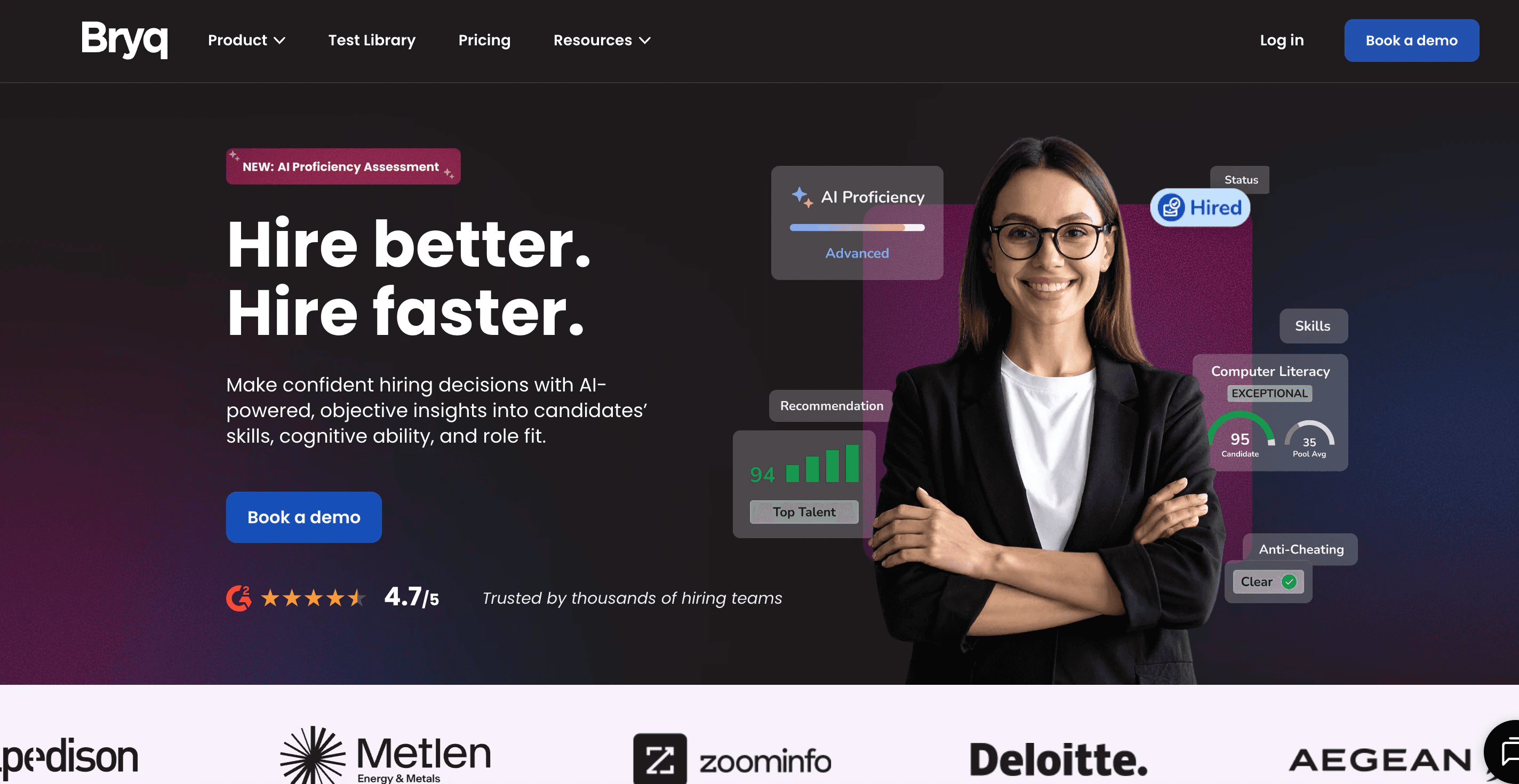
This one does something different. It measures what actually drives on-the-job success: cognitive ability, behavioral traits, and hard skills, including AI proficiency, in one integrated assessment. Then it scores every candidate against a science-backed Ideal Candidate Profile built from your top performers. Not just "can they do the work" but "will they perform, grow, and stay."
The methodology sits on I-O psychology (specifically the 16PF and Big Five frameworks). The platform builds a role-specific success model, then matches candidates against it with a Fit Score ranging from Exceptional Fit to Poor Fit. Companies using this approach report an 80% reduction in screening time and 40% reduction in early turnover.
The candidate assessment takes about 10 minutes through a conversational interface. One assessment, not a battery of separate tests. Conversational interface, available in 23 languages. No 45-minute marathon sessions that lose your best applicants halfway through.
What stands out:
AI Proficiency Assessment. This one matters. 75% of knowledge workers already use AI on the job, but most organisations have no way to tell who uses it well and who just pastes everything into a chat window and hits send. The newest module measures how candidates actually work with AI in realistic scenarios. It's tool-agnostic, scenario-based, and built on six peer-reviewed research frameworks. It produces a five-dimension proficiency profile (not a pass/fail score) covering task delegation, prompting quality, critical evaluation, ethical use, and workflow integration. Included in your current plan. No add-on fee.
Measure what actually matters, before you hire. Most hiring tools filter. This one measures. It parses job descriptions and analyzes your existing top performers to build a success model that's specific to how work gets done at your company. Candidates are then matched against that model. The difference between "what can this person do?" and "will this person succeed here?"
25+ applicant tracking integrations including Greenhouse, Lever, Workable, and SAP. Monthly billing starting at $83. Interview guides that suggest specific interview questions based on each candidate's profile.
Where it falls short:
No live technical interview or developer workspace built in. If you need to watch a developer write code in real time, you'll need a separate technical screening tool. And while the AI Proficiency Assessment is a genuine differentiator, the broader hard skills test library is still growing. For niche positions, you may want supplementary testing. On the proctoring side, the platform has built-in test security that covers the essentials (IP monitoring, focus loss detection, developer tools detection, video snapshots, copy/paste blocking, and a three-level risk classification system) but doesn't include full browser lockdown like some large-organization competitors.
Cost: Unlimited evaluations starting at $83/month. AI Proficiency Assessment included in every plan. No credit-based headcount scaling. For a 100-employee company running 1,000 tests per year, that's roughly $6,000 annually (all-in, including setup and applicant tracking connectors). Compare that to TestGorilla, where the same volume can exceed $20,000 due to credit overages and headcount-based tier increases.
2. HackerRank: best for coding assessments at scale
If you're hiring software engineers, this is the benchmark. Companies like Microsoft and Google use it. There's a reason for that.
It gives candidates a real-world development environment that supports over 40 programming languages and frameworks. Not multiple-choice questions about code. Actual code. Candidates write, run, and debug in a browser-based IDE that mirrors real development workflows. For technical roles where problem-solving matters more than memorized syntax, this is the gold standard.
What's good:
Certified Assessments that let you standardize your technical bar across global hiring. Every office, every team, same benchmark.
Live coding interviews where hiring teams and candidates share a workspace in real time. You watch how they think through problems, not just whether they get the right answer.
An extensive library of coding challenges covering algorithms, data structures, and real-world engineering scenarios. The difficulty ranges from junior to staff-level.
Solid test integrity features including code-copying detection that flags suspicious patterns across submissions.
What's not:
It's built for engineering. Period. If you also need to assess soft skills, cognitive ability, personality, or cultural fit, you'll need a separate tool. The candidate experience can also feel intimidating for non-senior developers; the competitive coding roots show. And the fees get steep at scale. The free tier is limited, and larger plans require a conversation with sales.
Pricing: Free tier available (basic features). Paid plans start around $100/month. Enterprise rates are quote-based. Free trial on paid tiers.
3. Codility: best for structured engineering evaluation with code playback
Codility is the closest competitor to #2 on this list, and in some ways it's more thoughtful about how it evaluates engineers. The headline feature is Code Playback: hiring managers can watch a video-like reconstruction of a candidate's entire coding session. You see how they approached the problem, where they got stuck, how they debugged. That's signal you'll never get from a final answer alone.
What's good:
Code Playback gives you a window into how candidates actually think. Watching someone debug is more revealing than checking whether they got the right answer.
The Next Gen IDE and Skills Intelligence modules keep evaluations current with modern development standards.
Test integrity tools including plagiarism detection and behavioral monitoring. The AI assistant Cody helps flag suspicious activity.
1,800+ tasks on the Scale plan, covering real-world engineering scenarios, not just algorithmic puzzles.
What's not:
Like HackerRank, Codility covers technical skills only. No behavioral testing, no personality evaluation, no culture fit. The platform can also be overkill for smaller teams that don't need deep engineering benchmarking. And you'll need to talk to sales for rates.
Pricing: Quote-based. Contact sales.
4. Testlify: best for fast pre-screening at scale
Testlify is what you reach for when you need to screen high volumes quickly and don't want to lock into annual billing. Its test catalog covers a wide range of roles and industries, and the tests are designed to take 30 minutes or less. For companies with seasonal or fluctuating hiring needs, the monthly billing option is a real advantage over TestGorilla's annual commitment.
What's good:
Video interviews in async format that capture communication skills and personality. Candidates record on their own time; you review when it's convenient.
A free, automated job description generator that creates role-specific descriptions from basic inputs. Surprisingly useful for hiring teams covering unfamiliar industries.
White-label customization: add your brand's colors and logo to tests for a consistent candidate experience.
Skills assessment templates across industries, available in 15 languages.
Monthly billing starts at $69/month. That flexibility matters for the hiring process.
What's not:
The mobile experience is inconsistent, particularly with video and audio questions that don't always render properly on phones. Several users report a frustrating cancellation process filled with back-and-forth emails. And while Testlify covers breadth well, it doesn't go particularly deep on psychological testing or forecasting analytics. It's a screening tool, not a talent intelligence platform.
Pricing: Starting at $69/month (billed annually). 7-day trial period.
5. iMocha: best for large-org skills intelligence
This one isn't really a TestGorilla competitor in the traditional sense. It's a corporate-grade skills intelligence platform that happens to include pre-employment testing as one of its capabilities. The real play is workforce planning: mapping skills across your entire organization, identifying gaps, and facilitating targeted upskilling.
The numbers are staggering. Over 10,000 skills assessments. 3,000+ skills ontologies. Companies like Ericsson and Hexaware use the platform to understand their talent pool at a level of granularity that most tools can't touch.
What's good:
The deepest skills library on this list. Over 100 ready-made question sets across technical, cognitive, and domain-specific categories. If a skill exists, they probably have a test for it.
Automated monitoring that detects cheating in real time and tells you exactly how and when it happened.
Internal mobility and upskilling tools. The platform doesn't just help you hire top talent; it helps you develop the people you've already got.
Deep connections with major HCM systems: Workday, SAP SuccessFactors, Oracle HCM. Skills data stays synchronized across the employee lifecycle.
Customer support that users consistently praise for responsiveness and ease of use.
What's not:
Built for large organizations with complex workforce needs. The cost, navigation, and feature complexity reflect that. If you're a mid-market company with straightforward hiring needs, this will feel like using a sledgehammer to hang a picture. ATS integrations are also limited to the top-tier plan, which means smaller plans come with manual workarounds.
Pricing: From $999/year for the Skills Assessment module. 14-day trial included. Skills Intelligence rates require a sales conversation.
6. Vervoe: best for job simulations and performance-based tasks
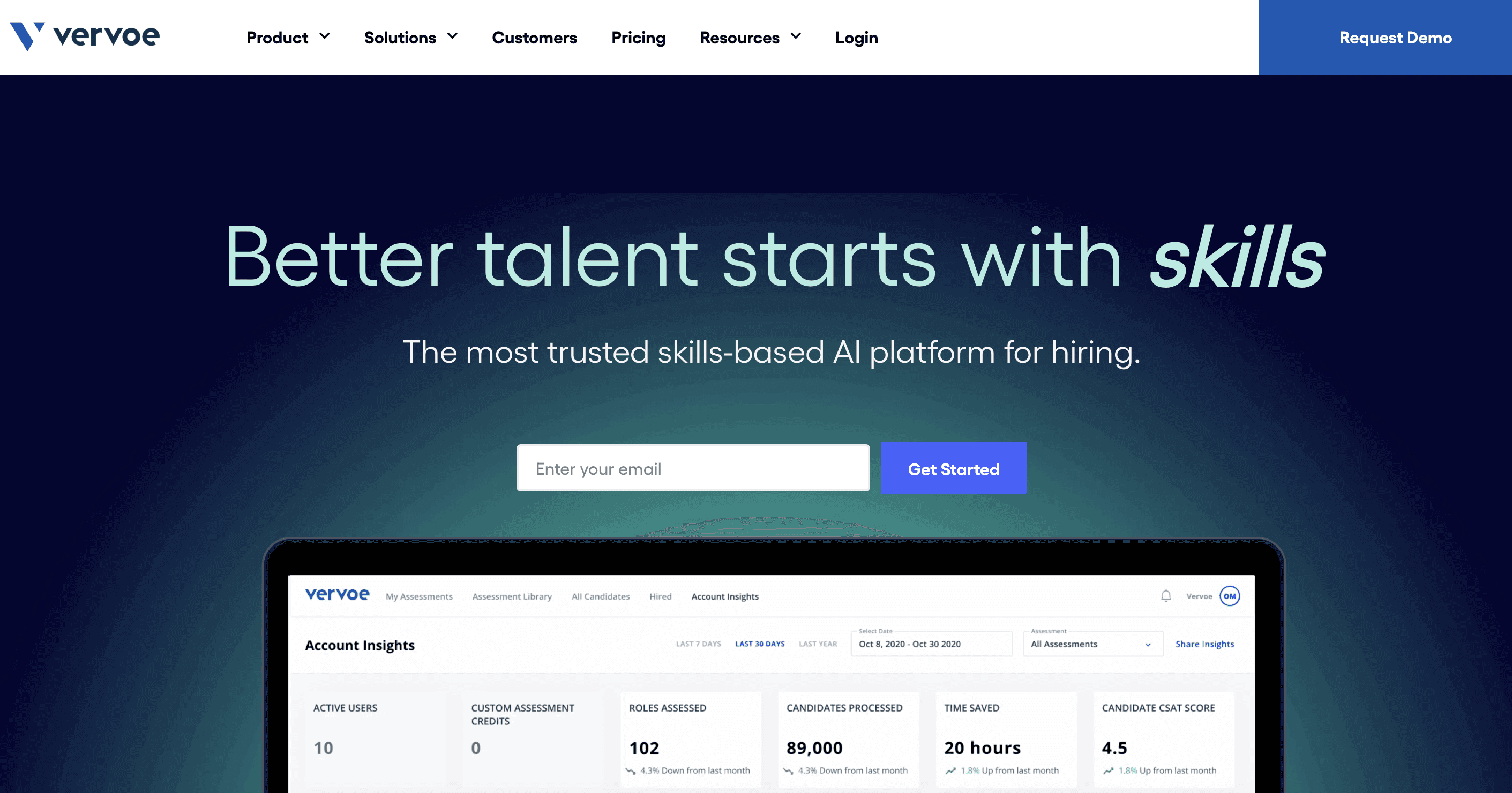
Most skills testing platforms ask candidates to answer questions. Vervoe asks them to do the work.
The entire platform is built around performance tasks: realistic, role-specific exercises that mirror what a candidate would actually do on day one. Write a marketing plan. Debug a code snippet. Handle a customer complaint. These aren't hypotheticals. They're practical scenarios graded automatically, ranking candidates based on output quality.
What's good:
Practical tasks that go far beyond multiple-choice. Candidates produce actual work product, and the system grades it automatically. This dramatically reduces the administrative load on your team.
Role-based templates that you can customize or build from scratch for specific job descriptions.
The exercises genuinely forecast on-the-job performance. When you see someone handle a realistic customer escalation, you learn more than any personality test would tell you.
What's not:
Vervoe works best for roles where you can define clear tasks and outputs. For highly strategic or abstract positions (think: VP of Strategy), the approach becomes harder to apply. It's also less useful for high-volume screening where you need speed over depth. And rates aren't published; you'll have to request a quote.
Pricing: Quote-based. Contact sales.
7. eSkill: best for admin, retail, and MS Office proficiency testing
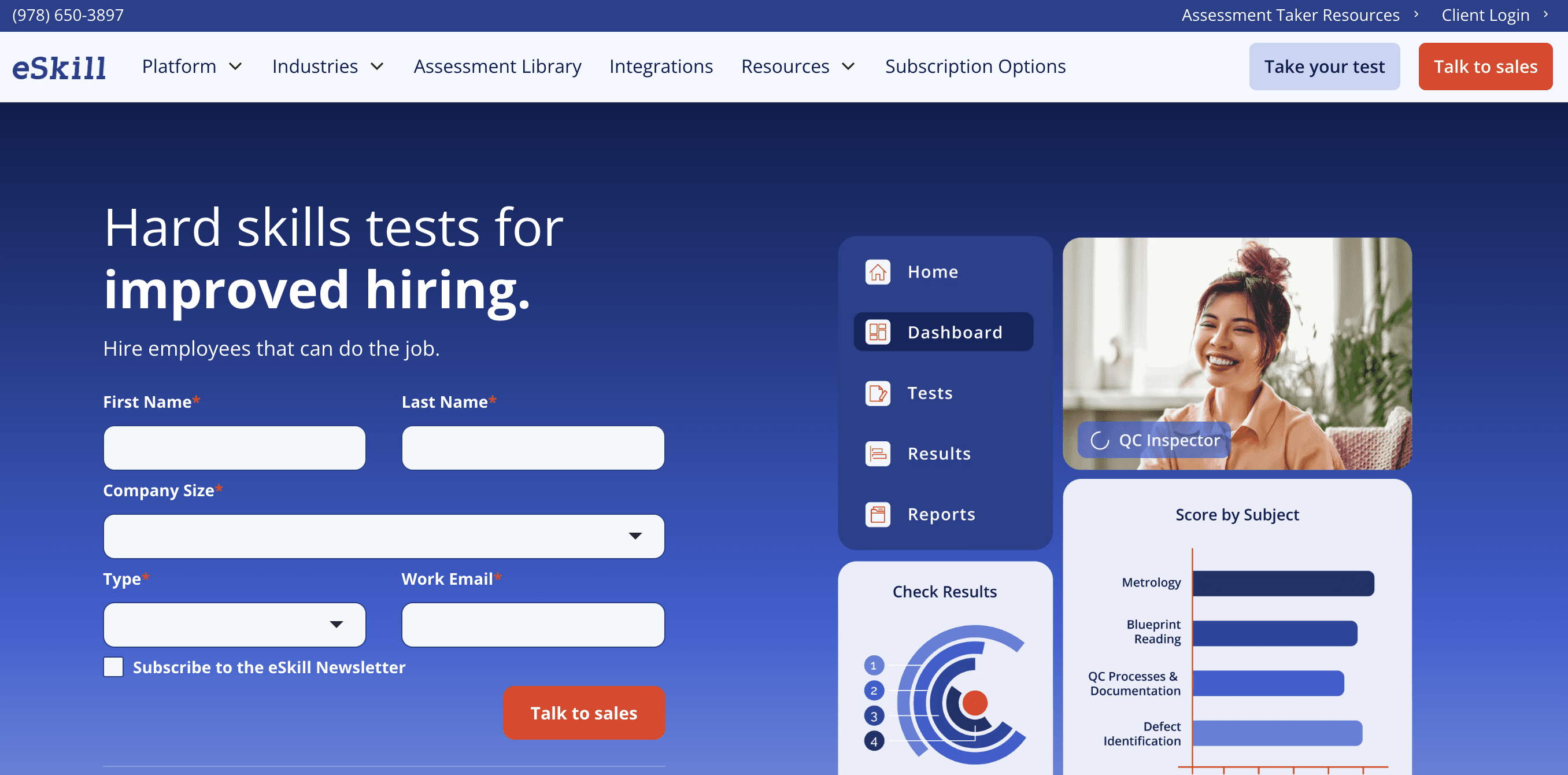
eSkill occupies a specific niche that few other platforms cover well: practical, simulated testing for administrative, retail, and operational roles. Its standout feature is Microsoft Office simulations that test candidates on Word, Excel, Outlook, and PowerPoint inside a browser-based environment. Not questions about Excel. Actual Excel tasks.
What's good:
Over 600 subjects and 75,000 unique questions. The customization is extremely granular; you can mix and match to create custom tests that match your exact requirements.
Multitasking exercises where candidates juggle emails, chat messages, and orders simultaneously. Ideal for call center and retail hiring at high volume.
Job-specific tasks that measure functional skills no standard test can replicate.
Strong for pre-employment assessment in industries where practical software proficiency matters more than theoretical knowledge.
What's not:
Built for operational and administrative roles. If you need psychometric tests, behavioral analysis, or technical coding evaluations, look elsewhere. The interface also feels dated compared to newer platforms, and the onboarding process for creating assessments takes some getting used to.
Pricing: Quote-based. Contact sales.
8. Criteria Corp: best for cognitive assessments and game-based testing
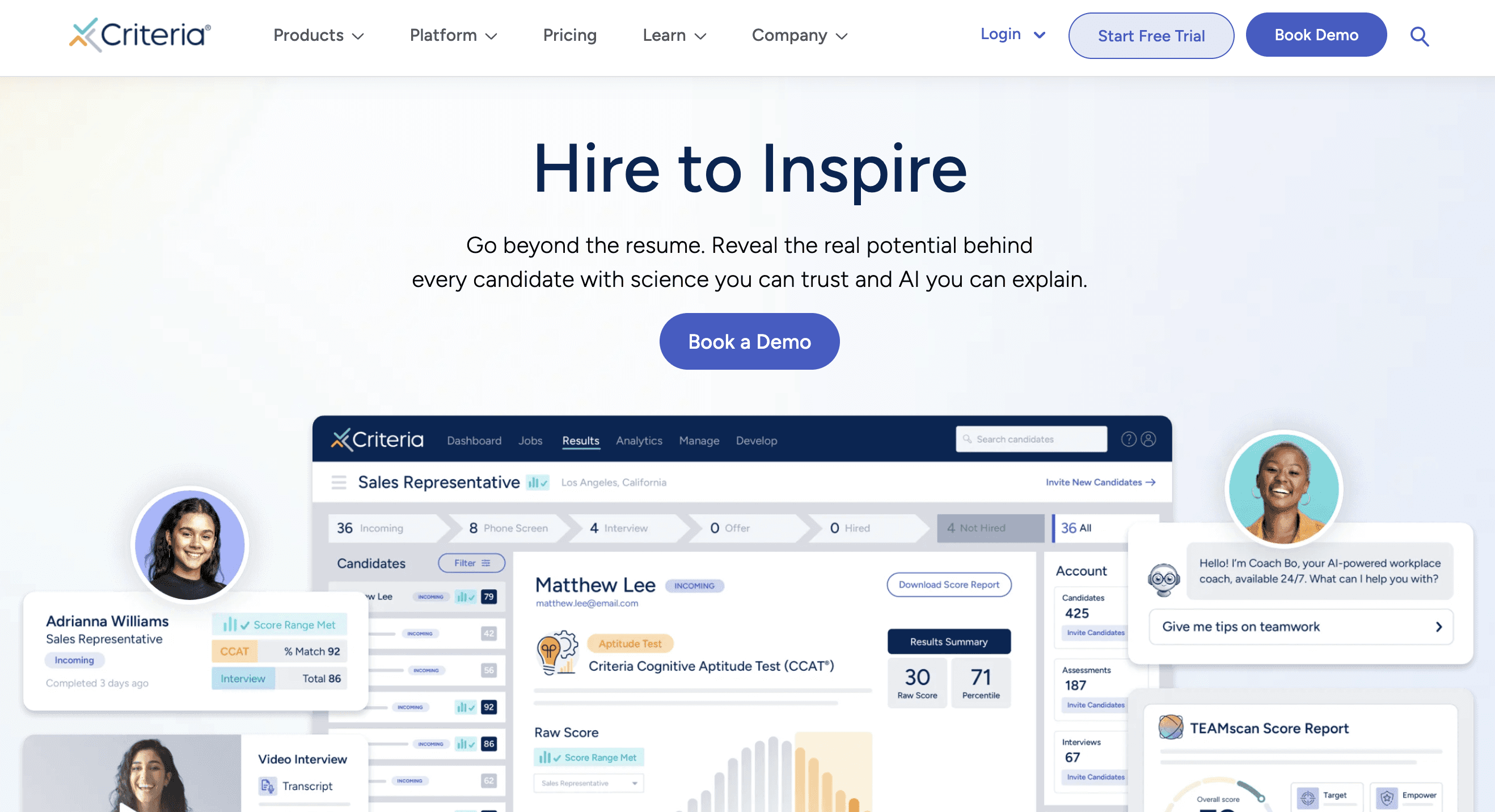
Criteria Corp is built on science, specifically the CCAT (Criteria Cognitive Aptitude Test). The CCAT is a 15-minute, 50-question assessment that measures critical thinking, problem-solving, and the ability to learn new information quickly. Research shows cognitive aptitude is 1.6x more accurate than job interviews at forecasting success, making the CCAT one of the most validated cognitive assessments on the market. It works across a wide variety of roles.
What's good:
Game-based testing that makes the hiring process genuinely enjoyable for candidates. They complete engaging tasks in under 20 minutes, and hiring teams get science-backed insights.
Cognitive aptitude pairs with personality evaluation and emotional intelligence for a multi-dimensional view. Good benchmarking against validated norms.
Mobile-friendly tests with white-label branding options.
40+ ATS integrations. Detailed reports that are digestible without a psychology degree.
Tests available in 20+ languages.
What's not:
Users report that the reporting could be more intuitive, and customer support can be slow to respond. The platform's strength is cognitive and behavioral; if you need deep technical assessments or coding challenges, you'll need to supplement it. And rates aren't transparent.
Pricing: Quote-based. 14-day trial available.
9. Predictive Index: best for behavioral fit and team alignment

Predictive Index (PI) takes a focused approach: behavioral and cognitive fit, measured fast. Their behavioral test takes 6 minutes. Six. That's it. And it's backed by 65 years of behavioral research.
PI generates Reference Profiles and Fit Ratings that help hiring managers understand how a candidate naturally works, communicates, and collaborates. It's less about what they can do and more about how they'll do it within your team's specific dynamics.
What's good:
The fastest behavioral testing on this list. Six minutes, validated, accurate. For volume hiring where you need quick signals, nothing competes.
Five distinct products covering everything from pre-employment testing to team building and employee engagement.
Interview Builder that helps you design targeted interview questions based on the candidate's profile.
Built by psychometricians who continuously test reliability. The science is solid.
Integrations with Greenhouse, Lever, and other major ATS platforms via API. Automated delivery and instant results inside the recruiter's existing workflow.
What's not:
PI's strength is behavioral, not technical. There are no coding tests, no test library for skills, and no performance tasks. If you need a complete assessment platform, PI will be one piece of a larger stack. The multiple product offerings can also make costs confusing, and there's a learning curve to using the full suite effectively.
Pricing: Contact sales for a quote. Trial available (limited scope).
10. Mercer Mettl: best for test security in regulated industries
If you work in healthcare, finance, or manufacturing where test integrity isn't optional, Mercer Mettl is built for you. Its monitoring suite is the most comprehensive on this list: live human proctors, algorithm-driven automated oversight, and a "record and review" option. Pick the level your compliance team requires.
What's good:
The deepest test security on this list. Live monitoring with human proctors, machine-learning oversight, and full session recording. Multi-layer security catches everything from screen sharing to second-device usage.
100,000+ technical questions across 300+ job roles in 25 industries. The breadth is enormous.
Situational judgment tests, inbox exercises, and case study tasks for in-depth functional evaluation.
Learning and development tools that extend beyond hiring into employee growth, including online hackathons for scouting top talent.
20+ languages supported. Strong data security including annual penetration testing.
What's not:
The most consistent complaint across user reviews: slow customer support and issues with test reports. For a platform focused on regulated industries, that's a concerning gap. The interface can also feel dense, and the sheer volume of options means the recruitment process takes longer to set up than simpler platforms.
Pricing: Quote-based. Trial available (unspecified duration).
11. Equip: best for quick test creation with integrity scoring
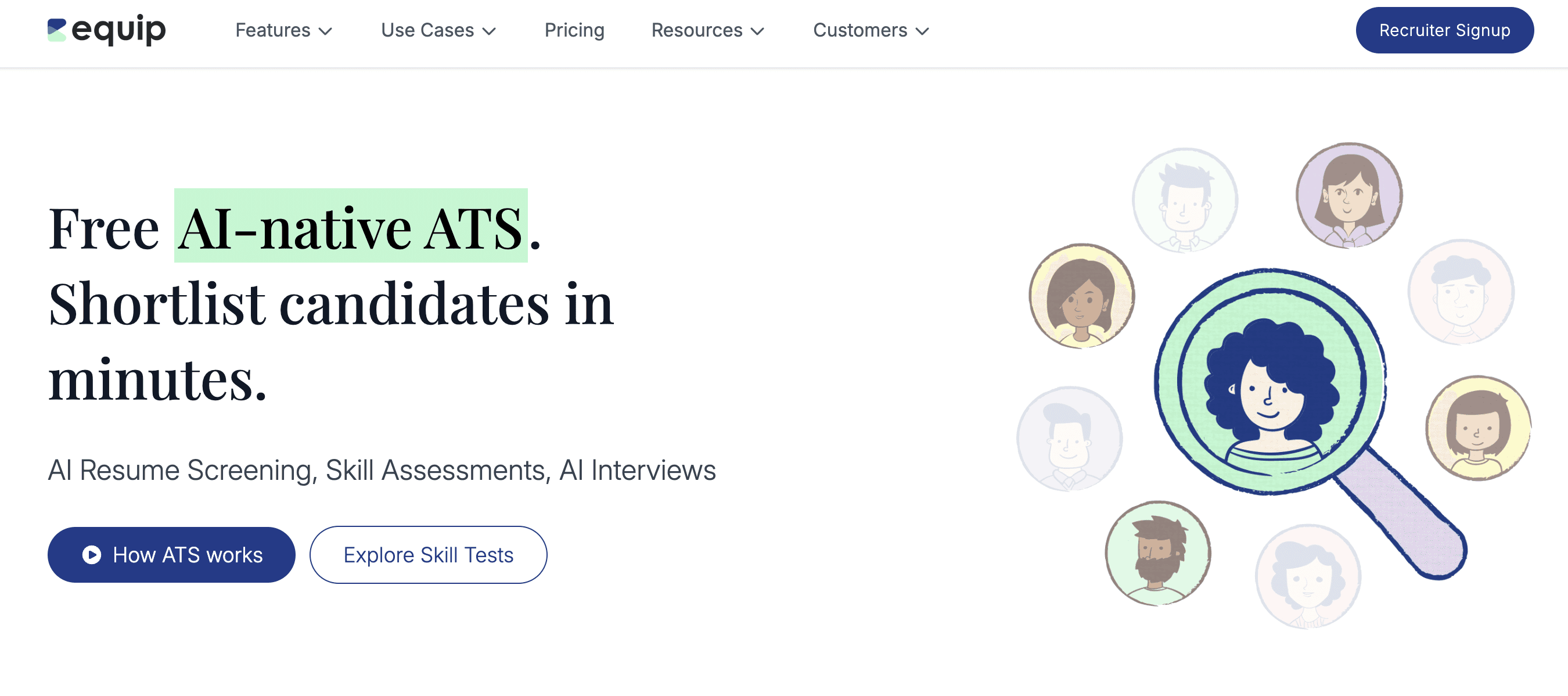
Equip is the "get it done in minutes" option. Create a test in three steps, send it out, and let the system handle the rest. Its Trust Score calculator is the defining feature: an integrity system that screens for ChatGPT usage, Google searches, and other violations during every assessment.
What's good:
Three-step test creation that genuinely takes minutes, not hours. Ease of use is the platform's calling card.
Trust Score that quantifies test integrity per candidate. Flags ChatGPT usage, tab-switching, and suspicious browser behavior.
1,000+ ready-to-use questions across tech and non-tech categories. One-click Excel import for building custom tests from your existing question banks.
Video interviews that candidates complete on any device, with screen recording for teams to replay.
Pay-as-you-go at $1 per candidate. No commitment. No annual contract.
What's not:
Loading times are a recurring user complaint. The strict time limits (sometimes without adequate warning) frustrate candidates and can produce unreliable results. And while the integrity features are strong, the test depth is relatively shallow compared to specialized platforms. It covers breadth, not depth.
Pricing: $1 per candidate (credit-based). Trial for up to 10 candidates.
12. Adaface: best for developer-friendly testing at budget-friendly rates
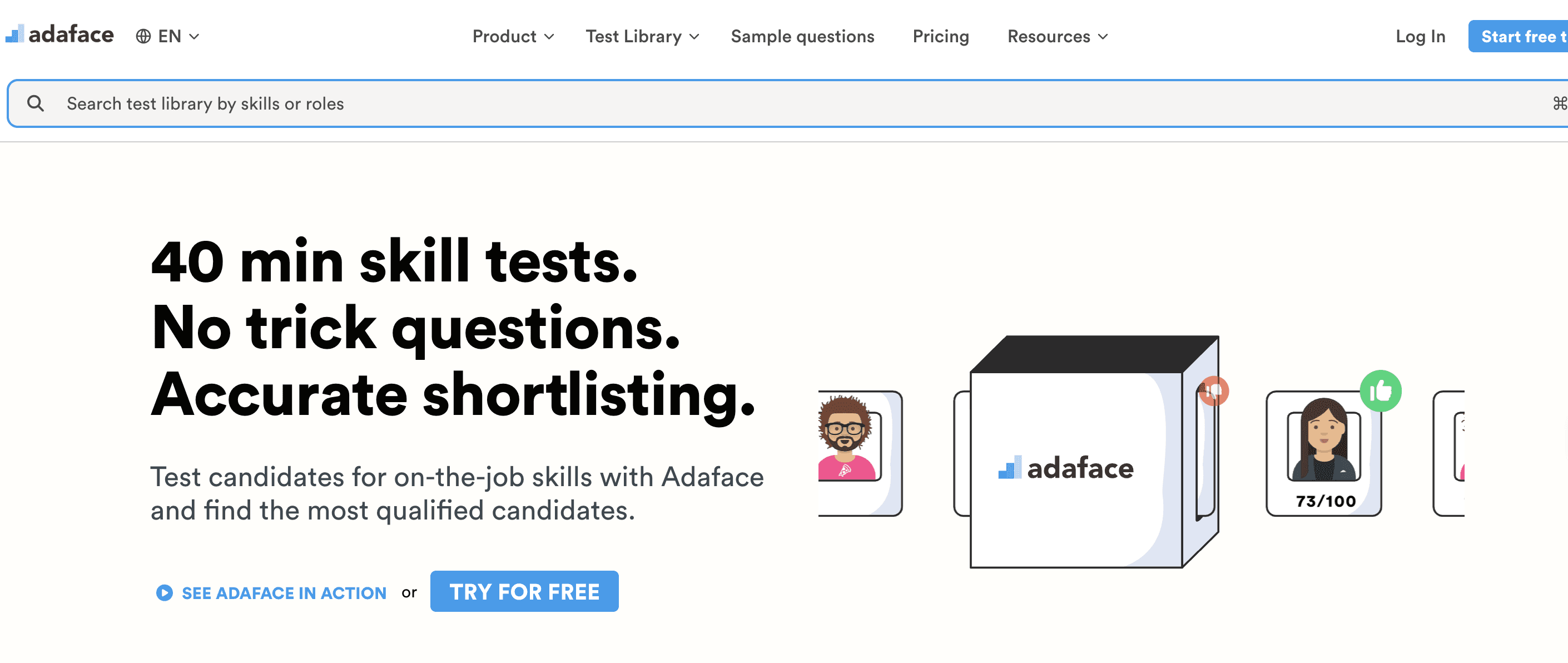
Adaface rounds out the list as the most accessible option for small businesses that need solid technical tests without a five-figure annual investment. The platform focuses on conversational, role-based assessments that feel less like exams and more like practical problem-solving.
What's good:
Tests designed to feel conversational, reducing candidate anxiety and improving completion rates. The experience is noticeably less stressful than traditional coding tests.
Good coverage of coding challenges, aptitude testing, and job-specific technical skills.
Anti-cheating measures including plagiarism detection and monitoring.
Particularly well-suited for smaller companies that want quality talent assessment without a five-figure annual contract.
API access for teams that want to integrate tests into custom workflows.
What's not:
Adaface doesn't attempt to be a comprehensive talent intelligence or talent management platform. No behavioral evaluation, no culture fit measurement, no psychological depth. It's a testing tool, and it does that well within its scope. But if you're looking for something that predicts long-term success or helps with internal mobility, it won't cover those needs.
Pricing: Starting at $180/year. Trial available. Flexible model for SMBs.
Test integrity in 2026: why it matters more than ever
This deserves its own section because it's the single biggest shift in the talent assessment market right now. When TestGorilla launched, "proctoring" meant watching a webcam feed and detecting full-screen exits. That's not enough anymore.
Candidates today have access to AI tools that can solve coding challenges, generate essay responses, and pass personality tests in seconds. If your assessment tool can't detect that, your results are compromised. Proctoring and anti-cheating capabilities should be a primary evaluation criterion, not an afterthought.
Here's how the TestGorilla alternatives compare:
Feature | TestGorilla | Bryq | iMocha | Equip | Mercer Mettl | HackerRank |
|---|---|---|---|---|---|---|
Webcam/ video monitoring | Yes | Yes | Yes | Yes | Yes | Yes |
Focus loss / tab-switch detection | Yes | Yes | Yes | Yes | Yes | Yes |
Browser lockdown | No | No | Yes | No | Yes | No |
ChatGPT detection | No | Indirect (focus loss) | Yes | Yes | Yes | No |
Copy/paste blocking | No | Yes | Yes | No | Yes | No |
Dev tools detection | No | Yes | No | No | No | No |
IP/Device monitoring | IP only | Yes | Yes | Yes | Yes | Limited |
Risk scoring system | No | Yes (3-level) | Yes | Yes (Trust Score) | Yes | No |
The platforms taking test integrity most seriously are iMocha, Mercer Mettl, and Equip. If security is a top priority for your hiring process (and in 2026, it should be), weight this table heavily in your evaluation.
What you'll actually pay: the real cost comparison
Cost is the #1 reason people leave TestGorilla, so let's be specific about what these alternatives actually run at scale.
Platform | Starting rate | Model | What to watch for |
|---|---|---|---|
Bryq | $83/month | Unlimited tests | No hidden costs. Setup and training included. |
Testlify | $69/month | Credit-based | Add-ons cost ~$2,388/year on top |
TestGorilla | ~€84/month | Credit + headcount | Fees scale with company size, not hiring volume |
iMocha | $999/year | Attempt-based | Connectors limited to top tier |
Equip | $1/candidate | Pay-as-you-go | Skills-only; limited behavioral depth |
Adaface | $180/year | Credit-based | Flexible for startups |
HackerRank | Free / ~$100/mo | Tiered | Top plans require sales conversation |
Others | Quote-based | Varies | Request quotes; negotiate annual vs. monthly |
The key insight: most platforms use credit-based or headcount-based models that get expensive as you scale. The unlimited model is the exception, and for high-volume hiring it's a significant cost advantage.
How to choose the right TestGorilla alternative
Skip the feature-comparison paralysis. Start with what your hiring process actually needs:
If you're hiring for long-term fit and retention: Bryq. One integrated assessment that measures cognitive ability, behavioral fit, hard skills, and AI proficiency in a single candidate profile. It's talent intelligence, not just talent assessment. And if your teams need people who actually work well with modern tools (not just talk about them), the Proficiency Assessment is included in every plan.
If you're hiring engineers and need technical depth: Options #2 or #3 on this list. Proper coding environments with practical challenges. Pair one of these with a behavioral tool (like PI) for a complete picture.
If you're an enterprise with complex workforce needs: iMocha. The skills intelligence and upskilling capabilities justify the investment at scale.
If you need fast screening with flexible billing: Testlify. Monthly rates and a solid test catalog for broad pre-screening.
If test integrity is your primary concern: Mercer Mettl or Equip. The most advanced anti-cheating systems available.
If you're watching every dollar: Adaface. Solid tests at rates that won't break a seed-stage budget.
Ready to see what Bryq does differently?
Most testing tools tell you what a candidate knows. The right platform tells you whether they'll succeed in the role, stay past the first year, and actually grow into what you need.
One integrated assessment. Cognitive ability, behavioral traits, hard skills, and AI proficiency. One science-backed candidate profile. If you're serious about improving quality of hire and reducing early turnover, start with a 14-day free trial. No annual commitment. No credit-based surprises.
FAQs
Why do companies look for TestGorilla alternatives?
The three biggest reasons: costs that scale with headcount rather than usage, basic test security that doesn't catch tool-assisted cheating, and skills tests that don't forecast whether someone will actually succeed in the role. Most companies switching want either deeper technical assessments, better hiring analytics, or more flexible billing.
How should you choose the right alternative for your team?
Start with your primary hiring challenge. If it's retention, look for tools with psychometric depth and science-backed matching (Criteria Corp or PI). If it's technical hiring, prioritize coding environments and practical exercises (HackerRank, Codility, Vervoe). If it's budget, compare the actual cost at your hiring volume, not just the starting rate.
Do TestGorilla competitors offer more affordable options?
Several do. The first option on this list offers unlimited evaluations starting at $83/month with no headcount-based scaling. Testlify starts at $69/month with monthly billing. The pay-per-candidate option charges $1 each with no contract. Adaface starts at $180/year. TestGorilla's Core plan is approximately €84/month billed annually with credits that get expensive as you grow.
Which alternative is the best assessment platform for technical hiring?
Both are purpose-built for technical roles. Both offer real coding environments, support for dozens of programming languages, and features like code playback and copy detection that generalist tools can't match.
Can I use multiple tools together?
Yes, and many companies do. A common stack: a talent intelligence tool for cultural fit, plus a dedicated coding platform for deep technical screening. Most of these tools integrate with the same ATS systems (Greenhouse, Lever, Workday) via API, so the data flows into one place.
Do these pre-employment assessment platforms meet compliance standards?
Most established platforms on this list follow EEOC guidelines and adverse impact testing protocols. Several vendors on this list, including Criteria Corp and PI, publish validation research. If you're in a regulated industry, ask vendors specifically about OFCCP compliance and whether their assessments have been tested for adverse impact across demographics. Scalability of that documentation matters too: what works for 50 hires per year gets complicated at 5,000.
Author

Bryq is composed of a diverse team of HR experts, including I-O psychologists, data scientists, and seasoned HR professionals, all united by a shared passion for soft skills.