
Bryq vs. The Predictive Index
Which Pre-Employment Assessment Fits Your Hiring Process?


Bryq vs. The Predictive Index
Which Pre-Employment Assessment Fits Your Hiring Process?
Bryq vs. The Predictive Index
Which Pre-Employment Assessment Fits Your Hiring Process?
Bryq vs. The Predictive Index: Which Pre-Employment Assessment Fits Your Hiring Process?
Bryq vs. The Predictive Index: Which Pre-Employment Assessment Fits Your Hiring Process?
Here's a question most HR professionals don't ask until it's too late: "Does your assessment measure what candidates can do, or just how they prefer to work?"
That's the fault line in this comparison. Both platforms promise better hiring decisions. Both use psychometric science. Both claim to predict job performance. But they start from fundamentally different assumptions about what makes someone succeed in a role, and those assumptions shape everything downstream.
PI has been around since 1955 — that's 70 years of behavioral science, 37 million assessments! A name that carries weight in human resources departments worldwide. Bryq is newer and built differently. One integrated assessment that captures cognitive ability, behavioral traits, and hard skills together, then scores candidates on actual fit. Not a label. Not an archetype. A prediction.
This post compares both platforms honestly: methodology, candidate experience, cost, integrations, and where each one genuinely excels. If you're evaluating assessment tools for your talent strategy, this is the breakdown that matters.
Here's a question most HR professionals don't ask until it's too late: "Does your assessment measure what candidates can do, or just how they prefer to work?"
That's the fault line in this comparison. Both platforms promise better hiring decisions. Both use psychometric science. Both claim to predict job performance. But they start from fundamentally different assumptions about what makes someone succeed in a role, and those assumptions shape everything downstream.
PI has been around since 1955 — that's 70 years of behavioral science, 37 million assessments! A name that carries weight in human resources departments worldwide. Bryq is newer and built differently. One integrated assessment that captures cognitive ability, behavioral traits, and hard skills together, then scores candidates on actual fit. Not a label. Not an archetype. A prediction.
This post compares both platforms honestly: methodology, candidate experience, cost, integrations, and where each one genuinely excels. If you're evaluating assessment tools for your talent strategy, this is the breakdown that matters.
Here's a question most HR professionals don't ask until it's too late: "Does your assessment measure what candidates can do, or just how they prefer to work?"
That's the fault line in this comparison. Both platforms promise better hiring decisions. Both use psychometric science. Both claim to predict job performance. But they start from fundamentally different assumptions about what makes someone succeed in a role, and those assumptions shape everything downstream.
PI has been around since 1955 — that's 70 years of behavioral science, 37 million assessments! A name that carries weight in human resources departments worldwide. Bryq is newer and built differently. One integrated assessment that captures cognitive ability, behavioral traits, and hard skills together, then scores candidates on actual fit. Not a label. Not an archetype. A prediction.
This post compares both platforms honestly: methodology, candidate experience, cost, integrations, and where each one genuinely excels. If you're evaluating assessment tools for your talent strategy, this is the breakdown that matters.
Side-by-Side Comparison at a Glance
Side-by-Side Comparison at a Glance
Bryq
Bryq
The Predictive Index
The Predictive Index
What it measures
What it measures
Cognitive ability + behavioral traits + hard skills (incl. AI proficiency) in one integrated assessment
Cognitive ability + behavioral traits + hard skills (incl. AI proficiency) in one integrated assessment
Cognitive ability + behavioral traits + hard skills (incl. AI proficiency) in one integrated assessment
Behavioral drives (4 factors) and thinking speed in two separate assessments
Behavioral drives (4 factors) and thinking speed in two separate assessments
Behavioral drives (4 factors) and thinking speed in two separate assessments
Core approach
Core approach
AI builds an Ideal Candidate Profile per role; scores every applicant on overall fit
AI builds an Ideal Candidate Profile per role; scores every applicant on overall fit
AI builds an Ideal Candidate Profile per role; scores every applicant on overall fit
Stakeholders define a Job Target; candidates matched on behavioral and cognitive alignment
Stakeholders define a Job Target; candidates matched on behavioral and cognitive alignment
Stakeholders define a Job Target; candidates matched on behavioral and cognitive alignment
Candidate output
Candidate output
Dimensional fit score combining all factors into one profile
Dimensional fit score combining all factors into one profile
Dimensional fit score combining all factors into one profile
17 Reference Profiles (behavioral archetypes) + separate cognitive score
17 Reference Profiles (behavioral archetypes) + separate cognitive score
17 Reference Profiles (behavioral archetypes) + separate cognitive score
AI proficiency
AI proficiency
Built-in: scenario-based, 5 dimensions, 6 peer-reviewed frameworks
Built-in: scenario-based, 5 dimensions, 6 peer-reviewed frameworks
Built-in: scenario-based, 5 dimensions, 6 peer-reviewed frameworks
N/A
N/A
N/A
Best for
Best for
Mid-market and enterprise teams focused on quality of hire and full-picture assessment
Mid-market and enterprise teams focused on quality of hire and full-picture assessment
Mid-market and enterprise teams focused on quality of hire and full-picture assessment
Organizations wanting behavioral benchmarking, team composition analysis, and people strategy
Organizations wanting behavioral benchmarking, team composition analysis, and people strategy
Organizations wanting behavioral benchmarking, team composition analysis, and people strategy
Cost model
Cost model
Flat-rate subscription, unlimited assessments
Flat-rate subscription, unlimited assessments
Flat-rate subscription, unlimited assessments
Annual subscription starting ~$7,550/yr; median spend ~$14,350/yr
Annual subscription starting ~$7,550/yr; median spend ~$14,350/yr
Annual subscription starting ~$7,550/yr; median spend ~$14,350/yr
Post-hire use
Post-hire use
Cognitive and behavioral profile persists for talent management, L&D, internal mobility
Cognitive and behavioral profile persists for talent management, L&D, internal mobility
Cognitive and behavioral profile persists for talent management, L&D, internal mobility
PI Perform for 1:1s, coaching, OKRs; Team Discovery for team dynamics
PI Perform for 1:1s, coaching, OKRs; Team Discovery for team dynamics
PI Perform for 1:1s, coaching, OKRs; Team Discovery for team dynamics
Integrations
Integrations
Greenhouse, Lever, Workday, iCIMS + API
Greenhouse, Lever, Workday, iCIMS + API
Greenhouse, Lever, Workday, iCIMS + API
60+ HRIS and ATS integrations including Greenhouse, Workday, BambooHR + API
60+ HRIS and ATS integrations including Greenhouse, Workday, BambooHR + API
60+ HRIS and ATS integrations including Greenhouse, Workday, BambooHR + API
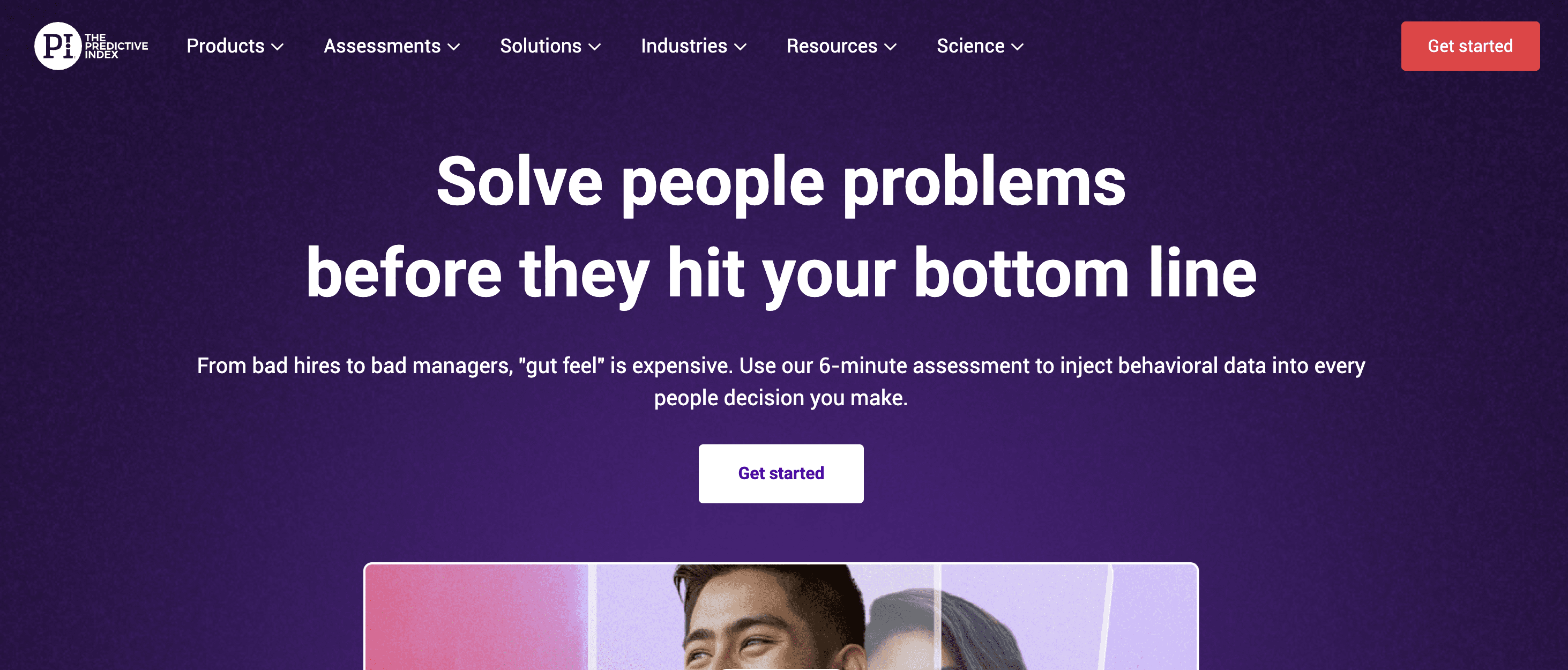
What Is The Predictive Index?
What Is The Predictive Index?
The Predictive Index started in 1955 when Arnold Daniels noticed something about bomber crews during World War II: technical skill mattered less than how the team actually worked together. That observation became a behavioral science company that now serves over 10,000 clients in 140 countries.
The core product is the Predictive Index Behavioral Assessment. It's a free-choice adjective tool that takes about six minutes to complete. Candidates select words that describe how others expect them to act, then words they feel genuinely describe themselves. The gap between those two lists tells you something useful about workplace behavior: how much someone is stretching outside their natural work style to meet perceived job requirements.
Four behavioral factors drive the model. Dominance (the need to influence), extraversion (the need for social interaction), patience (the need for stability), and formality (the need for structure). Results map to one of 17 Reference Profiles, archetypes like "Strategist," "Maverick," or "Guardian" that give managers a shorthand for understanding behavioral tendencies and communication preferences.
PI also offers a cognitive assessment: 50 questions in 12 minutes, measuring verbal, numerical, and abstract reasoning through a Linear-on-the-Fly Test engine that generates a unique evaluation for every candidate. It targets "speededness," the ability to learn and adapt under time pressure.
Beyond hiring, PI has built its talent optimization framework around four pillars: Design (team composition), Hire (candidate selection), Inspire (management coaching), and Diagnose (engagement surveys). The 2023 acquisition of Charma, now rebranded as PI Perform, added performance management tools: structured 1:1s, goal tracking, and feedback nudges informed by behavioral data.
Where PI earns its reputation is team analysis. The Team Discovery tool visualises how individual drives aggregate, showing where a group naturally excels and where it might need to stretch for its strategic goals. For organisations already invested in that discipline, the payoff is real.
The Predictive Index started in 1955 when Arnold Daniels noticed something about bomber crews during World War II: technical skill mattered less than how the team actually worked together. That observation became a behavioral science company that now serves over 10,000 clients in 140 countries.
The core product is the Predictive Index Behavioral Assessment. It's a free-choice adjective tool that takes about six minutes to complete. Candidates select words that describe how others expect them to act, then words they feel genuinely describe themselves. The gap between those two lists tells you something useful about workplace behavior: how much someone is stretching outside their natural work style to meet perceived job requirements.
Four behavioral factors drive the model. Dominance (the need to influence), extraversion (the need for social interaction), patience (the need for stability), and formality (the need for structure). Results map to one of 17 Reference Profiles, archetypes like "Strategist," "Maverick," or "Guardian" that give managers a shorthand for understanding behavioral tendencies and communication preferences.
PI also offers a cognitive assessment: 50 questions in 12 minutes, measuring verbal, numerical, and abstract reasoning through a Linear-on-the-Fly Test engine that generates a unique evaluation for every candidate. It targets "speededness," the ability to learn and adapt under time pressure.
Beyond hiring, PI has built its talent optimization framework around four pillars: Design (team composition), Hire (candidate selection), Inspire (management coaching), and Diagnose (engagement surveys). The 2023 acquisition of Charma, now rebranded as PI Perform, added performance management tools: structured 1:1s, goal tracking, and feedback nudges informed by behavioral data.
Where PI earns its reputation is team analysis. The Team Discovery tool visualises how individual drives aggregate, showing where a group naturally excels and where it might need to stretch for its strategic goals. For organisations already invested in that discipline, the payoff is real.
The Predictive Index started in 1955 when Arnold Daniels noticed something about bomber crews during World War II: technical skill mattered less than how the team actually worked together. That observation became a behavioral science company that now serves over 10,000 clients in 140 countries.
The core product is the Predictive Index Behavioral Assessment. It's a free-choice adjective tool that takes about six minutes to complete. Candidates select words that describe how others expect them to act, then words they feel genuinely describe themselves. The gap between those two lists tells you something useful about workplace behavior: how much someone is stretching outside their natural work style to meet perceived job requirements.
Four behavioral factors drive the model. Dominance (the need to influence), extraversion (the need for social interaction), patience (the need for stability), and formality (the need for structure). Results map to one of 17 Reference Profiles, archetypes like "Strategist," "Maverick," or "Guardian" that give managers a shorthand for understanding behavioral tendencies and communication preferences.
PI also offers a cognitive assessment: 50 questions in 12 minutes, measuring verbal, numerical, and abstract reasoning through a Linear-on-the-Fly Test engine that generates a unique evaluation for every candidate. It targets "speededness," the ability to learn and adapt under time pressure.
Beyond hiring, PI has built its talent optimization framework around four pillars: Design (team composition), Hire (candidate selection), Inspire (management coaching), and Diagnose (engagement surveys). The 2023 acquisition of Charma, now rebranded as PI Perform, added performance management tools: structured 1:1s, goal tracking, and feedback nudges informed by behavioral data.
Where PI earns its reputation is team analysis. The Team Discovery tool visualises how individual drives aggregate, showing where a group naturally excels and where it might need to stretch for its strategic goals. For organisations already invested in that discipline, the payoff is real.
What Is Bryq?
What Is Bryq?
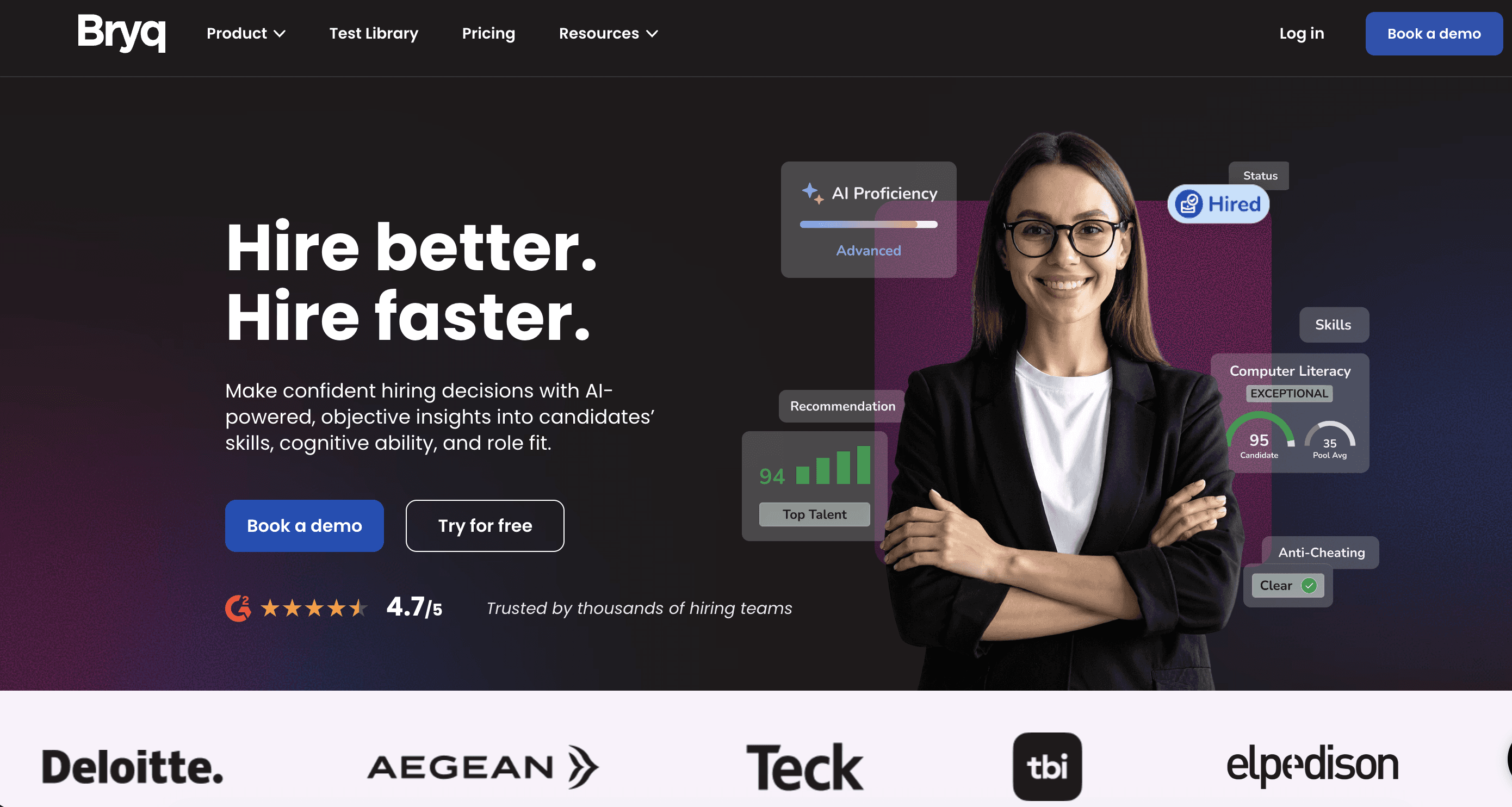
Most hiring tools measure one thing well and leave the rest to guesswork. Bryq was built to close that gap.
It's an assessment platform that measures what actually drives job performance: thinking ability, behavioral traits, and hard skills, including how effectively candidates work with AI. All of it lives inside one integrated psychometric assessment. One candidate experience. One data-driven profile that scores applicants on actual role fit.
The AI matching engine builds an Ideal Candidate Profile for every position. It doesn't ask hiring managers to guess which work preferences matter. It models the role, scores every applicant against it, and surfaces who's most likely to perform and stay. That's not a personality assessments label. It's a prediction backed by I/O psychology and validated for no adverse impact across demographics.
The newest module is the AI Proficiency Assessment. Seventy-five percent of knowledge workers already use AI on the job, but most organisations can't tell whether someone uses it well or badly. This assessment is scenario-based, tool-agnostic, and built on six peer-reviewed research frameworks. Fifteen minutes. Five scored dimensions on a 0-100 scale. No pass/fail. Included in all plans.
Teams report an 80% reduction in screening time, a 3x improvement in quality of hire, a 40% drop in early turnover, and stronger retention across the first year. The assessment respects candidate time: no webcam surveillance, no hour-long test marathons.
Most hiring tools measure one thing well and leave the rest to guesswork. Bryq was built to close that gap.
It's an assessment platform that measures what actually drives job performance: thinking ability, behavioral traits, and hard skills, including how effectively candidates work with AI. All of it lives inside one integrated psychometric assessment. One candidate experience. One data-driven profile that scores applicants on actual role fit.
The AI matching engine builds an Ideal Candidate Profile for every position. It doesn't ask hiring managers to guess which work preferences matter. It models the role, scores every applicant against it, and surfaces who's most likely to perform and stay. That's not a personality assessments label. It's a prediction backed by I/O psychology and validated for no adverse impact across demographics.
The newest module is the AI Proficiency Assessment. Seventy-five percent of knowledge workers already use AI on the job, but most organisations can't tell whether someone uses it well or badly. This assessment is scenario-based, tool-agnostic, and built on six peer-reviewed research frameworks. Fifteen minutes. Five scored dimensions on a 0-100 scale. No pass/fail. Included in all plans.
Teams report an 80% reduction in screening time, a 3x improvement in quality of hire, a 40% drop in early turnover, and stronger retention across the first year. The assessment respects candidate time: no webcam surveillance, no hour-long test marathons.
Most hiring tools measure one thing well and leave the rest to guesswork. Bryq was built to close that gap.
It's an assessment platform that measures what actually drives job performance: thinking ability, behavioral traits, and hard skills, including how effectively candidates work with AI. All of it lives inside one integrated psychometric assessment. One candidate experience. One data-driven profile that scores applicants on actual role fit.
The AI matching engine builds an Ideal Candidate Profile for every position. It doesn't ask hiring managers to guess which work preferences matter. It models the role, scores every applicant against it, and surfaces who's most likely to perform and stay. That's not a personality assessments label. It's a prediction backed by I/O psychology and validated for no adverse impact across demographics.
The newest module is the AI Proficiency Assessment. Seventy-five percent of knowledge workers already use AI on the job, but most organisations can't tell whether someone uses it well or badly. This assessment is scenario-based, tool-agnostic, and built on six peer-reviewed research frameworks. Fifteen minutes. Five scored dimensions on a 0-100 scale. No pass/fail. Included in all plans.
Teams report an 80% reduction in screening time, a 3x improvement in quality of hire, a 40% drop in early turnover, and stronger retention across the first year. The assessment respects candidate time: no webcam surveillance, no hour-long test marathons.
The Detailed Breakdown
The Detailed Breakdown
Assessment Methodology: Full Profile vs. Behavioral Focus
Assessment Methodology: Full Profile vs. Behavioral Focus
This is where the two platforms diverge most sharply.
The Predictive Index Behavioral Assessment measures 4 behavioral drives and maps them to Reference Profiles. It's fast, it's well-validated, and it tells you how someone prefers to work. A separate cognitive instrument adds a measure of learning speed. But those are two tools measuring two dimensions. Hard skills? Not covered. Practical capability with AI? Not on the radar.
Bryq takes a different approach. Instead of splitting behavioral and cognitive into separate instruments, it runs one integrated evaluation that captures thinking ability, personality traits, and practical skills together. The AI scores every applicant against the role's requirements. Hiring managers aren't triangulating across multiple reports. They're looking at one fit picture that covers traits, mental agility, and on-the-job capability.
The research on why hires fail supports measuring more dimensions. People rarely wash out because their behavioral tendencies were wrong. They leave because of misaligned capability, poor problem-solving fit, or friction between what the role actually demands and what they can deliver. A behavioral-only lens catches the first issue. It misses the others.
This is where the two platforms diverge most sharply.
The Predictive Index Behavioral Assessment measures 4 behavioral drives and maps them to Reference Profiles. It's fast, it's well-validated, and it tells you how someone prefers to work. A separate cognitive instrument adds a measure of learning speed. But those are two tools measuring two dimensions. Hard skills? Not covered. Practical capability with AI? Not on the radar.
Bryq takes a different approach. Instead of splitting behavioral and cognitive into separate instruments, it runs one integrated evaluation that captures thinking ability, personality traits, and practical skills together. The AI scores every applicant against the role's requirements. Hiring managers aren't triangulating across multiple reports. They're looking at one fit picture that covers traits, mental agility, and on-the-job capability.
The research on why hires fail supports measuring more dimensions. People rarely wash out because their behavioral tendencies were wrong. They leave because of misaligned capability, poor problem-solving fit, or friction between what the role actually demands and what they can deliver. A behavioral-only lens catches the first issue. It misses the others.
This is where the two platforms diverge most sharply.
The Predictive Index Behavioral Assessment measures 4 behavioral drives and maps them to Reference Profiles. It's fast, it's well-validated, and it tells you how someone prefers to work. A separate cognitive instrument adds a measure of learning speed. But those are two tools measuring two dimensions. Hard skills? Not covered. Practical capability with AI? Not on the radar.
Bryq takes a different approach. Instead of splitting behavioral and cognitive into separate instruments, it runs one integrated evaluation that captures thinking ability, personality traits, and practical skills together. The AI scores every applicant against the role's requirements. Hiring managers aren't triangulating across multiple reports. They're looking at one fit picture that covers traits, mental agility, and on-the-job capability.
The research on why hires fail supports measuring more dimensions. People rarely wash out because their behavioral tendencies were wrong. They leave because of misaligned capability, poor problem-solving fit, or friction between what the role actually demands and what they can deliver. A behavioral-only lens catches the first issue. It misses the others.
Candidate Experience and What You Get Back
Candidate Experience and What You Get Back
PI's core instrument is genuinely quick. Six minutes. Adjective selection. No proctoring. That's hard to beat on speed alone. The cognitive test adds another 12 minutes, so a full battery runs about 18 minutes total.
The integrated assessment covers more ground in a single sitting. The AI Proficiency module takes about 15 minutes of scenario-based work. Because everything lives in one evaluation rather than separate instruments, candidates complete one experience rather than bouncing between two different personality tests with different formats.
The bigger difference is in what candidates receive. PI produces a Reference Profile: a label like "Persuader" or "Analyst" that summarizes drives into an archetype. Useful for quick communication. But archetypes can also flatten people. The risk of pigeonholing is real, and user feedback consistently flags it. Bryq produces dimensional scores across every measured trait. No labels. No archetypes. Scores that tell you where someone sits on each dimension rather than which box they fit into.
PI's core instrument is genuinely quick. Six minutes. Adjective selection. No proctoring. That's hard to beat on speed alone. The cognitive test adds another 12 minutes, so a full battery runs about 18 minutes total.
The integrated assessment covers more ground in a single sitting. The AI Proficiency module takes about 15 minutes of scenario-based work. Because everything lives in one evaluation rather than separate instruments, candidates complete one experience rather than bouncing between two different personality tests with different formats.
The bigger difference is in what candidates receive. PI produces a Reference Profile: a label like "Persuader" or "Analyst" that summarizes drives into an archetype. Useful for quick communication. But archetypes can also flatten people. The risk of pigeonholing is real, and user feedback consistently flags it. Bryq produces dimensional scores across every measured trait. No labels. No archetypes. Scores that tell you where someone sits on each dimension rather than which box they fit into.
PI's core instrument is genuinely quick. Six minutes. Adjective selection. No proctoring. That's hard to beat on speed alone. The cognitive test adds another 12 minutes, so a full battery runs about 18 minutes total.
The integrated assessment covers more ground in a single sitting. The AI Proficiency module takes about 15 minutes of scenario-based work. Because everything lives in one evaluation rather than separate instruments, candidates complete one experience rather than bouncing between two different personality tests with different formats.
The bigger difference is in what candidates receive. PI produces a Reference Profile: a label like "Persuader" or "Analyst" that summarizes drives into an archetype. Useful for quick communication. But archetypes can also flatten people. The risk of pigeonholing is real, and user feedback consistently flags it. Bryq produces dimensional scores across every measured trait. No labels. No archetypes. Scores that tell you where someone sits on each dimension rather than which box they fit into.
How Each Platform Handles Cognitive Assessment
How Each Platform Handles Cognitive Assessment
Both platforms measure mental agility. The approaches differ.
PI's Cognitive Assessment is a 12-minute, 50-question timed test using a LOFT engine. It's well-constructed and EFPA-certified. The cognitive test measures general mental ability, what psychometricians call "g," across verbal, numerical, and abstract reasoning. Scores are compared against a specific job target that hiring managers set before the recruitment process begins.
Bryq integrates cognitive measurement into its core assessment alongside behavioral and practical dimensions. It isn't a separate instrument; it's woven into the same experience. The advantage is that hiring teams get one combined profile rather than needing to weight two separate scores against each other.
For roles where raw learning speed is the primary hiring criterion, PI's standalone depth has merit. For roles where you need to understand how thinking ability interacts with personality traits, work style, and practical skills, the integrated approach gives you more to work with.
Both platforms measure mental agility. The approaches differ.
PI's Cognitive Assessment is a 12-minute, 50-question timed test using a LOFT engine. It's well-constructed and EFPA-certified. The cognitive test measures general mental ability, what psychometricians call "g," across verbal, numerical, and abstract reasoning. Scores are compared against a specific job target that hiring managers set before the recruitment process begins.
Bryq integrates cognitive measurement into its core assessment alongside behavioral and practical dimensions. It isn't a separate instrument; it's woven into the same experience. The advantage is that hiring teams get one combined profile rather than needing to weight two separate scores against each other.
For roles where raw learning speed is the primary hiring criterion, PI's standalone depth has merit. For roles where you need to understand how thinking ability interacts with personality traits, work style, and practical skills, the integrated approach gives you more to work with.
Both platforms measure mental agility. The approaches differ.
PI's Cognitive Assessment is a 12-minute, 50-question timed test using a LOFT engine. It's well-constructed and EFPA-certified. The cognitive test measures general mental ability, what psychometricians call "g," across verbal, numerical, and abstract reasoning. Scores are compared against a specific job target that hiring managers set before the recruitment process begins.
Bryq integrates cognitive measurement into its core assessment alongside behavioral and practical dimensions. It isn't a separate instrument; it's woven into the same experience. The advantage is that hiring teams get one combined profile rather than needing to weight two separate scores against each other.
For roles where raw learning speed is the primary hiring criterion, PI's standalone depth has merit. For roles where you need to understand how thinking ability interacts with personality traits, work style, and practical skills, the integrated approach gives you more to work with.
Talent Optimization vs. Talent Intelligence
Talent Optimization vs. Talent Intelligence
PI has organised its platform around talent optimization: Design, Hire, Inspire, Diagnose. It's a framework for treating people data as a strategic asset. Team Discovery shows how individual drives aggregate. Coaching Guides help managers adapt their style. The Employee Experience Survey measures engagement across job fit, manager relationship, team collaboration, and culture.
That framework is genuine. Organisations that commit to the discipline get real value from the system. The post-hire application is strong.
Bryq approaches post-hire differently. Because the assessment captures cognitive and behavioral dimensions alongside practical skills, the data stays relevant for talent management, internal mobility, career development, and L&D planning well beyond the initial hire. Where PI gives you a behavioral label to coach around, Bryq gives you a dimensional profile that evolves with the person's role. For organisations building a long-term talent strategy, that distinction matters.
And there's one area PI doesn't touch at all: AI proficiency. 50% of employers cite AI skills gaps as a top barrier to adoption. Bryq's AI Proficiency Assessment provides documented, scenario-based evaluation of how candidates actually work with AI. For organizations in the EU, this also supports compliance with the EU AI Act's requirement to ensure staff AI literacy.
PI has organised its platform around talent optimization: Design, Hire, Inspire, Diagnose. It's a framework for treating people data as a strategic asset. Team Discovery shows how individual drives aggregate. Coaching Guides help managers adapt their style. The Employee Experience Survey measures engagement across job fit, manager relationship, team collaboration, and culture.
That framework is genuine. Organisations that commit to the discipline get real value from the system. The post-hire application is strong.
Bryq approaches post-hire differently. Because the assessment captures cognitive and behavioral dimensions alongside practical skills, the data stays relevant for talent management, internal mobility, career development, and L&D planning well beyond the initial hire. Where PI gives you a behavioral label to coach around, Bryq gives you a dimensional profile that evolves with the person's role. For organisations building a long-term talent strategy, that distinction matters.
And there's one area PI doesn't touch at all: AI proficiency. 50% of employers cite AI skills gaps as a top barrier to adoption. Bryq's AI Proficiency Assessment provides documented, scenario-based evaluation of how candidates actually work with AI. For organizations in the EU, this also supports compliance with the EU AI Act's requirement to ensure staff AI literacy.
PI has organised its platform around talent optimization: Design, Hire, Inspire, Diagnose. It's a framework for treating people data as a strategic asset. Team Discovery shows how individual drives aggregate. Coaching Guides help managers adapt their style. The Employee Experience Survey measures engagement across job fit, manager relationship, team collaboration, and culture.
That framework is genuine. Organisations that commit to the discipline get real value from the system. The post-hire application is strong.
Bryq approaches post-hire differently. Because the assessment captures cognitive and behavioral dimensions alongside practical skills, the data stays relevant for talent management, internal mobility, career development, and L&D planning well beyond the initial hire. Where PI gives you a behavioral label to coach around, Bryq gives you a dimensional profile that evolves with the person's role. For organisations building a long-term talent strategy, that distinction matters.
And there's one area PI doesn't touch at all: AI proficiency. 50% of employers cite AI skills gaps as a top barrier to adoption. Bryq's AI Proficiency Assessment provides documented, scenario-based evaluation of how candidates actually work with AI. For organizations in the EU, this also supports compliance with the EU AI Act's requirement to ensure staff AI literacy.
Integrations and API
Integrations and API
PI wins on sheer integration volume. Over 60 connections spanning ATS platforms (Greenhouse, Paylocity, Pinpoint), HRIS systems (Workday, BambooHR, SAP SuccessFactors, Personio), and identity management tools (Okta, Microsoft Entra). A robust API covers custom builds. If your HR stack is complex, you'll likely find a connector.
Bryq connects to the platforms mid-market and enterprise teams actually run: Greenhouse, Lever, Workday, iCIMS, and others. Setup takes days, not weeks. The API handles custom configurations. For a direct comparison, see our detailed comparison page.
The practical difference is what flows through the connection. PI sends behavioral profiles and cognitive scores as separate data points. The other sends one combined fit profile. One gives recruiters information to interpret. The other gives them a recommendation.
PI wins on sheer integration volume. Over 60 connections spanning ATS platforms (Greenhouse, Paylocity, Pinpoint), HRIS systems (Workday, BambooHR, SAP SuccessFactors, Personio), and identity management tools (Okta, Microsoft Entra). A robust API covers custom builds. If your HR stack is complex, you'll likely find a connector.
Bryq connects to the platforms mid-market and enterprise teams actually run: Greenhouse, Lever, Workday, iCIMS, and others. Setup takes days, not weeks. The API handles custom configurations. For a direct comparison, see our detailed comparison page.
The practical difference is what flows through the connection. PI sends behavioral profiles and cognitive scores as separate data points. The other sends one combined fit profile. One gives recruiters information to interpret. The other gives them a recommendation.
PI wins on sheer integration volume. Over 60 connections spanning ATS platforms (Greenhouse, Paylocity, Pinpoint), HRIS systems (Workday, BambooHR, SAP SuccessFactors, Personio), and identity management tools (Okta, Microsoft Entra). A robust API covers custom builds. If your HR stack is complex, you'll likely find a connector.
Bryq connects to the platforms mid-market and enterprise teams actually run: Greenhouse, Lever, Workday, iCIMS, and others. Setup takes days, not weeks. The API handles custom configurations. For a direct comparison, see our detailed comparison page.
The practical difference is what flows through the connection. PI sends behavioral profiles and cognitive scores as separate data points. The other sends one combined fit profile. One gives recruiters information to interpret. The other gives them a recommendation.
Pricing: Flat Rate vs. Annual Commitment
Pricing: Flat Rate vs. Annual Commitment
Cost is where the gap shows up clearly.
PI operates on annual contracts. The Validated Hiring tier starts around $7,550 per year. PI Essentials starts at $8,500. The median buyer on software marketplaces spends approximately $14,350 annually. Additional modules (Team Discovery, Diagnose) add to the total. All plans include unlimited assessments and unlimited users, which is a real advantage over per-candidate models.
Bryq also charges a flat-rate subscription with unlimited assessments, but the entry point is significantly lower. The AI Proficiency Assessment is included in every plan at no additional charge. For mid-market organizations comparing total cost of ownership, the integrated approach wins, especially considering that it covers cognitive, behavioral, hard skills, and AI proficiency in one platform where PI requires add-on modules to approach similar breadth.
Cost is where the gap shows up clearly.
PI operates on annual contracts. The Validated Hiring tier starts around $7,550 per year. PI Essentials starts at $8,500. The median buyer on software marketplaces spends approximately $14,350 annually. Additional modules (Team Discovery, Diagnose) add to the total. All plans include unlimited assessments and unlimited users, which is a real advantage over per-candidate models.
Bryq also charges a flat-rate subscription with unlimited assessments, but the entry point is significantly lower. The AI Proficiency Assessment is included in every plan at no additional charge. For mid-market organizations comparing total cost of ownership, the integrated approach wins, especially considering that it covers cognitive, behavioral, hard skills, and AI proficiency in one platform where PI requires add-on modules to approach similar breadth.
Cost is where the gap shows up clearly.
PI operates on annual contracts. The Validated Hiring tier starts around $7,550 per year. PI Essentials starts at $8,500. The median buyer on software marketplaces spends approximately $14,350 annually. Additional modules (Team Discovery, Diagnose) add to the total. All plans include unlimited assessments and unlimited users, which is a real advantage over per-candidate models.
Bryq also charges a flat-rate subscription with unlimited assessments, but the entry point is significantly lower. The AI Proficiency Assessment is included in every plan at no additional charge. For mid-market organizations comparing total cost of ownership, the integrated approach wins, especially considering that it covers cognitive, behavioral, hard skills, and AI proficiency in one platform where PI requires add-on modules to approach similar breadth.
Unconscious Bias and Validation
Unconscious Bias and Validation
Both platforms take fairness seriously.
PI has EFPA certification (audited by DNV-GL), over 400 criterion-related validity studies, and ongoing Differential Item Functioning studies to ensure scores don't differ by age, gender, or ethnicity. The instrument is available in 70+ languages. Validation is a genuine strength.
Bryq's assessments are validated by I/O psychologists for no adverse impact across demographics. EEOC and OFCCP compliance standards met. Because it doesn't rely on resumes, job titles, or university credentials as inputs, it sidesteps many of the unconscious bias vectors that behavioural-only tools can't address. The AI Proficiency Assessment is built on six peer-reviewed frameworks (UNESCO, SFIA, OECD, and others), adding research credibility that proprietary-only models can't match.
Both platforms take fairness seriously.
PI has EFPA certification (audited by DNV-GL), over 400 criterion-related validity studies, and ongoing Differential Item Functioning studies to ensure scores don't differ by age, gender, or ethnicity. The instrument is available in 70+ languages. Validation is a genuine strength.
Bryq's assessments are validated by I/O psychologists for no adverse impact across demographics. EEOC and OFCCP compliance standards met. Because it doesn't rely on resumes, job titles, or university credentials as inputs, it sidesteps many of the unconscious bias vectors that behavioural-only tools can't address. The AI Proficiency Assessment is built on six peer-reviewed frameworks (UNESCO, SFIA, OECD, and others), adding research credibility that proprietary-only models can't match.
Both platforms take fairness seriously.
PI has EFPA certification (audited by DNV-GL), over 400 criterion-related validity studies, and ongoing Differential Item Functioning studies to ensure scores don't differ by age, gender, or ethnicity. The instrument is available in 70+ languages. Validation is a genuine strength.
Bryq's assessments are validated by I/O psychologists for no adverse impact across demographics. EEOC and OFCCP compliance standards met. Because it doesn't rely on resumes, job titles, or university credentials as inputs, it sidesteps many of the unconscious bias vectors that behavioural-only tools can't address. The AI Proficiency Assessment is built on six peer-reviewed frameworks (UNESCO, SFIA, OECD, and others), adding research credibility that proprietary-only models can't match.
Which One Fits Your Recruitment Process?
Which One Fits Your Recruitment Process?
The Predictive Index makes sense if:
• You're committed to the talent optimization discipline and want Design, Hire, Inspire, and Diagnose pillars built into your workflow
• Your primary need is understanding behavioral patterns and team dynamics: how people prefer to work, communicate, and collaborate
• You want practice tests and Reference Profiles that give managers a quick, accessible language for coaching and employee engagement
• You have budget for annual contracts in the $8,000-$15,000 range and plan to use the platform across the entire hiring process and beyond
Bryq makes sense if:
• You want to measure the full picture: thinking ability, behavioral traits, and practical skills (including AI proficiency) in one integrated assessment
• You'd rather get a dimensional fit score per candidate than a behavioral archetype, and you want AI to build role profiles rather than relying on stakeholder self-reporting
• You need to understand how candidates actually work with AI in real-world scenarios, something no behaviour-only instrument covers
• You want flat-rate cost at a lower entry point without sacrificing breadth
• Candidate experience matters and you want one streamlined evaluation rather than separate instruments
• YYou want data that supports talent management and career development beyond the initial hire, with dimensional scores rather than personality tests labels
The Predictive Index makes sense if:
• You're committed to the talent optimization discipline and want Design, Hire, Inspire, and Diagnose pillars built into your workflow
• Your primary need is understanding behavioral patterns and team dynamics: how people prefer to work, communicate, and collaborate
• You want practice tests and Reference Profiles that give managers a quick, accessible language for coaching and employee engagement
• You have budget for annual contracts in the $8,000-$15,000 range and plan to use the platform across the entire hiring process and beyond
Bryq makes sense if:
• You want to measure the full picture: thinking ability, behavioral traits, and practical skills (including AI proficiency) in one integrated assessment
• You'd rather get a dimensional fit score per candidate than a behavioral archetype, and you want AI to build role profiles rather than relying on stakeholder self-reporting
• You need to understand how candidates actually work with AI in real-world scenarios, something no behaviour-only instrument covers
• You want flat-rate cost at a lower entry point without sacrificing breadth
• Candidate experience matters and you want one streamlined evaluation rather than separate instruments
• YYou want data that supports talent management and career development beyond the initial hire, with dimensional scores rather than personality tests labels
The Predictive Index makes sense if:
• You're committed to the talent optimization discipline and want Design, Hire, Inspire, and Diagnose pillars built into your workflow
• Your primary need is understanding behavioral patterns and team dynamics: how people prefer to work, communicate, and collaborate
• You want practice tests and Reference Profiles that give managers a quick, accessible language for coaching and employee engagement
• You have budget for annual contracts in the $8,000-$15,000 range and plan to use the platform across the entire hiring process and beyond
Bryq makes sense if:
• You want to measure the full picture: thinking ability, behavioral traits, and practical skills (including AI proficiency) in one integrated assessment
• You'd rather get a dimensional fit score per candidate than a behavioral archetype, and you want AI to build role profiles rather than relying on stakeholder self-reporting
• You need to understand how candidates actually work with AI in real-world scenarios, something no behaviour-only instrument covers
• You want flat-rate cost at a lower entry point without sacrificing breadth
• Candidate experience matters and you want one streamlined evaluation rather than separate instruments
• YYou want data that supports talent management and career development beyond the initial hire, with dimensional scores rather than personality tests labels
FAQs
FAQs
What's the core difference between these two platforms?
PI measures behavioral drives and thinking speed in two separate instruments. Bryq measures thinking ability, behavioral traits, and hard skills (including AI proficiency) in one integrated assessment. The distinction is between understanding how someone prefers to work and predicting whether they'll succeed in a specific job.
Can The Predictive Index measure AI proficiency?
No. PI focuses on workplace behavior and learning speed. It does not offer any measure of AI proficiency. The AI Proficiency Assessment from Bryq evaluates how candidates actually work with AI across five dimensions, built on six peer-reviewed frameworks.
How does cost compare?
PI's annual contracts start around $7,550 for hiring-focused plans, with median spend around $14,350/year. Bryq offers flat-rate subscriptions with unlimited assessments at a lower entry point. Both include unlimited use, but the integrated approach includes AI proficiency measurement in all plans at no extra charge.
Which one is better for understanding how teams work?
PI has a clear edge here. The Team Discovery tool and Reference Profiles give managers an accessible language for understanding team composition. Bryq's strength is in the hiring process itself and in providing dimensional data for talent acquisition, internal mobility, and L&D, but PI's post-hire team analysis tools are more developed.
Are both platforms validated for pre-employment use?
Yes. PI has EFPA certification and 400+ validity studies. Bryq is validated by I/O psychologists for no adverse impact across demographics. Both meet EEOC compliance standards. For pre-employment decision-making, both are scientifically defensible.
What are Reference Profiles, and does Bryq have them?
Reference Profiles are PI's 17 behavioral archetypes (e.g., "Captain," "Collaborator," "Analyzer"). They simplify complex behavioral data into a quick label. Bryq does not use archetypes. Instead, it provides dimensional scores across each measured trait, giving hr professionals more granular valuable insights without the risk of pigeonholing.
Can I share Predictive Index Behavioral Assessment results on LinkedIn?
Yes. PI encourages sharing Reference Profiles on LinkedIn as a professional development and networking tool. Bryq focuses its scores on hiring and talent acquisition rather than social sharing.
See the Difference for Yourself
Bryq's cognitive and behavioral profile persists after onboarding for team development, career planning, and L&D initiatives. Skill test scores from other platforms tend to age out. If referral-ready compliance documentation matters (especially for the EU AI Act), the assessment software also provides auditable evidence of how candidates work with AI.
What's the core difference between these two platforms?
PI measures behavioral drives and thinking speed in two separate instruments. Bryq measures thinking ability, behavioral traits, and hard skills (including AI proficiency) in one integrated assessment. The distinction is between understanding how someone prefers to work and predicting whether they'll succeed in a specific job.
Can The Predictive Index measure AI proficiency?
No. PI focuses on workplace behavior and learning speed. It does not offer any measure of AI proficiency. The AI Proficiency Assessment from Bryq evaluates how candidates actually work with AI across five dimensions, built on six peer-reviewed frameworks.
How does cost compare?
PI's annual contracts start around $7,550 for hiring-focused plans, with median spend around $14,350/year. Bryq offers flat-rate subscriptions with unlimited assessments at a lower entry point. Both include unlimited use, but the integrated approach includes AI proficiency measurement in all plans at no extra charge.
Which one is better for understanding how teams work?
PI has a clear edge here. The Team Discovery tool and Reference Profiles give managers an accessible language for understanding team composition. Bryq's strength is in the hiring process itself and in providing dimensional data for talent acquisition, internal mobility, and L&D, but PI's post-hire team analysis tools are more developed.
Are both platforms validated for pre-employment use?
Yes. PI has EFPA certification and 400+ validity studies. Bryq is validated by I/O psychologists for no adverse impact across demographics. Both meet EEOC compliance standards. For pre-employment decision-making, both are scientifically defensible.
What are Reference Profiles, and does Bryq have them?
Reference Profiles are PI's 17 behavioral archetypes (e.g., "Captain," "Collaborator," "Analyzer"). They simplify complex behavioral data into a quick label. Bryq does not use archetypes. Instead, it provides dimensional scores across each measured trait, giving hr professionals more granular valuable insights without the risk of pigeonholing.
Can I share Predictive Index Behavioral Assessment results on LinkedIn?
Yes. PI encourages sharing Reference Profiles on LinkedIn as a professional development and networking tool. Bryq focuses its scores on hiring and talent acquisition rather than social sharing.
See the Difference for Yourself
Bryq's cognitive and behavioral profile persists after onboarding for team development, career planning, and L&D initiatives. Skill test scores from other platforms tend to age out. If referral-ready compliance documentation matters (especially for the EU AI Act), the assessment software also provides auditable evidence of how candidates work with AI.
What's the core difference between these two platforms?
PI measures behavioral drives and thinking speed in two separate instruments. Bryq measures thinking ability, behavioral traits, and hard skills (including AI proficiency) in one integrated assessment. The distinction is between understanding how someone prefers to work and predicting whether they'll succeed in a specific job.
Can The Predictive Index measure AI proficiency?
No. PI focuses on workplace behavior and learning speed. It does not offer any measure of AI proficiency. The AI Proficiency Assessment from Bryq evaluates how candidates actually work with AI across five dimensions, built on six peer-reviewed frameworks.
How does cost compare?
PI's annual contracts start around $7,550 for hiring-focused plans, with median spend around $14,350/year. Bryq offers flat-rate subscriptions with unlimited assessments at a lower entry point. Both include unlimited use, but the integrated approach includes AI proficiency measurement in all plans at no extra charge.
Which one is better for understanding how teams work?
PI has a clear edge here. The Team Discovery tool and Reference Profiles give managers an accessible language for understanding team composition. Bryq's strength is in the hiring process itself and in providing dimensional data for talent acquisition, internal mobility, and L&D, but PI's post-hire team analysis tools are more developed.
Are both platforms validated for pre-employment use?
Yes. PI has EFPA certification and 400+ validity studies. Bryq is validated by I/O psychologists for no adverse impact across demographics. Both meet EEOC compliance standards. For pre-employment decision-making, both are scientifically defensible.
What are Reference Profiles, and does Bryq have them?
Reference Profiles are PI's 17 behavioral archetypes (e.g., "Captain," "Collaborator," "Analyzer"). They simplify complex behavioral data into a quick label. Bryq does not use archetypes. Instead, it provides dimensional scores across each measured trait, giving hr professionals more granular valuable insights without the risk of pigeonholing.
Can I share Predictive Index Behavioral Assessment results on LinkedIn?
Yes. PI encourages sharing Reference Profiles on LinkedIn as a professional development and networking tool. Bryq focuses its scores on hiring and talent acquisition rather than social sharing.
See the Difference for Yourself
Bryq's cognitive and behavioral profile persists after onboarding for team development, career planning, and L&D initiatives. Skill test scores from other platforms tend to age out. If referral-ready compliance documentation matters (especially for the EU AI Act), the assessment software also provides auditable evidence of how candidates work with AI.
See the Difference for Yourself
See the Difference for Yourself
Comparison tables only tell you so much. The fastest way to understand the platform is to see your own role profile in action.
Book a 30-minute demo and we'll build one together. You'll see how one integrated assessment captures what separate behavioral and cognitive instruments can't.
Comparison tables only tell you so much. The fastest way to understand the platform is to see your own role profile in action.
Book a 30-minute demo and we'll build one together. You'll see how one integrated assessment captures what separate behavioral and cognitive instruments can't.
Comparison tables only tell you so much. The fastest way to understand the platform is to see your own role profile in action.
Book a 30-minute demo and we'll build one together. You'll see how one integrated assessment captures what separate behavioral and cognitive instruments can't.
Ready to see Bryq in action?
Start hiring based on real data.
Ready to see Bryq in action?
Start hiring based on
real data.
Ready to see Bryq in action?
Start hiring based on real data.