
Bryq vs. Maki People
Which Pre-Employment Assessment Fits Your Hiring Process?
Updated July 2026.


Bryq vs. Maki People
Which Pre-Employment Assessment Fits Your Hiring Process?
Updated July 2026.
Bryq vs. Maki People
Which Pre-Employment Assessment Fits Your Hiring Process?
Updated July 2026.
Maki People review and comparison: where it fits, where Bryq fits
Maki People review and comparison: where it fits, where Bryq fits
Maki People review and comparison: where it fits, where Bryq fits
Maki People runs an “AI Tier” of six agents that screen, interview, schedule, and, as of April 2026, assess AI proficiency, with minimal human involvement at each stage. Bryq takes a different position: one integrated candidate assessment, one profile, with the AI Fluency Assessment, built on six peer-reviewed frameworks, as one of five dimensions measured in a single session. The AI does the analytical work. Your hiring team makes the decision. Teams using Bryq see a 3x improvement in quality of hire, 47% lower attrition, and 2x faster hiring. Here is an honest side-by-side.
Maki People runs an “AI Tier” of six agents that screen, interview, schedule, and, as of April 2026, assess AI proficiency, with minimal human involvement at each stage. Bryq takes a different position: one integrated candidate assessment, one profile, with the AI Fluency Assessment, built on six peer-reviewed frameworks, as one of five dimensions measured in a single session. The AI does the analytical work. Your hiring team makes the decision. Teams using Bryq see a 3x improvement in quality of hire, 47% lower attrition, and 2x faster hiring. Here is an honest side-by-side.
Maki People runs an “AI Tier” of six agents that screen, interview, schedule, and, as of April 2026, assess AI proficiency, with minimal human involvement at each stage. Bryq takes a different position: one integrated candidate assessment, one profile, with the AI Fluency Assessment, built on six peer-reviewed frameworks, as one of five dimensions measured in a single session. The AI does the analytical work. Your hiring team makes the decision. Teams using Bryq see a 3x improvement in quality of hire, 47% lower attrition, and 2x faster hiring. Here is an honest side-by-side.
Side-by-Side Comparison at a Glance
Side-by-Side Comparison at a Glance
Bryq
Bryq
Bryq
Maki People
Maki People
Maki People
Core approach
Core approach
AI
proficiency
AI builds an Ideal Candidate Profile per role; every applicant scored on predicted fit, decision stays with your team
AI builds an Ideal Candidate Profile per role; every applicant scored on predicted fit, decision stays with your team
AI builds an Ideal Candidate Profile per role; every applicant scored on predicted fit, decision stays with your team
Six autonomous agents (Shiro, Mochi, Ken, Kumi, Tomo, Riku), each handling a different funnel stage
Six autonomous agents (Shiro, Mochi, Ken, Kumi, Tomo, Riku), each handling a different funnel stage
Six autonomous agents (Shiro, Mochi, Ken, Kumi, Tomo, Riku), each handling a different funnel stage
Candidate experience
Candidate experience
Candidate
experience
One cohesive assessment, structured and respectful, no heavy surveillance
One cohesive assessment, structured and respectful, no heavy surveillance
One cohesive assessment, structured and respectful, no heavy surveillance
Multimodal (text, voice, video); webcam snapshots every 30 seconds, device fingerprinting
Multimodal (text, voice, video); webcam snapshots every 30 seconds, device fingerprinting
Multimodal (text, voice, video); webcam snapshots every 30 seconds, device fingerprinting
AI fluency
AI fluency
AI fluency
Five scored dimensions built on six peer-reviewed frameworks (UNESCO, SFIA, OECD), included in every plan
Five scored dimensions built on six peer-reviewed frameworks (UNESCO, SFIA, OECD), included in every plan
Five scored dimensions built on six peer-reviewed frameworks (UNESCO, SFIA, OECD), included in every plan
Four-dimension framework launched April 2026, available inside two of the six agents
Four-dimension framework launched April 2026, available inside two of the six agents
Four-dimension framework launched April 2026, available inside two of the six agents
Pricing
Pricing
Reference
checks
Flat-rate subscription, unlimited assessments
Flat-rate subscription, unlimited assessments
Flat-rate subscription, unlimited assessments
Usage-based credit model; enterprise quotes required
Usage-based credit model; enterprise quotes required
Usage-based credit model; enterprise quotes required
Setup
Setup
Setup
ATS-integrated in under a week
ATS-integrated in under a week
ATS-integrated in under a week
Ashby, Workable, Greenhouse, Workday, SmartRecruiters + more
Ashby, Workable, Greenhouse, Workday, SmartRecruiters + more
Ashby, Workable, Greenhouse, Workday, SmartRecruiters + more
Measurable result
Measurable result
Measurable result
3x quality of hire, 47% lower attrition, 2x faster hiring
3x quality of hire, 47% lower attrition, 2x faster hiring
3x quality of hire, 47% lower attrition, 2x faster hiring
(varies)
(varies)
(varies)
What Is Maki People?
What Is Maki People?
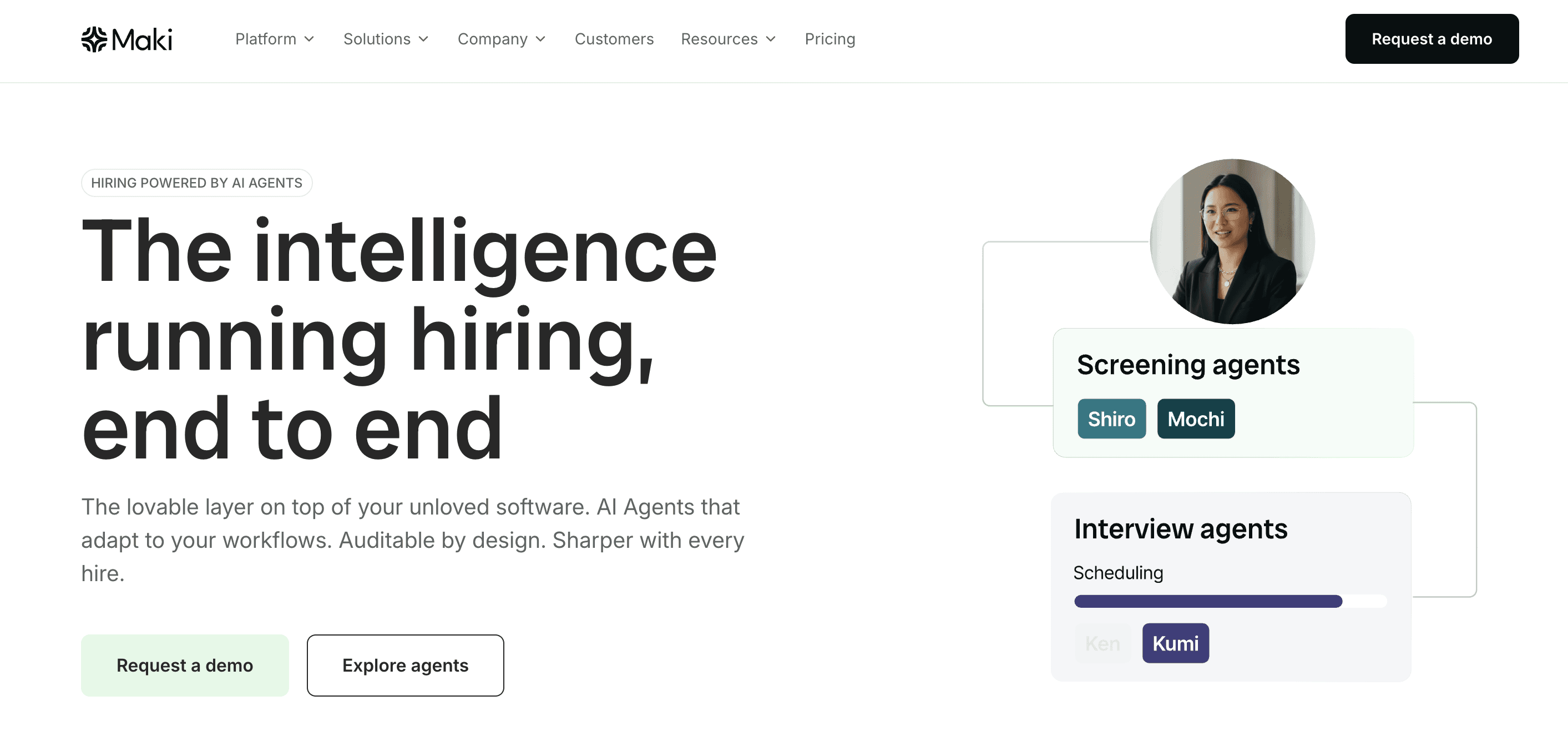
Maki People is a Paris-based assessment platform founded in 2021 by a team with roots in logistics and management consulting. The CEO previously built a digital freight company, the COO is a former McKinsey Partner, and the CPO led product at Uber. That operational DNA shows up in the product: built for speed and volume.
The central idea is an “AI Tier” that sits above your existing ATS. Six autonomous agents, each handling a different stage of the funnel.
Shiro handles skills assessment and top-of-funnel screening with custom questions and knock-out logic.
Mochi runs conversational interviews across multiple languages.
Ken administers deeper evaluation with coding tests, aptitude tests, and problem-solving simulations.
Kumi schedules interviews automatically.
Tomo is their AI Interview Co-pilot, sitting alongside human interviewers with structured plans, real-time candidate signals, and post-interview scorecards.
Riku (early access) handles internal mobility using a unified skills framework.
In April 2026, Maki added a new capability: an AI proficiency assessment, available inside Shiro and Mochi at no additional cost. It uses a four-dimensional framework covering AI tool agility, human-tool interactivity, ethical use, and data and algorithmic literacy, delivered through situational judgment tests and structured behavioral grids.
The company has raised $35.3 million, including a $28.6 million Series A in January 2025. Their client list includes H&M, PwC, Deloitte, and IKEA. They use a credit-based model: you pay per candidate interaction and per agent activated. Enterprise pricing requires a custom quote.
Maki People is a Paris-based assessment platform founded in 2021 by a team with roots in logistics and management consulting. The CEO previously built a digital freight company, the COO is a former McKinsey Partner, and the CPO led product at Uber. That operational DNA shows up in the product: built for speed and volume.
The central idea is an “AI Tier” that sits above your existing ATS. Six autonomous agents, each handling a different stage of the funnel.
Shiro handles skills assessment and top-of-funnel screening with custom questions and knock-out logic.
Mochi runs conversational interviews across multiple languages.
Ken administers deeper evaluation with coding tests, aptitude tests, and problem-solving simulations.
Kumi schedules interviews automatically.
Tomo is their AI Interview Co-pilot, sitting alongside human interviewers with structured plans, real-time candidate signals, and post-interview scorecards.
Riku (early access) handles internal mobility using a unified skills framework.
In April 2026, Maki added a new capability: an AI proficiency assessment, available inside Shiro and Mochi at no additional cost. It uses a four-dimensional framework covering AI tool agility, human-tool interactivity, ethical use, and data and algorithmic literacy, delivered through situational judgment tests and structured behavioral grids.
The company has raised $35.3 million, including a $28.6 million Series A in January 2025. Their client list includes H&M, PwC, Deloitte, and IKEA. They use a credit-based model: you pay per candidate interaction and per agent activated. Enterprise pricing requires a custom quote.
Maki People is a Paris-based assessment platform founded in 2021 by a team with roots in logistics and management consulting. The CEO previously built a digital freight company, the COO is a former McKinsey Partner, and the CPO led product at Uber. That operational DNA shows up in the product: built for speed and volume.
The central idea is an “AI Tier” that sits above your existing ATS. Six autonomous agents, each handling a different stage of the funnel.
Shiro handles skills assessment and top-of-funnel screening with custom questions and knock-out logic.
Mochi runs conversational interviews across multiple languages.
Ken administers deeper evaluation with coding tests, aptitude tests, and problem-solving simulations.
Kumi schedules interviews automatically.
Tomo is their AI Interview Co-pilot, sitting alongside human interviewers with structured plans, real-time candidate signals, and post-interview scorecards.
Riku (early access) handles internal mobility using a unified skills framework.
In April 2026, Maki added a new capability: an AI proficiency assessment, available inside Shiro and Mochi at no additional cost. It uses a four-dimensional framework covering AI tool agility, human-tool interactivity, ethical use, and data and algorithmic literacy, delivered through situational judgment tests and structured behavioral grids.
The company has raised $35.3 million, including a $28.6 million Series A in January 2025. Their client list includes H&M, PwC, Deloitte, and IKEA. They use a credit-based model: you pay per candidate interaction and per agent activated. Enterprise pricing requires a custom quote.
What Is Bryq?
What Is Bryq?

Bryq is an assessment platform built around one core idea: you shouldn’t need five separate tools to understand whether someone will succeed in a role. The platform measures reasoning aptitude, personality traits, role-specific hard skills, and AI proficiency in a single integrated evaluation. One session. One profile.
The AI engine starts by building an Ideal Candidate Profile for each specific job, then scores every applicant against it. Talent acquisition teams get a ranked list with composite fit scores, not separate test results to reconcile. That means fewer wrong-fit interviews and more time with the right candidates.
Central to that profile: the AI Fluency Assessment. Scenario-based. Tool-agnostic. Built on six peer-reviewed frameworks including UNESCO, SFIA, and OECD. Five scored dimensions (AI Task Strategy, Prompting and Interaction Quality, Critical Evaluation and Validation, Ethical and Responsible Use, Workflow Integration and Output Quality), 0 to 100 per dimension, across three proficiency levels: Aware, Functional, and Advanced. Roughly 15 minutes. Included in all plans.
On the science side, the assessments are grounded in I-O psychology principles and validated for predictive validity. The platform integrates with Greenhouse, Lever, Workday, iCIMS, and custom setups.
Customers report 3x improvement in quality of hire, 47% lower attrition, and 2x faster hiring. Those results come from measuring actual job fit, not just processing speed.
Bryq is an assessment platform built around one core idea: you shouldn’t need five separate tools to understand whether someone will succeed in a role. The platform measures reasoning aptitude, personality traits, role-specific hard skills, and AI proficiency in a single integrated evaluation. One session. One profile.
The AI engine starts by building an Ideal Candidate Profile for each specific job, then scores every applicant against it. Talent acquisition teams get a ranked list with composite fit scores, not separate test results to reconcile. That means fewer wrong-fit interviews and more time with the right candidates.
Central to that profile: the AI Fluency Assessment. Scenario-based. Tool-agnostic. Built on six peer-reviewed frameworks including UNESCO, SFIA, and OECD. Five scored dimensions (AI Task Strategy, Prompting and Interaction Quality, Critical Evaluation and Validation, Ethical and Responsible Use, Workflow Integration and Output Quality), 0 to 100 per dimension, across three proficiency levels: Aware, Functional, and Advanced. Roughly 15 minutes. Included in all plans.
On the science side, the assessments are grounded in I-O psychology principles and validated for predictive validity. The platform integrates with Greenhouse, Lever, Workday, iCIMS, and custom setups.
Customers report 3x improvement in quality of hire, 47% lower attrition, and 2x faster hiring. Those results come from measuring actual job fit, not just processing speed.
Bryq is an assessment platform built around one core idea: you shouldn’t need five separate tools to understand whether someone will succeed in a role. The platform measures reasoning aptitude, personality traits, role-specific hard skills, and AI proficiency in a single integrated evaluation. One session. One profile.
The AI engine starts by building an Ideal Candidate Profile for each specific job, then scores every applicant against it. Talent acquisition teams get a ranked list with composite fit scores, not separate test results to reconcile. That means fewer wrong-fit interviews and more time with the right candidates.
Central to that profile: the AI Fluency Assessment. Scenario-based. Tool-agnostic. Built on six peer-reviewed frameworks including UNESCO, SFIA, and OECD. Five scored dimensions (AI Task Strategy, Prompting and Interaction Quality, Critical Evaluation and Validation, Ethical and Responsible Use, Workflow Integration and Output Quality), 0 to 100 per dimension, across three proficiency levels: Aware, Functional, and Advanced. Roughly 15 minutes. Included in all plans.
On the science side, the assessments are grounded in I-O psychology principles and validated for predictive validity. The platform integrates with Greenhouse, Lever, Workday, iCIMS, and custom setups.
Customers report 3x improvement in quality of hire, 47% lower attrition, and 2x faster hiring. Those results come from measuring actual job fit, not just processing speed.
Detailed Comparison: Where They Diverge
Detailed Comparison: Where They Diverge
Philosophy: Autonomous Agents vs. Integrated Assessment Platform
Philosophy: Autonomous Agents vs. Integrated Assessment Platform
This is the fork in the road. Everything else follows from it.
Maki People believes the early hiring process should be largely automated. Their agents act: Shiro screens, Mochi interviews, Ken evaluates, Kumi schedules, Tomo coaches the human interviewer in the room. The recruiter enters after the system has already made significant decisions about who advances.
That’s appealing if your primary problem is volume. Their case studies back it up: Foundever processed 200,000 candidates in six months, and The Restaurant Group eliminated manual screening as a bottleneck. Speed metrics, though. Not quality-of-hire metrics. Nobody is publishing retention data from fully autonomous screening yet.
The tradeoff: when AI agents make autonomous calls about who moves forward, you’re trusting the system’s judgment at a point where the stakes are high and the signal is thin. Auditing a decision made by a conversational AI that adapts its questions on the fly is harder than most teams realize.
Bryq’s approach is different. The AI does the analytical heavy lifting: building the role profile, running the evaluation, scoring the fit. The decisions stay with your team. You see the ranked list. You see the dimension scores. You decide who to interview. For organizations that want AI-powered intelligence without surrendering control of who gets hired, that distinction matters, especially in regulated industries.
This is the fork in the road. Everything else follows from it.
Maki People believes the early hiring process should be largely automated. Their agents act: Shiro screens, Mochi interviews, Ken evaluates, Kumi schedules, Tomo coaches the human interviewer in the room. The recruiter enters after the system has already made significant decisions about who advances.
That’s appealing if your primary problem is volume. Their case studies back it up: Foundever processed 200,000 candidates in six months, and The Restaurant Group eliminated manual screening as a bottleneck. Speed metrics, though. Not quality-of-hire metrics. Nobody is publishing retention data from fully autonomous screening yet.
The tradeoff: when AI agents make autonomous calls about who moves forward, you’re trusting the system’s judgment at a point where the stakes are high and the signal is thin. Auditing a decision made by a conversational AI that adapts its questions on the fly is harder than most teams realize.
Bryq’s approach is different. The AI does the analytical heavy lifting: building the role profile, running the evaluation, scoring the fit. The decisions stay with your team. You see the ranked list. You see the dimension scores. You decide who to interview. For organizations that want AI-powered intelligence without surrendering control of who gets hired, that distinction matters, especially in regulated industries.
This is the fork in the road. Everything else follows from it.
Maki People believes the early hiring process should be largely automated. Their agents act: Shiro screens, Mochi interviews, Ken evaluates, Kumi schedules, Tomo coaches the human interviewer in the room. The recruiter enters after the system has already made significant decisions about who advances.
That’s appealing if your primary problem is volume. Their case studies back it up: Foundever processed 200,000 candidates in six months, and The Restaurant Group eliminated manual screening as a bottleneck. Speed metrics, though. Not quality-of-hire metrics. Nobody is publishing retention data from fully autonomous screening yet.
The tradeoff: when AI agents make autonomous calls about who moves forward, you’re trusting the system’s judgment at a point where the stakes are high and the signal is thin. Auditing a decision made by a conversational AI that adapts its questions on the fly is harder than most teams realize.
Bryq’s approach is different. The AI does the analytical heavy lifting: building the role profile, running the evaluation, scoring the fit. The decisions stay with your team. You see the ranked list. You see the dimension scores. You decide who to interview. For organizations that want AI-powered intelligence without surrendering control of who gets hired, that distinction matters, especially in regulated industries.
Candidate Assessment: Breadth vs. Depth
Candidate Assessment: Breadth vs. Depth
Maki People’s assessment library spans 300+ skills through modular assessments: personality tests, cognitive assessments, aptitude tests, coding tests, and situational judgment tests. That breadth pays off when you’re hiring across dozens of different role types.
But breadth creates complexity. Which tools do you combine? How do you weight cognitive assessments against personality tests against code challenges? The test library doesn’t interpret itself, and reconciling scores across different agents with different scoring logic adds overhead.
Bryq collapses all of that into one evaluation. Cognitive ability, personality traits, hard skills, and AI fluency, scored against a single Ideal Candidate Profile built for that job. Teams spend less time configuring modules and more time interviewing the right candidates.
Maki People’s assessment library spans 300+ skills through modular assessments: personality tests, cognitive assessments, aptitude tests, coding tests, and situational judgment tests. That breadth pays off when you’re hiring across dozens of different role types.
But breadth creates complexity. Which tools do you combine? How do you weight cognitive assessments against personality tests against code challenges? The test library doesn’t interpret itself, and reconciling scores across different agents with different scoring logic adds overhead.
Bryq collapses all of that into one evaluation. Cognitive ability, personality traits, hard skills, and AI fluency, scored against a single Ideal Candidate Profile built for that job. Teams spend less time configuring modules and more time interviewing the right candidates.
Maki People’s assessment library spans 300+ skills through modular assessments: personality tests, cognitive assessments, aptitude tests, coding tests, and situational judgment tests. That breadth pays off when you’re hiring across dozens of different role types.
But breadth creates complexity. Which tools do you combine? How do you weight cognitive assessments against personality tests against code challenges? The test library doesn’t interpret itself, and reconciling scores across different agents with different scoring logic adds overhead.
Bryq collapses all of that into one evaluation. Cognitive ability, personality traits, hard skills, and AI fluency, scored against a single Ideal Candidate Profile built for that job. Teams spend less time configuring modules and more time interviewing the right candidates.
Candidate Experience: Surveilled vs. Structured
Candidate Experience: Surveilled vs. Structured
Maki People’s proctoring suite is extensive: webcam snapshots every 30 seconds, device fingerprinting across 70+ technical factors, IP geolocation, focus-out detection, AI-powered answer detection, CNN-based object detection for phones and tablets. For compliance-heavy contexts, that logic holds.
For most professional roles, it doesn’t. A candidate with options will notice they’re being surveilled like a test-taker, not evaluated like a professional. That hits completion rates and employer brand.
The candidate experience in Bryq is built around a different principle: respect the candidate’s time and intelligence. One cohesive assessment, structured and scenario-based, no heavy proctoring. Completion rates stay high because the format feels closer to real-world problem-solving than a webcam-monitored exam.
Maki People’s proctoring suite is extensive: webcam snapshots every 30 seconds, device fingerprinting across 70+ technical factors, IP geolocation, focus-out detection, AI-powered answer detection, CNN-based object detection for phones and tablets. For compliance-heavy contexts, that logic holds.
For most professional roles, it doesn’t. A candidate with options will notice they’re being surveilled like a test-taker, not evaluated like a professional. That hits completion rates and employer brand.
The candidate experience in Bryq is built around a different principle: respect the candidate’s time and intelligence. One cohesive assessment, structured and scenario-based, no heavy proctoring. Completion rates stay high because the format feels closer to real-world problem-solving than a webcam-monitored exam.
Maki People’s proctoring suite is extensive: webcam snapshots every 30 seconds, device fingerprinting across 70+ technical factors, IP geolocation, focus-out detection, AI-powered answer detection, CNN-based object detection for phones and tablets. For compliance-heavy contexts, that logic holds.
For most professional roles, it doesn’t. A candidate with options will notice they’re being surveilled like a test-taker, not evaluated like a professional. That hits completion rates and employer brand.
The candidate experience in Bryq is built around a different principle: respect the candidate’s time and intelligence. One cohesive assessment, structured and scenario-based, no heavy proctoring. Completion rates stay high because the format feels closer to real-world problem-solving than a webcam-monitored exam.
AI Proficiency: Two Approaches to the Same Problem
AI Proficiency: Two Approaches to the Same Problem
Both platforms now offer AI proficiency assessment, but they approach it differently. Maki launched their module in April 2026, integrated into Shiro and Mochi at no extra cost. Their framework covers four dimensions: AI tool agility (learning and adapting to new tools), human-tool interactivity (prompting quality and output evaluation), ethical use of AI, and data and algorithmic literacy. Delivery is via situational judgment tests and structured behavioral grids, with conversational cognitive tasks coming in a future Mochi release.
Bryq’s AI Fluency Assessment is built on six peer-reviewed research frameworks (UNESCO, SFIA, OECD among them) and covers five scored dimensions: AI Task Strategy, Prompting and Interaction Quality, Critical Evaluation and Validation, Ethical and Responsible Use, and Workflow Integration and Output Quality. Scores run 0 to 100 per dimension. Three proficiency levels (Aware, Functional, Advanced) let you calibrate expectations by role type. It’s scenario-based, tool-agnostic, and included in every plan.
The key difference is integration. In Maki, the AI proficiency score sits in the candidate’s profile alongside agent outputs from Shiro and Mochi. In Bryq, it sits inside a single composite profile that already includes cognitive ability, personality, and hard skills, all scored against the same Ideal Candidate Profile for that specific role. One number to weigh against one benchmark, not outputs from multiple agents to reconcile. For hiring teams trying to make fast, confident decisions, that matters.
Both platforms now offer AI proficiency assessment, but they approach it differently. Maki launched their module in April 2026, integrated into Shiro and Mochi at no extra cost. Their framework covers four dimensions: AI tool agility (learning and adapting to new tools), human-tool interactivity (prompting quality and output evaluation), ethical use of AI, and data and algorithmic literacy. Delivery is via situational judgment tests and structured behavioral grids, with conversational cognitive tasks coming in a future Mochi release.
Bryq’s AI Fluency Assessment is built on six peer-reviewed research frameworks (UNESCO, SFIA, OECD among them) and covers five scored dimensions: AI Task Strategy, Prompting and Interaction Quality, Critical Evaluation and Validation, Ethical and Responsible Use, and Workflow Integration and Output Quality. Scores run 0 to 100 per dimension. Three proficiency levels (Aware, Functional, Advanced) let you calibrate expectations by role type. It’s scenario-based, tool-agnostic, and included in every plan.
The key difference is integration. In Maki, the AI proficiency score sits in the candidate’s profile alongside agent outputs from Shiro and Mochi. In Bryq, it sits inside a single composite profile that already includes cognitive ability, personality, and hard skills, all scored against the same Ideal Candidate Profile for that specific role. One number to weigh against one benchmark, not outputs from multiple agents to reconcile. For hiring teams trying to make fast, confident decisions, that matters.
Both platforms now offer AI proficiency assessment, but they approach it differently. Maki launched their module in April 2026, integrated into Shiro and Mochi at no extra cost. Their framework covers four dimensions: AI tool agility (learning and adapting to new tools), human-tool interactivity (prompting quality and output evaluation), ethical use of AI, and data and algorithmic literacy. Delivery is via situational judgment tests and structured behavioral grids, with conversational cognitive tasks coming in a future Mochi release.
Bryq’s AI Fluency Assessment is built on six peer-reviewed research frameworks (UNESCO, SFIA, OECD among them) and covers five scored dimensions: AI Task Strategy, Prompting and Interaction Quality, Critical Evaluation and Validation, Ethical and Responsible Use, and Workflow Integration and Output Quality. Scores run 0 to 100 per dimension. Three proficiency levels (Aware, Functional, Advanced) let you calibrate expectations by role type. It’s scenario-based, tool-agnostic, and included in every plan.
The key difference is integration. In Maki, the AI proficiency score sits in the candidate’s profile alongside agent outputs from Shiro and Mochi. In Bryq, it sits inside a single composite profile that already includes cognitive ability, personality, and hard skills, all scored against the same Ideal Candidate Profile for that specific role. One number to weigh against one benchmark, not outputs from multiple agents to reconcile. For hiring teams trying to make fast, confident decisions, that matters.
Pricing Plans: Credits vs. Flat Rate
Pricing Plans: Credits vs. Flat Rate
Maki People uses a credit-based model: you pay per candidate interaction and per agent activated. No public pricing. Enterprise tier requires a custom quote. A seasonal hiring spike means a cost spike.
Bryq’s flat-rate subscription covers unlimited assessments. Your per-candidate cost goes down as volume goes up. For teams that need to budget around fluctuating hiring needs, that predictability matters. You’re paying for insight, not for agent activations.
Maki People uses a credit-based model: you pay per candidate interaction and per agent activated. No public pricing. Enterprise tier requires a custom quote. A seasonal hiring spike means a cost spike.
Bryq’s flat-rate subscription covers unlimited assessments. Your per-candidate cost goes down as volume goes up. For teams that need to budget around fluctuating hiring needs, that predictability matters. You’re paying for insight, not for agent activations.
Maki People uses a credit-based model: you pay per candidate interaction and per agent activated. No public pricing. Enterprise tier requires a custom quote. A seasonal hiring spike means a cost spike.
Bryq’s flat-rate subscription covers unlimited assessments. Your per-candidate cost goes down as volume goes up. For teams that need to budget around fluctuating hiring needs, that predictability matters. You’re paying for insight, not for agent activations.
ATS Integrations and Job Descriptions
ATS Integrations and Job Descriptions
Maki People positions itself as a layer above your ATS, the “system of intelligence” on top of the “system of record.” They offer 30+ ATS integrations including Ashby, Workable, Greenhouse, and SmartRecruiters. Evaluations trigger automatically at specific pipeline stages.
Bryq connects directly with Greenhouse, Lever, Workday, iCIMS, and custom systems. It works inside your existing workflow rather than adding a new architectural layer. You pull job descriptions from existing roles; the AI builds the Ideal Candidate Profile from there.
Maki People positions itself as a layer above your ATS, the “system of intelligence” on top of the “system of record.” They offer 30+ ATS integrations including Ashby, Workable, Greenhouse, and SmartRecruiters. Evaluations trigger automatically at specific pipeline stages.
Bryq connects directly with Greenhouse, Lever, Workday, iCIMS, and custom systems. It works inside your existing workflow rather than adding a new architectural layer. You pull job descriptions from existing roles; the AI builds the Ideal Candidate Profile from there.
Maki People positions itself as a layer above your ATS, the “system of intelligence” on top of the “system of record.” They offer 30+ ATS integrations including Ashby, Workable, Greenhouse, and SmartRecruiters. Evaluations trigger automatically at specific pipeline stages.
Bryq connects directly with Greenhouse, Lever, Workday, iCIMS, and custom systems. It works inside your existing workflow rather than adding a new architectural layer. You pull job descriptions from existing roles; the AI builds the Ideal Candidate Profile from there.
Science and Decision-Making
Science and Decision-Making
Both platforms take science seriously.
Maki People follows a 12-step development process, from skill definition through AI-based item generation, pilot testing, and ongoing review. Their science team favors situational judgment tests and structured interviews over personality assessment methods, using Behaviorally Anchored Rating Scales for scoring and Differential Item Functioning for bias mitigation.
Bryq’s assessments are built on I-O psychology principles and validated for predictive validity. Cognitive ability, behavioral tendencies, hard skills, and AI proficiency all feed into a single integrated profile. The AI Fluency Assessment draws on six peer-reviewed frameworks. Customers report 3x improvement in quality of hire, 47% lower attrition, and 2x faster hiring. Those numbers track actual hiring outcomes, not processing speed.
The difference isn’t rigor. It’s what each platform is optimizing for. Maki People’s science backs autonomous agent decision-making. Bryq’s science backs a single, interpretable candidate profile that your team uses to make better decisions.
Both platforms take science seriously.
Maki People follows a 12-step development process, from skill definition through AI-based item generation, pilot testing, and ongoing review. Their science team favors situational judgment tests and structured interviews over personality assessment methods, using Behaviorally Anchored Rating Scales for scoring and Differential Item Functioning for bias mitigation.
Bryq’s assessments are built on I-O psychology principles and validated for predictive validity. Cognitive ability, behavioral tendencies, hard skills, and AI proficiency all feed into a single integrated profile. The AI Fluency Assessment draws on six peer-reviewed frameworks. Customers report 3x improvement in quality of hire, 47% lower attrition, and 2x faster hiring. Those numbers track actual hiring outcomes, not processing speed.
The difference isn’t rigor. It’s what each platform is optimizing for. Maki People’s science backs autonomous agent decision-making. Bryq’s science backs a single, interpretable candidate profile that your team uses to make better decisions.
Both platforms take science seriously.
Maki People follows a 12-step development process, from skill definition through AI-based item generation, pilot testing, and ongoing review. Their science team favors situational judgment tests and structured interviews over personality assessment methods, using Behaviorally Anchored Rating Scales for scoring and Differential Item Functioning for bias mitigation.
Bryq’s assessments are built on I-O psychology principles and validated for predictive validity. Cognitive ability, behavioral tendencies, hard skills, and AI proficiency all feed into a single integrated profile. The AI Fluency Assessment draws on six peer-reviewed frameworks. Customers report 3x improvement in quality of hire, 47% lower attrition, and 2x faster hiring. Those numbers track actual hiring outcomes, not processing speed.
The difference isn’t rigor. It’s what each platform is optimizing for. Maki People’s science backs autonomous agent decision-making. Bryq’s science backs a single, interpretable candidate profile that your team uses to make better decisions.
Who Should Choose Bryq?
Who Should Choose Bryq?
Bryq fits best when the goal is quality of hire and retention, not just screening speed. Mid-market companies, enterprises, and recruiters who have felt the cost of early turnover tend to find the integrated assessment approach more useful than a suite of autonomous agents. It also makes more sense when your hiring process needs to scale without your costs scaling with it.
If AI fluency measurement is a priority, both platforms now offer it. The difference is depth and integration. Bryq’s AI Fluency Assessment is grounded in six peer-reviewed frameworks, covers five scored dimensions across three proficiency levels, and is woven into the same composite profile as cognitive ability, personality, and hard skills. You get one ranked list, one benchmark, one decision. Not outputs from multiple agents to weigh against each other.
Bryq fits best when the goal is quality of hire and retention, not just screening speed. Mid-market companies, enterprises, and recruiters who have felt the cost of early turnover tend to find the integrated assessment approach more useful than a suite of autonomous agents. It also makes more sense when your hiring process needs to scale without your costs scaling with it.
If AI fluency measurement is a priority, both platforms now offer it. The difference is depth and integration. Bryq’s AI Fluency Assessment is grounded in six peer-reviewed frameworks, covers five scored dimensions across three proficiency levels, and is woven into the same composite profile as cognitive ability, personality, and hard skills. You get one ranked list, one benchmark, one decision. Not outputs from multiple agents to weigh against each other.
Bryq fits best when the goal is quality of hire and retention, not just screening speed. Mid-market companies, enterprises, and recruiters who have felt the cost of early turnover tend to find the integrated assessment approach more useful than a suite of autonomous agents. It also makes more sense when your hiring process needs to scale without your costs scaling with it.
If AI fluency measurement is a priority, both platforms now offer it. The difference is depth and integration. Bryq’s AI Fluency Assessment is grounded in six peer-reviewed frameworks, covers five scored dimensions across three proficiency levels, and is woven into the same composite profile as cognitive ability, personality, and hard skills. You get one ranked list, one benchmark, one decision. Not outputs from multiple agents to weigh against each other.
Who Should Choose Maki People?
Who Should Choose Maki People?
Maki People works best for high-volume frontline hiring where the bottleneck is recruiter bandwidth. If you’re processing tens of thousands of applications per month across multiple markets and your primary goal is automating the early funnel, the agent-based model was designed for that problem.
The addition of their AI proficiency assessment in April 2026 closes a gap that existed in earlier versions of the platform. For existing Shiro and Mochi customers, it’s available at no extra cost and requires no workflow changes, which makes it worth activating immediately. The four-dimensional framework is practical and the multi-method delivery is solid, even if the framework draws on fewer external research sources than Bryq’s.
Maki People works best for high-volume frontline hiring where the bottleneck is recruiter bandwidth. If you’re processing tens of thousands of applications per month across multiple markets and your primary goal is automating the early funnel, the agent-based model was designed for that problem.
The addition of their AI proficiency assessment in April 2026 closes a gap that existed in earlier versions of the platform. For existing Shiro and Mochi customers, it’s available at no extra cost and requires no workflow changes, which makes it worth activating immediately. The four-dimensional framework is practical and the multi-method delivery is solid, even if the framework draws on fewer external research sources than Bryq’s.
Maki People works best for high-volume frontline hiring where the bottleneck is recruiter bandwidth. If you’re processing tens of thousands of applications per month across multiple markets and your primary goal is automating the early funnel, the agent-based model was designed for that problem.
The addition of their AI proficiency assessment in April 2026 closes a gap that existed in earlier versions of the platform. For existing Shiro and Mochi customers, it’s available at no extra cost and requires no workflow changes, which makes it worth activating immediately. The four-dimensional framework is practical and the multi-method delivery is solid, even if the framework draws on fewer external research sources than Bryq’s.
How Bryq Compares to Other Assessment Platforms
How Bryq Compares to Other Assessment Platforms
If you’re doing a broader evaluation, it’s worth looking at how these platforms compare to others. TestGorilla and Testlify take a test-library approach with credit-based cost structures. The Predictive Index focuses more narrowly on behavioral and personality assessment. The right choice depends on what your current approach is missing.
If you’re doing a broader evaluation, it’s worth looking at how these platforms compare to others. TestGorilla and Testlify take a test-library approach with credit-based cost structures. The Predictive Index focuses more narrowly on behavioral and personality assessment. The right choice depends on what your current approach is missing.
If you’re doing a broader evaluation, it’s worth looking at how these platforms compare to others. TestGorilla and Testlify take a test-library approach with credit-based cost structures. The Predictive Index focuses more narrowly on behavioral and personality assessment. The right choice depends on what your current approach is missing.
See How Bryq Assesses Your Candidates
See How Bryq Assesses Your Candidates
If you're evaluating assessment platforms and want to see what an integrated, AI-powered candidate profile looks like in practice, Bryq's team can walk you through a live demo built around your actual roles and hiring needs.
If you're evaluating assessment platforms and want to see what an integrated, AI-powered candidate profile looks like in practice, Bryq's team can walk you through a live demo built around your actual roles and hiring needs.
If you're evaluating assessment platforms and want to see what an integrated, AI-powered candidate profile looks like in practice, Bryq's team can walk you through a live demo built around your actual roles and hiring needs.
Measurable impact on hiring outcomes
2x
Faster hiring
47%
Lower attrition
3x
Quality of hire
FAQ
Find answers to the most frequently asked questions about Bryq
Ready to see Bryq in action?
Start hiring based on real data.
Ready to see Bryq in action?
Start hiring based on real data.
Ready to see Bryq in action?
Start hiring based on
real data.
Join our community!
Get the latest HR trends & tips delivered to your inbox.
Join our community!
Get the latest HR trends & tips delivered to your inbox.
Join our community!
Get the latest HR trends & tips delivered to your inbox.
Resources
GDPR
COMPLIANT
AICPA SOC
CERTIFIED
Resources
GDPR
COMPLIANT
AICPA SOC
CERTIFIED
120
Resources