
Bryq vs. HiPeople
Which Platform Fits How You Screen Candidates?
Updated July 2026.


Bryq vs. HiPeople
Which Platform Fits How You Screen Candidates?
Updated July 2026.
Bryq vs. HiPeople
Which Platform Fits How You Screen Candidates?
Updated July 2026.
HiPeople review and comparison: assessments, references, and role fit
HiPeople review and comparison: assessments, references, and role fit
HiPeople is a four-module suite: AI resume screening, a 400+ test skills library, AI screening calls, and automated reference checks, each metered through a separate credit system. Bryq is the talent assessment platform that measures cognitive ability, behavioral traits, and hard skills including AI fluency in one integrated candidate profile, validated by I/O psychologists. The core difference: HiPeople gives you breadth across four disconnected modules that your team has to reconcile by hand. Bryq gives you one integrated fit score from one assessment. Teams using Bryq see a 3x improvement in quality of hire, 47% lower attrition, and 2x faster hiring. Here is an honest side-by-side.
HiPeople is a four-module suite: AI resume screening, a 400+ test skills library, AI screening calls, and automated reference checks, each metered through a separate credit system. Bryq is the talent assessment platform that measures cognitive ability, behavioral traits, and hard skills including AI fluency in one integrated candidate profile, validated by I/O psychologists. The core difference: HiPeople gives you breadth across four disconnected modules that your team has to reconcile by hand. Bryq gives you one integrated fit score from one assessment. Teams using Bryq see a 3x improvement in quality of hire, 47% lower attrition, and 2x faster hiring. Here is an honest side-by-side.
HiPeople is a four-module suite: AI resume screening, a 400+ test skills library, AI screening calls, and automated reference checks, each metered through a separate credit system. Bryq is the talent assessment platform that measures cognitive ability, behavioral traits, and hard skills including AI fluency in one integrated candidate profile, validated by I/O psychologists. The core difference: HiPeople gives you breadth across four disconnected modules that your team has to reconcile by hand. Bryq gives you one integrated fit score from one assessment. Teams using Bryq see a 3x improvement in quality of hire, 47% lower attrition, and 2x faster hiring. Here is an honest side-by-side.
At a Glance: Bryq vs HiPeople
At a Glance: Bryq vs HiPeople
Bryq
Bryq
Bryq
HiPeople
HiPeople
HiPeople
Core approach
What it
measures
Core approach
AI builds an Ideal Candidate Profile per role; every applicant scored on predicted job fit
AI builds an Ideal Candidate Profile per role; every applicant scored on predicted job fit
AI builds an Ideal Candidate Profile per role; every applicant scored on predicted job fit
Four-module suite: AI resume screening, skills assessments, AI screening calls, automated reference checks
Four-module suite: AI resume screening, skills assessments, AI screening calls, automated reference checks
Four-module suite: AI resume screening, skills assessments, AI screening calls, automated reference checks
AI fluency
Core
approach
AI fluency
One AI Fluency Assessment built on six peer-reviewed research sources, included in every plan
One AI Fluency Assessment built on six peer-reviewed research sources, included in every plan
One AI Fluency Assessment built on six peer-reviewed research sources, included in every plan
No dedicated AI fluency module
No dedicated AI fluency module
No dedicated AI fluency module
Candidate experience
AI
proficiency
Candidate experience
One cohesive assessment, structured, no proctoring or surveillance
One cohesive assessment, structured, no proctoring or surveillance
One cohesive assessment, structured, no proctoring or surveillance
Multiple touchpoints: assessment, AI call, reference request, sometimes a video interview
Multiple touchpoints: assessment, AI call, reference request, sometimes a video interview
Multiple touchpoints: assessment, AI call, reference request, sometimes a video interview
Pricing
Candidate
experience
Pricing
Flat-rate subscription, unlimited assessments
Flat-rate subscription, unlimited assessments
Flat-rate subscription, unlimited assessments
Tiered plans plus a credit system metered per action, 10 to 600 credits
Tiered plans plus a credit system metered per action, 10 to 600 credits
Tiered plans plus a credit system metered per action, 10 to 600 credits
Reference checks
Reference checks
Reference checks
Not a core feature
Not a core feature
Not a core feature
Automated, with fraud detection, roughly 25-hour turnaround
Automated, with fraud detection, roughly 25-hour turnaround
Automated, with fraud detection, roughly 25-hour turnaround
Measurable result
Reference
checks
Measurable result
3x quality of hire, 47% lower attrition, 2x faster hiring
3x quality of hire, 47% lower attrition, 2x faster hiring
3x quality of hire, 47% lower attrition, 2x faster hiring
(varies)
(varies)
(varies)
What Is HiPeople?
What Is HiPeople?
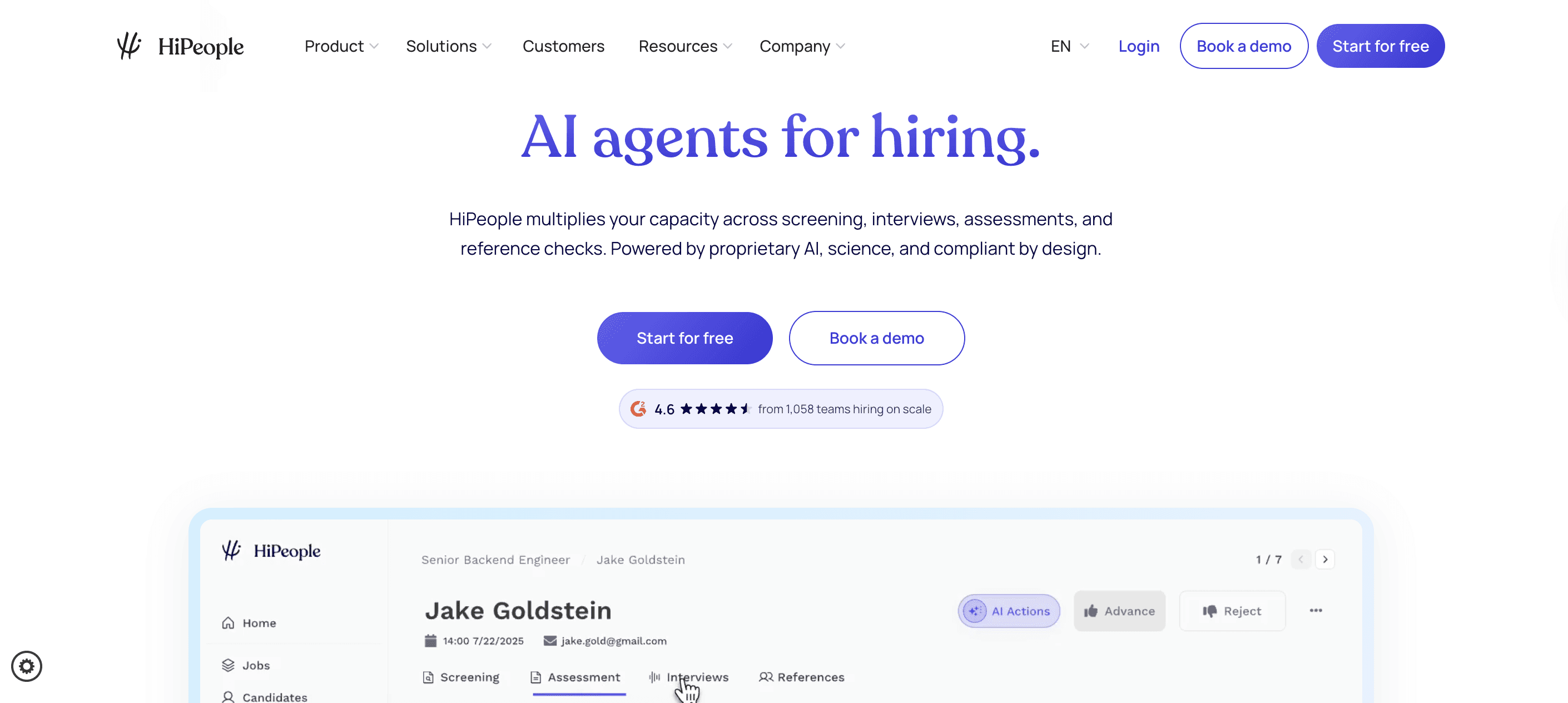
HiPeople was founded in 2019 by Jakob Gillmann (ex-Peakon, Optimizely) and Sebastian Schüller (ex-Google growth strategy). The platform positions itself as a unified AI hiring suite that automates up to 90% of the manual screening and validation work in talent acquisition. It's backed by Moonfire Ventures, Cherry Ventures, and Capnamic, with a $2.7 million capital injection in early 2026 from Mediahuis Ventures.
The architecture splits into four modules. First, AI Resume Screening that parses job descriptions and scores inbound applications against role-specific benchmarks instantly, claiming to cut screening time by 95%. Second, a skills assessment module with a test library of 400+ validated tests spanning technical competency, soft skills, cognitive ability, personality traits, and cultural fit. Third, AI Screening Calls that conduct conversational interviews in 113 languages around the clock. Fourth, automated reference checks with fraud detection and intelligent follow-up questions, completing in roughly 25 hours.
The team is roughly 20-30 employees. User reviews on G2 rate the platform 4.9/5 for ease of use and 4.8/5 for functionality. Reviewers praise the validation module especially, calling it the strongest piece of the suite. The critiques tend to focus on reporting customization and mobile experience for applicants.
Worth noting: HiPeople uses a credit-based consumption model on top of its subscription tiers. Every AI action, from resume screens (10 credits) to validation requests (600 credits) to long AI interviews (400 credits), eats into your allotment. The free plan includes 5,000 credits. That sounds generous until you realize a single validation request burns 600 of them. For data-driven organizations running volume recruitment, the credit math gets complicated fast.
HiPeople was founded in 2019 by Jakob Gillmann (ex-Peakon, Optimizely) and Sebastian Schüller (ex-Google growth strategy). The platform positions itself as a unified AI hiring suite that automates up to 90% of the manual screening and validation work in talent acquisition. It's backed by Moonfire Ventures, Cherry Ventures, and Capnamic, with a $2.7 million capital injection in early 2026 from Mediahuis Ventures.
The architecture splits into four modules. First, AI Resume Screening that parses job descriptions and scores inbound applications against role-specific benchmarks instantly, claiming to cut screening time by 95%. Second, a skills assessment module with a test library of 400+ validated tests spanning technical competency, soft skills, cognitive ability, personality traits, and cultural fit. Third, AI Screening Calls that conduct conversational interviews in 113 languages around the clock. Fourth, automated reference checks with fraud detection and intelligent follow-up questions, completing in roughly 25 hours.
The team is roughly 20-30 employees. User reviews on G2 rate the platform 4.9/5 for ease of use and 4.8/5 for functionality. Reviewers praise the validation module especially, calling it the strongest piece of the suite. The critiques tend to focus on reporting customization and mobile experience for applicants.
Worth noting: HiPeople uses a credit-based consumption model on top of its subscription tiers. Every AI action, from resume screens (10 credits) to validation requests (600 credits) to long AI interviews (400 credits), eats into your allotment. The free plan includes 5,000 credits. That sounds generous until you realize a single validation request burns 600 of them. For data-driven organizations running volume recruitment, the credit math gets complicated fast.
HiPeople was founded in 2019 by Jakob Gillmann (ex-Peakon, Optimizely) and Sebastian Schüller (ex-Google growth strategy). The platform positions itself as a unified AI hiring suite that automates up to 90% of the manual screening and validation work in talent acquisition. It's backed by Moonfire Ventures, Cherry Ventures, and Capnamic, with a $2.7 million capital injection in early 2026 from Mediahuis Ventures.
The architecture splits into four modules. First, AI Resume Screening that parses job descriptions and scores inbound applications against role-specific benchmarks instantly, claiming to cut screening time by 95%. Second, a skills assessment module with a test library of 400+ validated tests spanning technical competency, soft skills, cognitive ability, personality traits, and cultural fit. Third, AI Screening Calls that conduct conversational interviews in 113 languages around the clock. Fourth, automated reference checks with fraud detection and intelligent follow-up questions, completing in roughly 25 hours.
The team is roughly 20-30 employees. User reviews on G2 rate the platform 4.9/5 for ease of use and 4.8/5 for functionality. Reviewers praise the validation module especially, calling it the strongest piece of the suite. The critiques tend to focus on reporting customization and mobile experience for applicants.
Worth noting: HiPeople uses a credit-based consumption model on top of its subscription tiers. Every AI action, from resume screens (10 credits) to validation requests (600 credits) to long AI interviews (400 credits), eats into your allotment. The free plan includes 5,000 credits. That sounds generous until you realize a single validation request burns 600 of them. For data-driven organizations running volume recruitment, the credit math gets complicated fast.
What Is Bryq?
What Is Bryq?

Bryq is a talent intelligence platform built on I-O psychology (industrial-organizational psychology, the science of predicting job performance) and a belief that you shouldn't need four separate modules to understand whether someone will succeed in a role. The Bryq assessment measures cognitive ability, personality traits, role-specific technical skills, and AI fluency in one integrated session. One assessment. One science-backed profile that captures every dimension of fit.
The AI engine builds an Ideal Candidate Profile for each role based on job descriptions, job requirements, and the specific competencies the position demands. It scores every applicant against that profile, producing a ranked shortlist with composite fit scores. Hiring managers and talent acquisition teams get a clear picture of who's worth interviewing, not a pile of separate test results from different modules to reconcile by hand. That streamlines the hiring process and cuts decision-making time substantially.
The AI Fluency Assessment is where Bryq pulls ahead of nearly every competitor. It measures how candidates actually work with AI in realistic scenarios. Tool-agnostic. Role-universal. Built on six peer-reviewed research frameworks including UNESCO, SFIA, and OECD. Five scored dimensions, 0 to 100, no pass/fail binary. Takes roughly 15 minutes. It's included in your plan, not an add-on.
Proof points from the customer base: 80% reduction in screening time, 3x improvement in quality of hire, 47% lower attrition. The Bryq assessment is grounded in I-O psychology principles and validated for predictive validity with no adverse impact across demographics. The candidate experience skews positive because the format feels like solving real-world problems rather than sitting through a personality traits battery.
Bryq is a talent intelligence platform built on I-O psychology (industrial-organizational psychology, the science of predicting job performance) and a belief that you shouldn't need four separate modules to understand whether someone will succeed in a role. The Bryq assessment measures cognitive ability, personality traits, role-specific technical skills, and AI fluency in one integrated session. One assessment. One science-backed profile that captures every dimension of fit.
The AI engine builds an Ideal Candidate Profile for each role based on job descriptions, job requirements, and the specific competencies the position demands. It scores every applicant against that profile, producing a ranked shortlist with composite fit scores. Hiring managers and talent acquisition teams get a clear picture of who's worth interviewing, not a pile of separate test results from different modules to reconcile by hand. That streamlines the hiring process and cuts decision-making time substantially.
The AI Fluency Assessment is where Bryq pulls ahead of nearly every competitor. It measures how candidates actually work with AI in realistic scenarios. Tool-agnostic. Role-universal. Built on six peer-reviewed research frameworks including UNESCO, SFIA, and OECD. Five scored dimensions, 0 to 100, no pass/fail binary. Takes roughly 15 minutes. It's included in your plan, not an add-on.
Proof points from the customer base: 80% reduction in screening time, 3x improvement in quality of hire, 47% lower attrition. The Bryq assessment is grounded in I-O psychology principles and validated for predictive validity with no adverse impact across demographics. The candidate experience skews positive because the format feels like solving real-world problems rather than sitting through a personality traits battery.
Bryq is a talent intelligence platform built on I-O psychology (industrial-organizational psychology, the science of predicting job performance) and a belief that you shouldn't need four separate modules to understand whether someone will succeed in a role. The Bryq assessment measures cognitive ability, personality traits, role-specific technical skills, and AI fluency in one integrated session. One assessment. One science-backed profile that captures every dimension of fit.
The AI engine builds an Ideal Candidate Profile for each role based on job descriptions, job requirements, and the specific competencies the position demands. It scores every applicant against that profile, producing a ranked shortlist with composite fit scores. Hiring managers and talent acquisition teams get a clear picture of who's worth interviewing, not a pile of separate test results from different modules to reconcile by hand. That streamlines the hiring process and cuts decision-making time substantially.
The AI Fluency Assessment is where Bryq pulls ahead of nearly every competitor. It measures how candidates actually work with AI in realistic scenarios. Tool-agnostic. Role-universal. Built on six peer-reviewed research frameworks including UNESCO, SFIA, and OECD. Five scored dimensions, 0 to 100, no pass/fail binary. Takes roughly 15 minutes. It's included in your plan, not an add-on.
Proof points from the customer base: 80% reduction in screening time, 3x improvement in quality of hire, 47% lower attrition. The Bryq assessment is grounded in I-O psychology principles and validated for predictive validity with no adverse impact across demographics. The candidate experience skews positive because the format feels like solving real-world problems rather than sitting through a personality traits battery.
What HiPeople Measures vs What Bryq Measures
What HiPeople Measures vs What Bryq Measures
HiPeople gives you breadth. A library of 400+ assessments with 1,000+ job-specific templates. You can mix cognitive assessments, personality tests, skills assessment modules, and video interview questions into custom evaluation sequences. The platform calls this "People Science," and the library is genuinely extensive.
The tradeoff is fragmentation. When you assemble a candidate assessment from separate tests, you're left interpreting multiple disconnected scores. A candidate might score well on a personality assessment but average on cognitive abilities, and the platform doesn't automatically reconcile those signals into a unified prediction of fit. The hiring team has to do that synthesis, which reintroduces the subjective decision-making that data-driven hiring was supposed to eliminate.
The Bryq assessment takes the opposite approach. One integrated evaluation. Five dimensions measured together. The AI builds a talent profile that predicts fit as a whole, not in fragments. For recruiters tired of stitching together scores from three or four separate modules, that integration isn't a minor convenience. It's the whole point.
HiPeople gives you breadth. A library of 400+ assessments with 1,000+ job-specific templates. You can mix cognitive assessments, personality tests, skills assessment modules, and video interview questions into custom evaluation sequences. The platform calls this "People Science," and the library is genuinely extensive.
The tradeoff is fragmentation. When you assemble a candidate assessment from separate tests, you're left interpreting multiple disconnected scores. A candidate might score well on a personality assessment but average on cognitive abilities, and the platform doesn't automatically reconcile those signals into a unified prediction of fit. The hiring team has to do that synthesis, which reintroduces the subjective decision-making that data-driven hiring was supposed to eliminate.
The Bryq assessment takes the opposite approach. One integrated evaluation. Five dimensions measured together. The AI builds a talent profile that predicts fit as a whole, not in fragments. For recruiters tired of stitching together scores from three or four separate modules, that integration isn't a minor convenience. It's the whole point.
HiPeople gives you breadth. A library of 400+ assessments with 1,000+ job-specific templates. You can mix cognitive assessments, personality tests, skills assessment modules, and video interview questions into custom evaluation sequences. The platform calls this "People Science," and the library is genuinely extensive.
The tradeoff is fragmentation. When you assemble a candidate assessment from separate tests, you're left interpreting multiple disconnected scores. A candidate might score well on a personality assessment but average on cognitive abilities, and the platform doesn't automatically reconcile those signals into a unified prediction of fit. The hiring team has to do that synthesis, which reintroduces the subjective decision-making that data-driven hiring was supposed to eliminate.
The Bryq assessment takes the opposite approach. One integrated evaluation. Five dimensions measured together. The AI builds a talent profile that predicts fit as a whole, not in fragments. For recruiters tired of stitching together scores from three or four separate modules, that integration isn't a minor convenience. It's the whole point.
AI Fluency: Integrated vs Not Measured
AI Fluency: Integrated vs Not Measured
75% of knowledge workers already use AI at work. Most organizations can't tell who's using it well and who's just pasting prompts into a chatbot. For talent decisions in 2026, that's a blind spot you can't afford.
HiPeople doesn't measure AI fluency. The platform uses AI to power its screening and interview tools, but it doesn't assess whether candidates can work effectively with AI on the job. That's AI as infrastructure, not as a hiring signal.
Bryq's AI Fluency Assessment fills that gap. Scenario-based. Tool-agnostic. Grounded in six peer-reviewed frameworks. Five scored dimensions covering AI task strategy, prompting, critical evaluation, ethical use, and process integration. It's included in every Bryq plan. For CHROs building skills-based hiring strategies, it measures what no amount of aptitude tests or personality tests can tell you: whether this person will make AI work for them on the job.
75% of knowledge workers already use AI at work. Most organizations can't tell who's using it well and who's just pasting prompts into a chatbot. For talent decisions in 2026, that's a blind spot you can't afford.
HiPeople doesn't measure AI fluency. The platform uses AI to power its screening and interview tools, but it doesn't assess whether candidates can work effectively with AI on the job. That's AI as infrastructure, not as a hiring signal.
Bryq's AI Fluency Assessment fills that gap. Scenario-based. Tool-agnostic. Grounded in six peer-reviewed frameworks. Five scored dimensions covering AI task strategy, prompting, critical evaluation, ethical use, and process integration. It's included in every Bryq plan. For CHROs building skills-based hiring strategies, it measures what no amount of aptitude tests or personality tests can tell you: whether this person will make AI work for them on the job.
75% of knowledge workers already use AI at work. Most organizations can't tell who's using it well and who's just pasting prompts into a chatbot. For talent decisions in 2026, that's a blind spot you can't afford.
HiPeople doesn't measure AI fluency. The platform uses AI to power its screening and interview tools, but it doesn't assess whether candidates can work effectively with AI on the job. That's AI as infrastructure, not as a hiring signal.
Bryq's AI Fluency Assessment fills that gap. Scenario-based. Tool-agnostic. Grounded in six peer-reviewed frameworks. Five scored dimensions covering AI task strategy, prompting, critical evaluation, ethical use, and process integration. It's included in every Bryq plan. For CHROs building skills-based hiring strategies, it measures what no amount of aptitude tests or personality tests can tell you: whether this person will make AI work for them on the job.
Reference Checks: HiPeople's Strength
Reference Checks: HiPeople's Strength
Credit where it's due. Automated validation is HiPeople's standout module. The platform automates the entire process: collecting feedback from former managers, peers, and direct reports, analyzing responses with AI, flagging inconsistencies with fraud detection, and completing the cycle in about 25 hours. The "Intelligent Follow-up Questions" feature dynamically probes deeper based on initial referee input. For teams that treat post-interview validation as a critical step rather than a formality, this is genuinely useful.
Bryq doesn't compete on post-interview validation. The platform focuses on pre-employment assessment, the stage before onboarding begins: measuring cognitive abilities, behavioral traits, technical competency, and AI fluency to predict performance before the reference stage. If your workflow needs automated post-interview validation alongside your assessments, HiPeople offers that. But if your priority is predictive accuracy at the assessment stage itself, the Bryq assessment goes deeper on the measurement that matters most for hiring quality.
Credit where it's due. Automated validation is HiPeople's standout module. The platform automates the entire process: collecting feedback from former managers, peers, and direct reports, analyzing responses with AI, flagging inconsistencies with fraud detection, and completing the cycle in about 25 hours. The "Intelligent Follow-up Questions" feature dynamically probes deeper based on initial referee input. For teams that treat post-interview validation as a critical step rather than a formality, this is genuinely useful.
Bryq doesn't compete on post-interview validation. The platform focuses on pre-employment assessment, the stage before onboarding begins: measuring cognitive abilities, behavioral traits, technical competency, and AI fluency to predict performance before the reference stage. If your workflow needs automated post-interview validation alongside your assessments, HiPeople offers that. But if your priority is predictive accuracy at the assessment stage itself, the Bryq assessment goes deeper on the measurement that matters most for hiring quality.
Credit where it's due. Automated validation is HiPeople's standout module. The platform automates the entire process: collecting feedback from former managers, peers, and direct reports, analyzing responses with AI, flagging inconsistencies with fraud detection, and completing the cycle in about 25 hours. The "Intelligent Follow-up Questions" feature dynamically probes deeper based on initial referee input. For teams that treat post-interview validation as a critical step rather than a formality, this is genuinely useful.
Bryq doesn't compete on post-interview validation. The platform focuses on pre-employment assessment, the stage before onboarding begins: measuring cognitive abilities, behavioral traits, technical competency, and AI fluency to predict performance before the reference stage. If your workflow needs automated post-interview validation alongside your assessments, HiPeople offers that. But if your priority is predictive accuracy at the assessment stage itself, the Bryq assessment goes deeper on the measurement that matters most for hiring quality.
The Applicant Journey: Cohesion vs. Multiple Touchpoints
The Applicant Journey: Cohesion vs. Multiple Touchpoints
HiPeople candidates might encounter multiple touchpoints: a skills assessment, an AI screening call, a reference request to their former colleagues, and possibly a video interview. Each module is well-designed on its own. "Magic links" let candidates jump into interviews without creating accounts. But the cumulative experience is a multi-step process that asks more of the candidate's time and patience than a single evaluation would.
The Bryq assessment takes roughly 15 minutes. One cohesive session covering cognitive, behavioral, technical, and AI proficiency dimensions. No proctoring. No surveillance. Structured, scenario-based, and responsive across devices. Candidates report that it feels like solving real problems rather than sitting through a test. For organizations competing for top talent in tight labor markets, the experience your evaluation creates is part of your employer brand. A shorter, more respectful process sends a signal about how you treat people.
HiPeople candidates might encounter multiple touchpoints: a skills assessment, an AI screening call, a reference request to their former colleagues, and possibly a video interview. Each module is well-designed on its own. "Magic links" let candidates jump into interviews without creating accounts. But the cumulative experience is a multi-step process that asks more of the candidate's time and patience than a single evaluation would.
The Bryq assessment takes roughly 15 minutes. One cohesive session covering cognitive, behavioral, technical, and AI proficiency dimensions. No proctoring. No surveillance. Structured, scenario-based, and responsive across devices. Candidates report that it feels like solving real problems rather than sitting through a test. For organizations competing for top talent in tight labor markets, the experience your evaluation creates is part of your employer brand. A shorter, more respectful process sends a signal about how you treat people.
HiPeople candidates might encounter multiple touchpoints: a skills assessment, an AI screening call, a reference request to their former colleagues, and possibly a video interview. Each module is well-designed on its own. "Magic links" let candidates jump into interviews without creating accounts. But the cumulative experience is a multi-step process that asks more of the candidate's time and patience than a single evaluation would.
The Bryq assessment takes roughly 15 minutes. One cohesive session covering cognitive, behavioral, technical, and AI proficiency dimensions. No proctoring. No surveillance. Structured, scenario-based, and responsive across devices. Candidates report that it feels like solving real problems rather than sitting through a test. For organizations competing for top talent in tight labor markets, the experience your evaluation creates is part of your employer brand. A shorter, more respectful process sends a signal about how you treat people.
Pricing: Flat Rate vs. Credits
Pricing: Flat Rate vs. Credits
HiPeople's cost structure has layers. Subscription tiers range from a free plan to Scale ($84/month) to custom Enterprise quotes. But the real cost lives in the credit system. Every AI-driven action consumes credits: 10 per resume screen, 75 for a short assessment, 150 for a long one, 600 for a reference check, 400 for a long AI interview. Avatar tests add 100 credits. Custom tests add 300. For data-driven organizations running volume recruitment, the credits stack up and the total cost becomes hard to predict.
Bryq's flat-rate subscription covers unlimited assessments. Your per-candidate cost drops as volume increases. Not the reverse. No credit tracking, no consumption surprises, no second-guessing which assessment tools to skip because they'll stretch the budget. For hiring managers and recruiters who need predictable costs, that transparency matters. Especially when the alternative requires a spreadsheet just to forecast monthly cost.
HiPeople's cost structure has layers. Subscription tiers range from a free plan to Scale ($84/month) to custom Enterprise quotes. But the real cost lives in the credit system. Every AI-driven action consumes credits: 10 per resume screen, 75 for a short assessment, 150 for a long one, 600 for a reference check, 400 for a long AI interview. Avatar tests add 100 credits. Custom tests add 300. For data-driven organizations running volume recruitment, the credits stack up and the total cost becomes hard to predict.
Bryq's flat-rate subscription covers unlimited assessments. Your per-candidate cost drops as volume increases. Not the reverse. No credit tracking, no consumption surprises, no second-guessing which assessment tools to skip because they'll stretch the budget. For hiring managers and recruiters who need predictable costs, that transparency matters. Especially when the alternative requires a spreadsheet just to forecast monthly cost.
HiPeople's cost structure has layers. Subscription tiers range from a free plan to Scale ($84/month) to custom Enterprise quotes. But the real cost lives in the credit system. Every AI-driven action consumes credits: 10 per resume screen, 75 for a short assessment, 150 for a long one, 600 for a reference check, 400 for a long AI interview. Avatar tests add 100 credits. Custom tests add 300. For data-driven organizations running volume recruitment, the credits stack up and the total cost becomes hard to predict.
Bryq's flat-rate subscription covers unlimited assessments. Your per-candidate cost drops as volume increases. Not the reverse. No credit tracking, no consumption surprises, no second-guessing which assessment tools to skip because they'll stretch the budget. For hiring managers and recruiters who need predictable costs, that transparency matters. Especially when the alternative requires a spreadsheet just to forecast monthly cost.
Assessment Science: Validated by I/O Psychologists
Assessment Science: Validated by I/O Psychologists
Both platforms take unconscious bias reduction seriously, but the depth differs. HiPeople uses de-identified data during initial screening stages and standardized evaluation criteria. The platform cites GDPR compliance, SOC 2 Type II certification, and alignment with the EU AI Act. Third-party bias audits are part of the process. The commitment is documented and real.
Bryq's approach to unconscious bias starts earlier, in the measurement design itself. By measuring actual cognitive abilities, behavioral dimensions, and hard skills rather than proxies like resume keywords or educational pedigree, the assessment removes the channels through which bias typically enters the hiring process. The assessments are validated by research psychologists for predictive validity with no adverse impact across demographics. Both approaches matter. The difference: one audits for bias after scoring; the other designs bias out of the scoring from the start.
Both platforms take unconscious bias reduction seriously, but the depth differs. HiPeople uses de-identified data during initial screening stages and standardized evaluation criteria. The platform cites GDPR compliance, SOC 2 Type II certification, and alignment with the EU AI Act. Third-party bias audits are part of the process. The commitment is documented and real.
Bryq's approach to unconscious bias starts earlier, in the measurement design itself. By measuring actual cognitive abilities, behavioral dimensions, and hard skills rather than proxies like resume keywords or educational pedigree, the assessment removes the channels through which bias typically enters the hiring process. The assessments are validated by research psychologists for predictive validity with no adverse impact across demographics. Both approaches matter. The difference: one audits for bias after scoring; the other designs bias out of the scoring from the start.
Both platforms take unconscious bias reduction seriously, but the depth differs. HiPeople uses de-identified data during initial screening stages and standardized evaluation criteria. The platform cites GDPR compliance, SOC 2 Type II certification, and alignment with the EU AI Act. Third-party bias audits are part of the process. The commitment is documented and real.
Bryq's approach to unconscious bias starts earlier, in the measurement design itself. By measuring actual cognitive abilities, behavioral dimensions, and hard skills rather than proxies like resume keywords or educational pedigree, the assessment removes the channels through which bias typically enters the hiring process. The assessments are validated by research psychologists for predictive validity with no adverse impact across demographics. Both approaches matter. The difference: one audits for bias after scoring; the other designs bias out of the scoring from the start.
ATS Integration Speed
ATS Integration Speed
HiPeople claims 43+ integrations, including Greenhouse, Lever, Workable, Recruitee, Ashby, and Slack. Enterprise customers get API access. The platform earned an interoperability score of 8.8 from reviewers, which is strong. Automated alerts push insights into existing productivity tools. For hiring teams that live inside their ATS, this breadth of integrations matters.
Bryq connects with 25+ application tracking systems, including Greenhouse, Lever, Workday, iCIMS, and custom systems via open API. Assessment triggers fire automatically when candidates reach specific pipeline stages. The connector count might be slightly smaller than HiPeople's, but the integrations that exist work inside your existing pipeline without adding friction. Both platforms support real-time data sync. For enterprise teams running complex hiring workflows across multiple ATS platforms, HiPeople's wider connector library is an advantage. For teams that use one of the major ATS platforms and want clean, reliable workflow automation, Bryq's integrations cover the ground.
HiPeople claims 43+ integrations, including Greenhouse, Lever, Workable, Recruitee, Ashby, and Slack. Enterprise customers get API access. The platform earned an interoperability score of 8.8 from reviewers, which is strong. Automated alerts push insights into existing productivity tools. For hiring teams that live inside their ATS, this breadth of integrations matters.
Bryq connects with 25+ application tracking systems, including Greenhouse, Lever, Workday, iCIMS, and custom systems via open API. Assessment triggers fire automatically when candidates reach specific pipeline stages. The connector count might be slightly smaller than HiPeople's, but the integrations that exist work inside your existing pipeline without adding friction. Both platforms support real-time data sync. For enterprise teams running complex hiring workflows across multiple ATS platforms, HiPeople's wider connector library is an advantage. For teams that use one of the major ATS platforms and want clean, reliable workflow automation, Bryq's integrations cover the ground.
HiPeople claims 43+ integrations, including Greenhouse, Lever, Workable, Recruitee, Ashby, and Slack. Enterprise customers get API access. The platform earned an interoperability score of 8.8 from reviewers, which is strong. Automated alerts push insights into existing productivity tools. For hiring teams that live inside their ATS, this breadth of integrations matters.
Bryq connects with 25+ application tracking systems, including Greenhouse, Lever, Workday, iCIMS, and custom systems via open API. Assessment triggers fire automatically when candidates reach specific pipeline stages. The connector count might be slightly smaller than HiPeople's, but the integrations that exist work inside your existing pipeline without adding friction. Both platforms support real-time data sync. For enterprise teams running complex hiring workflows across multiple ATS platforms, HiPeople's wider connector library is an advantage. For teams that use one of the major ATS platforms and want clean, reliable workflow automation, Bryq's integrations cover the ground.
Who Should Choose Bryq
Who Should Choose Bryq
Bryq fits best when the goal is quality of hire, not just automation volume. Mid-market companies, enterprises, and recruiters who've felt the cost of early turnover tend to find the integrated assessment approach more useful than a multi-module methodology that fragments the candidate assessment across separate tools. It also makes sense when your organization wants data-driven decisions without the complexity of managing a credit-based consumption system for every action in the funnel.
If you're building a skills-based hiring strategy that includes AI readiness, Bryq is the only talent assessment platform in this comparison with a validated AI Fluency Assessment grounded in peer-reviewed research. That matters if your board is asking about AI adoption and your hiring process has no way to measure it. For talent decisions that affect long-term fit and retention, the integrated talent profile gives you everything in one place.
Bryq fits best when the goal is quality of hire, not just automation volume. Mid-market companies, enterprises, and recruiters who've felt the cost of early turnover tend to find the integrated assessment approach more useful than a multi-module methodology that fragments the candidate assessment across separate tools. It also makes sense when your organization wants data-driven decisions without the complexity of managing a credit-based consumption system for every action in the funnel.
If you're building a skills-based hiring strategy that includes AI readiness, Bryq is the only talent assessment platform in this comparison with a validated AI Fluency Assessment grounded in peer-reviewed research. That matters if your board is asking about AI adoption and your hiring process has no way to measure it. For talent decisions that affect long-term fit and retention, the integrated talent profile gives you everything in one place.
Bryq fits best when the goal is quality of hire, not just automation volume. Mid-market companies, enterprises, and recruiters who've felt the cost of early turnover tend to find the integrated assessment approach more useful than a multi-module methodology that fragments the candidate assessment across separate tools. It also makes sense when your organization wants data-driven decisions without the complexity of managing a credit-based consumption system for every action in the funnel.
If you're building a skills-based hiring strategy that includes AI readiness, Bryq is the only talent assessment platform in this comparison with a validated AI Fluency Assessment grounded in peer-reviewed research. That matters if your board is asking about AI adoption and your hiring process has no way to measure it. For talent decisions that affect long-term fit and retention, the integrated talent profile gives you everything in one place.
Who Should Choose HiPeople
Who Should Choose HiPeople
HiPeople works best for organizations that want a single vendor covering the entire screening-to-reference pipeline. If automated post-interview validation is a major part of your process, HiPeople's module is genuinely strong. The AI screening calls in 113 languages make it a compelling pick for global organizations with multilingual hiring needs, and the 400+ test collection means you won't outgrow it quickly. And the collection of 400+ assessments gives you personality tests, aptitude tests, and cognitive assessments for almost any role imaginable.
Just go in with clear expectations about the credit system. High-volume operations running multiple modules simultaneously can burn through credits quickly. Budget for it. The breadth is impressive, though the platform doesn't cover internal mobility or produce a single integrated prediction of candidate success the way an I-O psychology-grounded assessment does. You'll be synthesizing multiple data points across modules, which some teams prefer because it allows more customization.
HiPeople works best for organizations that want a single vendor covering the entire screening-to-reference pipeline. If automated post-interview validation is a major part of your process, HiPeople's module is genuinely strong. The AI screening calls in 113 languages make it a compelling pick for global organizations with multilingual hiring needs, and the 400+ test collection means you won't outgrow it quickly. And the collection of 400+ assessments gives you personality tests, aptitude tests, and cognitive assessments for almost any role imaginable.
Just go in with clear expectations about the credit system. High-volume operations running multiple modules simultaneously can burn through credits quickly. Budget for it. The breadth is impressive, though the platform doesn't cover internal mobility or produce a single integrated prediction of candidate success the way an I-O psychology-grounded assessment does. You'll be synthesizing multiple data points across modules, which some teams prefer because it allows more customization.
HiPeople works best for organizations that want a single vendor covering the entire screening-to-reference pipeline. If automated post-interview validation is a major part of your process, HiPeople's module is genuinely strong. The AI screening calls in 113 languages make it a compelling pick for global organizations with multilingual hiring needs, and the 400+ test collection means you won't outgrow it quickly. And the collection of 400+ assessments gives you personality tests, aptitude tests, and cognitive assessments for almost any role imaginable.
Just go in with clear expectations about the credit system. High-volume operations running multiple modules simultaneously can burn through credits quickly. Budget for it. The breadth is impressive, though the platform doesn't cover internal mobility or produce a single integrated prediction of candidate success the way an I-O psychology-grounded assessment does. You'll be synthesizing multiple data points across modules, which some teams prefer because it allows more customization.
How Bryq Compares to Other Assessment Tools
How Bryq Compares to Other Assessment Tools
If you're doing a broader market evaluation, it's worth looking at how these tools compare to others in the assessment space. TestGorilla and Testlify take a test-library approach with credit-based model. The Predictive Index focuses on behavioral assessment. Maki People uses autonomous AI agents. Cangrade builds custom predictive models. Each has a different theory about how you identify best talent and improve hiring outcomes. And if you're evaluating the role of AI in hiring more broadly, LinkedIn's talent acquisition research tracks the latest shifts.
If you're doing a broader market evaluation, it's worth looking at how these tools compare to others in the assessment space. TestGorilla and Testlify take a test-library approach with credit-based model. The Predictive Index focuses on behavioral assessment. Maki People uses autonomous AI agents. Cangrade builds custom predictive models. Each has a different theory about how you identify best talent and improve hiring outcomes. And if you're evaluating the role of AI in hiring more broadly, LinkedIn's talent acquisition research tracks the latest shifts.
If you're doing a broader market evaluation, it's worth looking at how these tools compare to others in the assessment space. TestGorilla and Testlify take a test-library approach with credit-based model. The Predictive Index focuses on behavioral assessment. Maki People uses autonomous AI agents. Cangrade builds custom predictive models. Each has a different theory about how you identify best talent and improve hiring outcomes. And if you're evaluating the role of AI in hiring more broadly, LinkedIn's talent acquisition research tracks the latest shifts.
One Profile. Five Dimensions. No Credit Math.
One Profile. Five Dimensions. No Credit Math.
Most hiring platforms still can't measure AI fluency. Bryq can, and it works from day one without assembling separate test modules or tracking credit consumption. If you want to see what an integrated, AI-powered talent profile looks like for your actual roles, Bryq's team can walk you through a live assessment.
Most hiring platforms still can't measure AI fluency. Bryq can, and it works from day one without assembling separate test modules or tracking credit consumption. If you want to see what an integrated, AI-powered talent profile looks like for your actual roles, Bryq's team can walk you through a live assessment.
Most hiring platforms still can't measure AI fluency. Bryq can, and it works from day one without assembling separate test modules or tracking credit consumption. If you want to see what an integrated, AI-powered talent profile looks like for your actual roles, Bryq's team can walk you through a live assessment.
Measurable impact on hiring outcomes
2x
Faster hiring
47%
Lower attrition
3x
Quality of hire
FAQ
Find answers to the most frequently asked questions about Bryq
Ready to see Bryq in action?
Start hiring based on real data.
Ready to see Bryq in action?
Start hiring based on
real data.
Ready to see Bryq in action?
Start hiring based on real data.
Join our community!
Get the latest HR trends & tips delivered to your inbox.
Join our community!
Get the latest HR trends & tips delivered to your inbox.
Join our community!
Get the latest HR trends & tips delivered to your inbox.
Resources
GDPR
COMPLIANT
AICPA SOC
CERTIFIED
Resources


Resources
GDPR
COMPLIANT
AICPA SOC
CERTIFIED
120