
Bryq vs. Cangrade
Bryq vs. Cangrade: Which Platform Predicts Job Performance Better?
Updated July 2026.


Bryq vs. Cangrade
Bryq vs. Cangrade: Which Platform Predicts Job Performance Better?
Updated July 2026.
Bryq vs. Cangrade
Bryq vs. Cangrade: Which Platform Predicts Job Performance Better?
Updated July 2026.
Cangrade review and comparison: what to know before you choose
Cangrade review and comparison: what to know before you choose
Cangrade builds a custom “Success Model” per client, trained on that organization's own performance data, to predict who will succeed and stay. Bryq builds one integrated candidate profile, cognitive ability, behavioral traits, and hard skills including AI fluency, validated by I/O psychologists with published methodology. The core difference: Cangrade's prediction is only as strong as the historical data you feed it, and most fast-growing teams don't have that data yet. Bryq's Ideal Candidate Profile works from the role requirements alone, from day one. Teams using Bryq see a 3x improvement in quality of hire, 47% lower attrition, and 2x faster hiring. Here is an honest side-by-side.
Cangrade builds a custom “Success Model” per client, trained on that organization's own performance data, to predict who will succeed and stay. Bryq builds one integrated candidate profile, cognitive ability, behavioral traits, and hard skills including AI fluency, validated by I/O psychologists with published methodology. The core difference: Cangrade's prediction is only as strong as the historical data you feed it, and most fast-growing teams don't have that data yet. Bryq's Ideal Candidate Profile works from the role requirements alone, from day one. Teams using Bryq see a 3x improvement in quality of hire, 47% lower attrition, and 2x faster hiring. Here is an honest side-by-side.
Cangrade builds a custom “Success Model” per client, trained on that organization's own performance data, to predict who will succeed and stay. Bryq builds one integrated candidate profile, cognitive ability, behavioral traits, and hard skills including AI fluency, validated by I/O psychologists with published methodology. The core difference: Cangrade's prediction is only as strong as the historical data you feed it, and most fast-growing teams don't have that data yet. Bryq's Ideal Candidate Profile works from the role requirements alone, from day one. Teams using Bryq see a 3x improvement in quality of hire, 47% lower attrition, and 2x faster hiring. Here is an honest side-by-side.
At a glance: Bryq vs Cangrade
At a glance: Bryq vs Cangrade
Bryq
Bryq
Bryq
Cangrade
Cangrade
Cangrade
Core approach
Core approach
What it
measures
Cognitive ability + behavioral traits + hard skills + AI fluency in one integrated assessment
Cognitive ability + behavioral traits + hard skills + AI fluency in one integrated assessment
Cognitive ability + behavioral traits + hard skills + AI fluency in one integrated assessment
50+ behavioral and cognitive traits via custom Success Models built on client performance data
50+ behavioral and cognitive traits via custom Success Models built on client performance data
50+ behavioral and cognitive traits via custom Success Models built on client performance data
AI fluency
AI fluency
Core
approach
AI-powered Ideal Candidate Profile per role; every applicant scored on predicted fit
AI-powered Ideal Candidate Profile per role; every applicant scored on predicted fit
AI-powered Ideal Candidate Profile per role; every applicant scored on predicted fit
Custom predictive models per role + Jules AI copilot for screening and job descriptions
Custom predictive models per role + Jules AI copilot for screening and job descriptions
Custom predictive models per role + Jules AI copilot for screening and job descriptions
Candidate experience
Candidate experience
AI
proficiency
Built-in: ~15 min, scenario-based, 5 scored dimensions, 6 peer-reviewed frameworks
Built-in: ~15 min, scenario-based, 5 scored dimensions, 6 peer-reviewed frameworks
Built-in: ~15 min, scenario-based, 5 scored dimensions, 6 peer-reviewed frameworks
No dedicated AI fluency module
No dedicated AI fluency module
No dedicated AI fluency module
Pricing
Pricing
Candidate
experience
One cohesive assessment; structured, no proctoring or surveillance
One cohesive assessment; structured, no proctoring or surveillance
One cohesive assessment; structured, no proctoring or surveillance
14-minute assessment with instant Strength Reports; optional video interviewing
14-minute assessment with instant Strength Reports; optional video interviewing
14-minute assessment with instant Strength Reports; optional video interviewing
Measurable result
Measurable result
Measurable result
3x quality of hire, 47% lower attrition, 2x faster hiring
3x quality of hire, 47% lower attrition, 2x faster hiring
3x quality of hire, 47% lower attrition, 2x faster hiring
(varies)
(varies)
(varies)
What Is Cangrade?
What Is Cangrade?
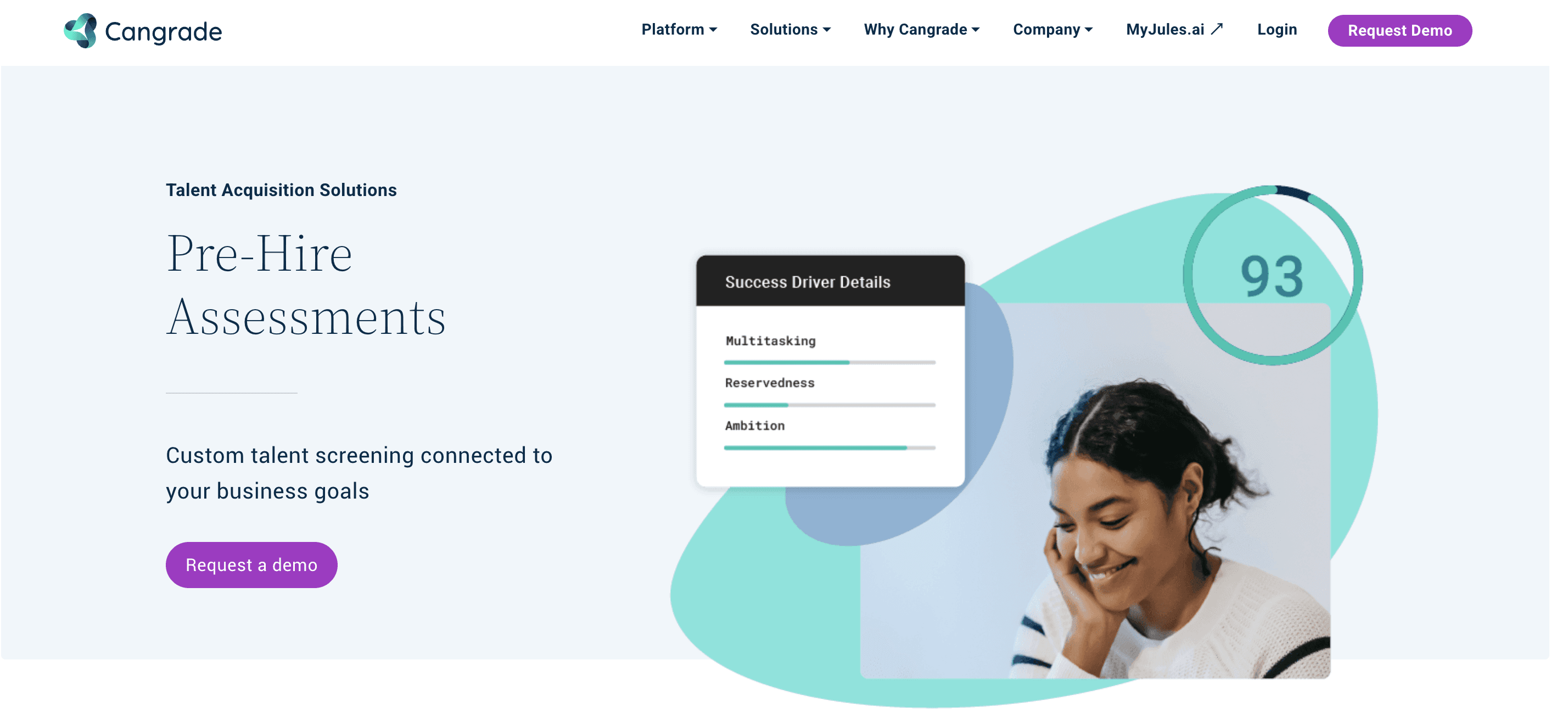
Cangrade launched in 2014 after three years of research at the intersection of I-O psychology and machine learning. The founding team, which includes a Harvard psychology researcher, built the platform around one idea: if you model what success looks like inside a specific organization, you can predict which candidates will perform and stay. Those are the key features of the "Success Model" methodology. It's a customizable approach to pre-hire assessments that uses an organization's own performance data to build benchmarking models for each role.
The assessment itself takes about 14 minutes and evaluates 50+ psychometric traits. The company reports that its predictions are 10x more accurate than traditional hiring methods, a claim based on internal case studies rather than independent research. The platform also provides "Explainable AI" scoring, meaning recruiters can see why a candidate received a particular score, which matters for compliance in human resources.
In 2024, the company added Jules, an AI copilot that automates candidate screening, generates customizable skills assessments from job descriptions, and supports recorded and live interviews. Jules can also create structured interview plans and job postings from role requirements. It's a significant expansion of the platform's function beyond pure psychometrics into ai-driven workflow efficiency.
Worth knowing: The team is roughly 14 employees. That's a lean team for an enterprise recruiting software provider. User reviews on G2 and Capterra praise the customer support and the science. The critiques tend to focus on integration complexity, reporting limitations, and a learning curve around interpreting psychometric scores. For teams evaluating providers, the small team size is a data point worth considering, especially if you need fast iteration or deep customization.
The talent management suite extends beyond hiring into longevity forecasts, onboarding plans, and an internal talent pipeline marketplace powered by a patented multi-role scoring system. The company has also filed a trade secret lawsuit against Synopsys (2025), which is still in litigation. For enterprise buyers doing due diligence, the legal situation is worth a conversation with their sales team.
Cangrade launched in 2014 after three years of research at the intersection of I-O psychology and machine learning. The founding team, which includes a Harvard psychology researcher, built the platform around one idea: if you model what success looks like inside a specific organization, you can predict which candidates will perform and stay. Those are the key features of the "Success Model" methodology. It's a customizable approach to pre-hire assessments that uses an organization's own performance data to build benchmarking models for each role.
The assessment itself takes about 14 minutes and evaluates 50+ psychometric traits. The company reports that its predictions are 10x more accurate than traditional hiring methods, a claim based on internal case studies rather than independent research. The platform also provides "Explainable AI" scoring, meaning recruiters can see why a candidate received a particular score, which matters for compliance in human resources.
In 2024, the company added Jules, an AI copilot that automates candidate screening, generates customizable skills assessments from job descriptions, and supports recorded and live interviews. Jules can also create structured interview plans and job postings from role requirements. It's a significant expansion of the platform's function beyond pure psychometrics into ai-driven workflow efficiency.
Worth knowing: The team is roughly 14 employees. That's a lean team for an enterprise recruiting software provider. User reviews on G2 and Capterra praise the customer support and the science. The critiques tend to focus on integration complexity, reporting limitations, and a learning curve around interpreting psychometric scores. For teams evaluating providers, the small team size is a data point worth considering, especially if you need fast iteration or deep customization.
The talent management suite extends beyond hiring into longevity forecasts, onboarding plans, and an internal talent pipeline marketplace powered by a patented multi-role scoring system. The company has also filed a trade secret lawsuit against Synopsys (2025), which is still in litigation. For enterprise buyers doing due diligence, the legal situation is worth a conversation with their sales team.
Cangrade launched in 2014 after three years of research at the intersection of I-O psychology and machine learning. The founding team, which includes a Harvard psychology researcher, built the platform around one idea: if you model what success looks like inside a specific organization, you can predict which candidates will perform and stay. Those are the key features of the "Success Model" methodology. It's a customizable approach to pre-hire assessments that uses an organization's own performance data to build benchmarking models for each role.
The assessment itself takes about 14 minutes and evaluates 50+ psychometric traits. The company reports that its predictions are 10x more accurate than traditional hiring methods, a claim based on internal case studies rather than independent research. The platform also provides "Explainable AI" scoring, meaning recruiters can see why a candidate received a particular score, which matters for compliance in human resources.
In 2024, the company added Jules, an AI copilot that automates candidate screening, generates customizable skills assessments from job descriptions, and supports recorded and live interviews. Jules can also create structured interview plans and job postings from role requirements. It's a significant expansion of the platform's function beyond pure psychometrics into ai-driven workflow efficiency.
Worth knowing: The team is roughly 14 employees. That's a lean team for an enterprise recruiting software provider. User reviews on G2 and Capterra praise the customer support and the science. The critiques tend to focus on integration complexity, reporting limitations, and a learning curve around interpreting psychometric scores. For teams evaluating providers, the small team size is a data point worth considering, especially if you need fast iteration or deep customization.
The talent management suite extends beyond hiring into longevity forecasts, onboarding plans, and an internal talent pipeline marketplace powered by a patented multi-role scoring system. The company has also filed a trade secret lawsuit against Synopsys (2025), which is still in litigation. For enterprise buyers doing due diligence, the legal situation is worth a conversation with their sales team.
What Is Bryq?
What Is Bryq?

Bryq is a talent intelligence platform built around a simple premise: you shouldn't need a stack of disconnected assessment tools to understand whether someone will succeed in a role. The platform measures cognitive ability, personality traits, role-specific hard skills, and AI proficiency in a single integrated assessment. One session. One science-backed candidate profile that captures every dimension of fit.
The AI engine starts by building an Ideal Candidate Profile for each role. It evaluates the job descriptions and requirements, then scores every applicant against that profile. Hiring managers and talent acquisition teams get a ranked shortlist with composite fit scores, not separate test results to piece together by hand. That means fewer wrong-fit interviews, faster hiring decisions, and a way to streamline the hiring funnel so you're spending time with qualified candidates who are actually worth talking to.
The AI Fluency Assessment is where Bryq pulls ahead of nearly every competitor. It measures how candidates actually work with AI in realistic, real-world scenarios. Tool-agnostic. Role-universal. Built on six peer-reviewed research frameworks including UNESCO, SFIA, and OECD. Five scored dimensions, 0 to 100 per dimension, no pass/fail binary. Takes roughly 15 minutes. It's included in all plans, not sold as an add-on.
Proof points from the customer base: 3x improvement in quality of hire, 47% lower attrition. Those numbers track actual hiring outcomes. The assessments are grounded in I-O psychology principles and validated for predictive validity. The candidate experience skews positive because the format feels like solving real-world problems rather than sitting through a personality traits battery.
Bryq is a talent intelligence platform built around a simple premise: you shouldn't need a stack of disconnected assessment tools to understand whether someone will succeed in a role. The platform measures cognitive ability, personality traits, role-specific hard skills, and AI proficiency in a single integrated assessment. One session. One science-backed candidate profile that captures every dimension of fit.
The AI engine starts by building an Ideal Candidate Profile for each role. It evaluates the job descriptions and requirements, then scores every applicant against that profile. Hiring managers and talent acquisition teams get a ranked shortlist with composite fit scores, not separate test results to piece together by hand. That means fewer wrong-fit interviews, faster hiring decisions, and a way to streamline the hiring funnel so you're spending time with qualified candidates who are actually worth talking to.
The AI Fluency Assessment is where Bryq pulls ahead of nearly every competitor. It measures how candidates actually work with AI in realistic, real-world scenarios. Tool-agnostic. Role-universal. Built on six peer-reviewed research frameworks including UNESCO, SFIA, and OECD. Five scored dimensions, 0 to 100 per dimension, no pass/fail binary. Takes roughly 15 minutes. It's included in all plans, not sold as an add-on.
Proof points from the customer base: 3x improvement in quality of hire, 47% lower attrition. Those numbers track actual hiring outcomes. The assessments are grounded in I-O psychology principles and validated for predictive validity. The candidate experience skews positive because the format feels like solving real-world problems rather than sitting through a personality traits battery.
Bryq is a talent intelligence platform built around a simple premise: you shouldn't need a stack of disconnected assessment tools to understand whether someone will succeed in a role. The platform measures cognitive ability, personality traits, role-specific hard skills, and AI proficiency in a single integrated assessment. One session. One science-backed candidate profile that captures every dimension of fit.
The AI engine starts by building an Ideal Candidate Profile for each role. It evaluates the job descriptions and requirements, then scores every applicant against that profile. Hiring managers and talent acquisition teams get a ranked shortlist with composite fit scores, not separate test results to piece together by hand. That means fewer wrong-fit interviews, faster hiring decisions, and a way to streamline the hiring funnel so you're spending time with qualified candidates who are actually worth talking to.
The AI Fluency Assessment is where Bryq pulls ahead of nearly every competitor. It measures how candidates actually work with AI in realistic, real-world scenarios. Tool-agnostic. Role-universal. Built on six peer-reviewed research frameworks including UNESCO, SFIA, and OECD. Five scored dimensions, 0 to 100 per dimension, no pass/fail binary. Takes roughly 15 minutes. It's included in all plans, not sold as an add-on.
Proof points from the customer base: 3x improvement in quality of hire, 47% lower attrition. Those numbers track actual hiring outcomes. The assessments are grounded in I-O psychology principles and validated for predictive validity. The candidate experience skews positive because the format feels like solving real-world problems rather than sitting through a personality traits battery.
Custom models vs integrated profile
Custom models vs integrated profile
The central bet is that every organization is different, so every predictive model should be different. Feed it your performance data. It builds a Success Model specific to your company, and that pitch is compelling if you've got clean, deep historical data to train on.
But most organizations don't. Building a reliable custom model requires a meaningful sample of employees in the same role with consistent performance reviews. Startups don't have that. Neither do fast-growing teams or companies creating new positions. You're asking the system to predict success based on a sample that may not exist yet.
Bryq doesn't require your historical data to work. The AI builds the Ideal Candidate Profile from the role requirements and job descriptions, drawing on validated I-O psychology research rather than your internal benchmarking data. That means it works from day one, for any role, at any company. For organizations with strong performance data, it's a bonus input. For everyone else, it's a critical advantage that makes the recruitment process faster to launch and more consistent across your team.
The central bet is that every organization is different, so every predictive model should be different. Feed it your performance data. It builds a Success Model specific to your company, and that pitch is compelling if you've got clean, deep historical data to train on.
But most organizations don't. Building a reliable custom model requires a meaningful sample of employees in the same role with consistent performance reviews. Startups don't have that. Neither do fast-growing teams or companies creating new positions. You're asking the system to predict success based on a sample that may not exist yet.
Bryq doesn't require your historical data to work. The AI builds the Ideal Candidate Profile from the role requirements and job descriptions, drawing on validated I-O psychology research rather than your internal benchmarking data. That means it works from day one, for any role, at any company. For organizations with strong performance data, it's a bonus input. For everyone else, it's a critical advantage that makes the recruitment process faster to launch and more consistent across your team.
The central bet is that every organization is different, so every predictive model should be different. Feed it your performance data. It builds a Success Model specific to your company, and that pitch is compelling if you've got clean, deep historical data to train on.
But most organizations don't. Building a reliable custom model requires a meaningful sample of employees in the same role with consistent performance reviews. Startups don't have that. Neither do fast-growing teams or companies creating new positions. You're asking the system to predict success based on a sample that may not exist yet.
Bryq doesn't require your historical data to work. The AI builds the Ideal Candidate Profile from the role requirements and job descriptions, drawing on validated I-O psychology research rather than your internal benchmarking data. That means it works from day one, for any role, at any company. For organizations with strong performance data, it's a bonus input. For everyone else, it's a critical advantage that makes the recruitment process faster to launch and more consistent across your team.
AI Fluency: Built-In vs Not There
AI Fluency: Built-In vs Not There
75% of knowledge workers already use AI at work. Most organizations can't tell the difference between someone who uses AI as a force multiplier and someone who pastes everything into a chatbot and hits send. For decision-making about who to hire, that's a blind spot that grows wider every quarter.
Cangrade has no validated assessment for measuring whether candidates can work effectively with AI. Jules uses AI to power the platform's automation, but it doesn't measure the candidate's AI fluency. That's AI as infrastructure, not as a hiring signal.
The AI Fluency Assessment fills that gap. Scenario-based. Tool-agnostic. Grounded in six peer-reviewed frameworks. Five scored dimensions covering AI task strategy, prompting, critical evaluation, ethical use, and workflow integration. It's included in every plan. For hr professionals and CHROs building skills-based hiring strategies, it measures something no amount of pre-employment testing or standard scoring can tell you: whether this person will make AI work for them on the job.
75% of knowledge workers already use AI at work. Most organizations can't tell the difference between someone who uses AI as a force multiplier and someone who pastes everything into a chatbot and hits send. For decision-making about who to hire, that's a blind spot that grows wider every quarter.
Cangrade has no validated assessment for measuring whether candidates can work effectively with AI. Jules uses AI to power the platform's automation, but it doesn't measure the candidate's AI fluency. That's AI as infrastructure, not as a hiring signal.
The AI Fluency Assessment fills that gap. Scenario-based. Tool-agnostic. Grounded in six peer-reviewed frameworks. Five scored dimensions covering AI task strategy, prompting, critical evaluation, ethical use, and workflow integration. It's included in every plan. For hr professionals and CHROs building skills-based hiring strategies, it measures something no amount of pre-employment testing or standard scoring can tell you: whether this person will make AI work for them on the job.
75% of knowledge workers already use AI at work. Most organizations can't tell the difference between someone who uses AI as a force multiplier and someone who pastes everything into a chatbot and hits send. For decision-making about who to hire, that's a blind spot that grows wider every quarter.
Cangrade has no validated assessment for measuring whether candidates can work effectively with AI. Jules uses AI to power the platform's automation, but it doesn't measure the candidate's AI fluency. That's AI as infrastructure, not as a hiring signal.
The AI Fluency Assessment fills that gap. Scenario-based. Tool-agnostic. Grounded in six peer-reviewed frameworks. Five scored dimensions covering AI task strategy, prompting, critical evaluation, ethical use, and workflow integration. It's included in every plan. For hr professionals and CHROs building skills-based hiring strategies, it measures something no amount of pre-employment testing or standard scoring can tell you: whether this person will make AI work for them on the job.
Candidate Experience: Strength Reports vs. Integrated Assessment
Candidate Experience: Strength Reports vs. Integrated Assessment
The competitor does one thing well here: the "Strength Report." After completing the assessment, candidates get instant, personalized feedback on their professional strengths. They report 98% candidate satisfaction. That's an impressive number, though it comes from vendor data, and surveys taken during an active hiring process carry inherent selection bias. The assessment experience is mobile-friendly and takes about 14 minutes.
The assessment also takes roughly 15 minutes and is designed around respect for the candidate's time. One cohesive session covering cognitive ability, behavioral traits, hard skills, and AI fluency. No proctoring. No surveillance. Structured, scenario-based, and responsive across devices. Candidates consistently report that it feels like solving real problems rather than sitting for a standardized test. For organizations competing for top talent in tight labor markets, the experience your assessment creates is part of your employer brand, and that matters for outreach and retention both.
The competitor does one thing well here: the "Strength Report." After completing the assessment, candidates get instant, personalized feedback on their professional strengths. They report 98% candidate satisfaction. That's an impressive number, though it comes from vendor data, and surveys taken during an active hiring process carry inherent selection bias. The assessment experience is mobile-friendly and takes about 14 minutes.
The assessment also takes roughly 15 minutes and is designed around respect for the candidate's time. One cohesive session covering cognitive ability, behavioral traits, hard skills, and AI fluency. No proctoring. No surveillance. Structured, scenario-based, and responsive across devices. Candidates consistently report that it feels like solving real problems rather than sitting for a standardized test. For organizations competing for top talent in tight labor markets, the experience your assessment creates is part of your employer brand, and that matters for outreach and retention both.
The competitor does one thing well here: the "Strength Report." After completing the assessment, candidates get instant, personalized feedback on their professional strengths. They report 98% candidate satisfaction. That's an impressive number, though it comes from vendor data, and surveys taken during an active hiring process carry inherent selection bias. The assessment experience is mobile-friendly and takes about 14 minutes.
The assessment also takes roughly 15 minutes and is designed around respect for the candidate's time. One cohesive session covering cognitive ability, behavioral traits, hard skills, and AI fluency. No proctoring. No surveillance. Structured, scenario-based, and responsive across devices. Candidates consistently report that it feels like solving real problems rather than sitting for a standardized test. For organizations competing for top talent in tight labor markets, the experience your assessment creates is part of your employer brand, and that matters for outreach and retention both.
Pricing: Opaque vs. Flat Rate
Pricing: Opaque vs. Flat Rate
The competitor doesn't publish its cost structure. You'll need a custom quote, which typically means enterprise-tier pricing designed for larger organizations. The lack of published rates makes it harder to benchmark during procurement or compare against other recruiting software options. For small business buyers or mid-market teams doing early research, not seeing pricing upfront is a friction point.
The flat-rate subscription covers unlimited assessments. Your per-candidate cost drops as volume increases. Not the reverse. For teams with fluctuating hiring volume, seasonal surges, or organizations that want predictable budgeting, that pricing transparency matters. No credit-based surprises. No per-assessment charges eating into your budget when hiring ramps up.
The competitor doesn't publish its cost structure. You'll need a custom quote, which typically means enterprise-tier pricing designed for larger organizations. The lack of published rates makes it harder to benchmark during procurement or compare against other recruiting software options. For small business buyers or mid-market teams doing early research, not seeing pricing upfront is a friction point.
The flat-rate subscription covers unlimited assessments. Your per-candidate cost drops as volume increases. Not the reverse. For teams with fluctuating hiring volume, seasonal surges, or organizations that want predictable budgeting, that pricing transparency matters. No credit-based surprises. No per-assessment charges eating into your budget when hiring ramps up.
The competitor doesn't publish its cost structure. You'll need a custom quote, which typically means enterprise-tier pricing designed for larger organizations. The lack of published rates makes it harder to benchmark during procurement or compare against other recruiting software options. For small business buyers or mid-market teams doing early research, not seeing pricing upfront is a friction point.
The flat-rate subscription covers unlimited assessments. Your per-candidate cost drops as volume increases. Not the reverse. For teams with fluctuating hiring volume, seasonal surges, or organizations that want predictable budgeting, that pricing transparency matters. No credit-based surprises. No per-assessment charges eating into your budget when hiring ramps up.
ATS Integration And Time-to-Value
ATS Integration And Time-to-Value
This is where the competitor has invested heavily with Jules. The AI copilot handles resume screening, generates skills assessments from job descriptions, builds structured interview plans, and supports video interviewing. It's ai-powered automation designed to streamline the early funnel, and it covers a wide range of process steps that used to require manual recruiter effort.
The tradeoff: Jules is relatively new (launched 2024), and the platform's capabilities in this area are still maturing. User reviews mention occasional integration friction and reporting limitations. For hiring teams that need their automation to work flawlessly inside established applicant tracking systems, that maturity gap matters.
It connects with Greenhouse, Lever, Workday, iCIMS, and custom systems via API. The integration works inside your existing workflow, not as a new layer on top. Assessment triggers fire automatically when candidates reach specific pipeline stages. No new platform to manage. No learning curve. That's what recruiters actually need: reliability that doesn't break mid-process, without the overhead of onboarding another vendor.
This is where the competitor has invested heavily with Jules. The AI copilot handles resume screening, generates skills assessments from job descriptions, builds structured interview plans, and supports video interviewing. It's ai-powered automation designed to streamline the early funnel, and it covers a wide range of process steps that used to require manual recruiter effort.
The tradeoff: Jules is relatively new (launched 2024), and the platform's capabilities in this area are still maturing. User reviews mention occasional integration friction and reporting limitations. For hiring teams that need their automation to work flawlessly inside established applicant tracking systems, that maturity gap matters.
It connects with Greenhouse, Lever, Workday, iCIMS, and custom systems via API. The integration works inside your existing workflow, not as a new layer on top. Assessment triggers fire automatically when candidates reach specific pipeline stages. No new platform to manage. No learning curve. That's what recruiters actually need: reliability that doesn't break mid-process, without the overhead of onboarding another vendor.
This is where the competitor has invested heavily with Jules. The AI copilot handles resume screening, generates skills assessments from job descriptions, builds structured interview plans, and supports video interviewing. It's ai-powered automation designed to streamline the early funnel, and it covers a wide range of process steps that used to require manual recruiter effort.
The tradeoff: Jules is relatively new (launched 2024), and the platform's capabilities in this area are still maturing. User reviews mention occasional integration friction and reporting limitations. For hiring teams that need their automation to work flawlessly inside established applicant tracking systems, that maturity gap matters.
It connects with Greenhouse, Lever, Workday, iCIMS, and custom systems via API. The integration works inside your existing workflow, not as a new layer on top. Assessment triggers fire automatically when candidates reach specific pipeline stages. No new platform to manage. No learning curve. That's what recruiters actually need: reliability that doesn't break mid-process, without the overhead of onboarding another vendor.
Talent Management and Lifecycle
Talent Management and Lifecycle
Cangrade extends into post-hire territory with longevity forecasts, engagement surveys, onboarding tools, and an internal marketplace for internal mobility. The patented multi-role scoring system lets organizations score employees against any open role using a single assessment. That differentiates the platform for enterprises where internal mobility is a strategic priority.
Bryq focuses entirely on the hiring decision because that's where predictive value concentrates. One integrated evaluation. One profile. The data feeds directly into hiring decisions rather than spreading thin across a post-hire suite. For organizations that already manage post-hire programs elsewhere, paying for depth at the moment of truth is more efficient than duplicating those systems through another provider.
Cangrade extends into post-hire territory with longevity forecasts, engagement surveys, onboarding tools, and an internal marketplace for internal mobility. The patented multi-role scoring system lets organizations score employees against any open role using a single assessment. That differentiates the platform for enterprises where internal mobility is a strategic priority.
Bryq focuses entirely on the hiring decision because that's where predictive value concentrates. One integrated evaluation. One profile. The data feeds directly into hiring decisions rather than spreading thin across a post-hire suite. For organizations that already manage post-hire programs elsewhere, paying for depth at the moment of truth is more efficient than duplicating those systems through another provider.
Cangrade extends into post-hire territory with longevity forecasts, engagement surveys, onboarding tools, and an internal marketplace for internal mobility. The patented multi-role scoring system lets organizations score employees against any open role using a single assessment. That differentiates the platform for enterprises where internal mobility is a strategic priority.
Bryq focuses entirely on the hiring decision because that's where predictive value concentrates. One integrated evaluation. One profile. The data feeds directly into hiring decisions rather than spreading thin across a post-hire suite. For organizations that already manage post-hire programs elsewhere, paying for depth at the moment of truth is more efficient than duplicating those systems through another provider.
Assessment Science: Validated by I/O Psychologists
Assessment Science: Validated by I/O Psychologists
Both platforms take bias seriously, but the approaches differ. The company holds a patent for its adverse impact testing mechanism, which checks for demographic disparities in algorithmic output and iteratively removes biased statistical elements. They champion "Explainable AI" and publish a "Transparent AI Hiring Scorecard" as a framework for accountability. The commitment to bias-free decision-making is genuine and documented.
The assessments are built on I-O psychology principles and validated for predictive validity with no adverse impact across demographics. The approach to unconscious bias reduction is baked into the science itself: by measuring actual cognitive ability, behavioral dimensions, and hard skills rather than proxies like resume keywords or educational pedigree, the assessment removes the channels through which unconscious bias typically enters the hiring process. For DE&I leaders, both platforms take the problem seriously. The difference is in method: Cangrade removes bias through algorithmic auditing after the fact; Bryq prevents it through measurement design from the start.
Both platforms take bias seriously, but the approaches differ. The company holds a patent for its adverse impact testing mechanism, which checks for demographic disparities in algorithmic output and iteratively removes biased statistical elements. They champion "Explainable AI" and publish a "Transparent AI Hiring Scorecard" as a framework for accountability. The commitment to bias-free decision-making is genuine and documented.
The assessments are built on I-O psychology principles and validated for predictive validity with no adverse impact across demographics. The approach to unconscious bias reduction is baked into the science itself: by measuring actual cognitive ability, behavioral dimensions, and hard skills rather than proxies like resume keywords or educational pedigree, the assessment removes the channels through which unconscious bias typically enters the hiring process. For DE&I leaders, both platforms take the problem seriously. The difference is in method: Cangrade removes bias through algorithmic auditing after the fact; Bryq prevents it through measurement design from the start.
Both platforms take bias seriously, but the approaches differ. The company holds a patent for its adverse impact testing mechanism, which checks for demographic disparities in algorithmic output and iteratively removes biased statistical elements. They champion "Explainable AI" and publish a "Transparent AI Hiring Scorecard" as a framework for accountability. The commitment to bias-free decision-making is genuine and documented.
The assessments are built on I-O psychology principles and validated for predictive validity with no adverse impact across demographics. The approach to unconscious bias reduction is baked into the science itself: by measuring actual cognitive ability, behavioral dimensions, and hard skills rather than proxies like resume keywords or educational pedigree, the assessment removes the channels through which unconscious bias typically enters the hiring process. For DE&I leaders, both platforms take the problem seriously. The difference is in method: Cangrade removes bias through algorithmic auditing after the fact; Bryq prevents it through measurement design from the start.
Who Should Choose Bryq
Who Should Choose Bryq
The platform fits best when the goal is quality of hire, not just prediction accuracy on paper. Mid-market companies, enterprises, and recruiters who've felt the cost of early turnover tend to find the integrated assessment approach more useful than a custom-model methodology that requires historical data to function well. It also makes sense when your organization wants data-driven hiring decisions without needing to build and maintain custom benchmarking models for every role.
If you're building a skills-based hiring strategy that includes AI readiness, it's the only assessment platform in this comparison with a validated, research-grounded AI Fluency Assessment. That matters if your board is asking about AI adoption and your hiring process has no way to measure it. For talent decisions that affect long-term job performance, the integrated profile gives you everything in one place.
The platform fits best when the goal is quality of hire, not just prediction accuracy on paper. Mid-market companies, enterprises, and recruiters who've felt the cost of early turnover tend to find the integrated assessment approach more useful than a custom-model methodology that requires historical data to function well. It also makes sense when your organization wants data-driven hiring decisions without needing to build and maintain custom benchmarking models for every role.
If you're building a skills-based hiring strategy that includes AI readiness, it's the only assessment platform in this comparison with a validated, research-grounded AI Fluency Assessment. That matters if your board is asking about AI adoption and your hiring process has no way to measure it. For talent decisions that affect long-term job performance, the integrated profile gives you everything in one place.
The platform fits best when the goal is quality of hire, not just prediction accuracy on paper. Mid-market companies, enterprises, and recruiters who've felt the cost of early turnover tend to find the integrated assessment approach more useful than a custom-model methodology that requires historical data to function well. It also makes sense when your organization wants data-driven hiring decisions without needing to build and maintain custom benchmarking models for every role.
If you're building a skills-based hiring strategy that includes AI readiness, it's the only assessment platform in this comparison with a validated, research-grounded AI Fluency Assessment. That matters if your board is asking about AI adoption and your hiring process has no way to measure it. For talent decisions that affect long-term job performance, the integrated profile gives you everything in one place.
Who Should Choose Cangrade
Who Should Choose Cangrade
The platform works best for larger enterprises with clean, deep performance data who want custom predictive models tailored to their specific organizational culture. If you've got stable roles, consistent performance metrics, and the data to train a credible Success Model, the platform's approach to pre-hire evaluations and data-driven decisions delivers a genuinely personalized prediction engine.
Organizations that also need post-hire lifecycle tools, engagement surveys, and internal mobility scoring from the same vendor will appreciate the lifecycle breadth. And if your recruitment process priorities include video interviewing, ai-driven resume screening, and generative AI for job postings and interview planning, Jules adds real capability to the process. Just go in knowing the team is small, the pricing isn't public, and some of the newer automated features are still early.
The platform works best for larger enterprises with clean, deep performance data who want custom predictive models tailored to their specific organizational culture. If you've got stable roles, consistent performance metrics, and the data to train a credible Success Model, the platform's approach to pre-hire evaluations and data-driven decisions delivers a genuinely personalized prediction engine.
Organizations that also need post-hire lifecycle tools, engagement surveys, and internal mobility scoring from the same vendor will appreciate the lifecycle breadth. And if your recruitment process priorities include video interviewing, ai-driven resume screening, and generative AI for job postings and interview planning, Jules adds real capability to the process. Just go in knowing the team is small, the pricing isn't public, and some of the newer automated features are still early.
The platform works best for larger enterprises with clean, deep performance data who want custom predictive models tailored to their specific organizational culture. If you've got stable roles, consistent performance metrics, and the data to train a credible Success Model, the platform's approach to pre-hire evaluations and data-driven decisions delivers a genuinely personalized prediction engine.
Organizations that also need post-hire lifecycle tools, engagement surveys, and internal mobility scoring from the same vendor will appreciate the lifecycle breadth. And if your recruitment process priorities include video interviewing, ai-driven resume screening, and generative AI for job postings and interview planning, Jules adds real capability to the process. Just go in knowing the team is small, the pricing isn't public, and some of the newer automated features are still early.
How Bryq Compares to Other Assessment Tools
How Bryq Compares to Other Assessment Tools
If you're doing a broader market evaluation, it's worth looking at how these tools compare to others in the recruitment platform space. TestGorilla and Testlify take a test-library approach with credit-based pricing, whereas The Predictive Index focuses on behavioral assessment and Maki People uses autonomous AI agents. Each has a different theory about how you optimize hiring and identify top talent.
For a broader look at how skills-based hiring is reshaping recruitment, SHRM's research on why it's here to stay is a solid starting point. And if you're evaluating the role of AI in hiring more broadly, LinkedIn's talent acquisition research tracks the latest shifts in how organizations find and evaluate candidates.
If you're doing a broader market evaluation, it's worth looking at how these tools compare to others in the recruitment platform space. TestGorilla and Testlify take a test-library approach with credit-based pricing, whereas The Predictive Index focuses on behavioral assessment and Maki People uses autonomous AI agents. Each has a different theory about how you optimize hiring and identify top talent.
For a broader look at how skills-based hiring is reshaping recruitment, SHRM's research on why it's here to stay is a solid starting point. And if you're evaluating the role of AI in hiring more broadly, LinkedIn's talent acquisition research tracks the latest shifts in how organizations find and evaluate candidates.
If you're doing a broader market evaluation, it's worth looking at how these tools compare to others in the recruitment platform space. TestGorilla and Testlify take a test-library approach with credit-based pricing, whereas The Predictive Index focuses on behavioral assessment and Maki People uses autonomous AI agents. Each has a different theory about how you optimize hiring and identify top talent.
For a broader look at how skills-based hiring is reshaping recruitment, SHRM's research on why it's here to stay is a solid starting point. And if you're evaluating the role of AI in hiring more broadly, LinkedIn's talent acquisition research tracks the latest shifts in how organizations find and evaluate candidates.
See the Difference for Yourself
See the Difference for Yourself
Most assessment tools still can't measure AI fluency. Bryq can, and it works from day one without historical data. If you want to see what an integrated, ai-powered candidate profile looks like for your actual roles, Bryq's team can walk you through a live demo.
Most assessment tools still can't measure AI fluency. Bryq can, and it works from day one without historical data. If you want to see what an integrated, ai-powered candidate profile looks like for your actual roles, Bryq's team can walk you through a live demo.
Most assessment tools still can't measure AI fluency. Bryq can, and it works from day one without historical data. If you want to see what an integrated, ai-powered candidate profile looks like for your actual roles, Bryq's team can walk you through a live demo.
Measurable impact on hiring outcomes
2x
Faster hiring
47%
Lower attrition
3x
Quality of hire
FAQ
Find answers to the most frequently asked questions about Bryq
Ready to see Bryq in action?
Start hiring based on real data.
Ready to see Bryq in action?
Start hiring based on real data.
Ready to see Bryq in action?
Start hiring based on
real data.
Join our community!
Get the latest HR trends & tips delivered to your inbox.
Join our community!
Get the latest HR trends & tips delivered to your inbox.
Join our community!
Get the latest HR trends & tips delivered to your inbox.
Resources
GDPR
COMPLIANT
AICPA SOC
CERTIFIED
Resources
GDPR
COMPLIANT
AICPA SOC
CERTIFIED
120
Resources