Bryq Named Major Contender: Everest Group's 2026 Skills Intelligence PEAK Matrix
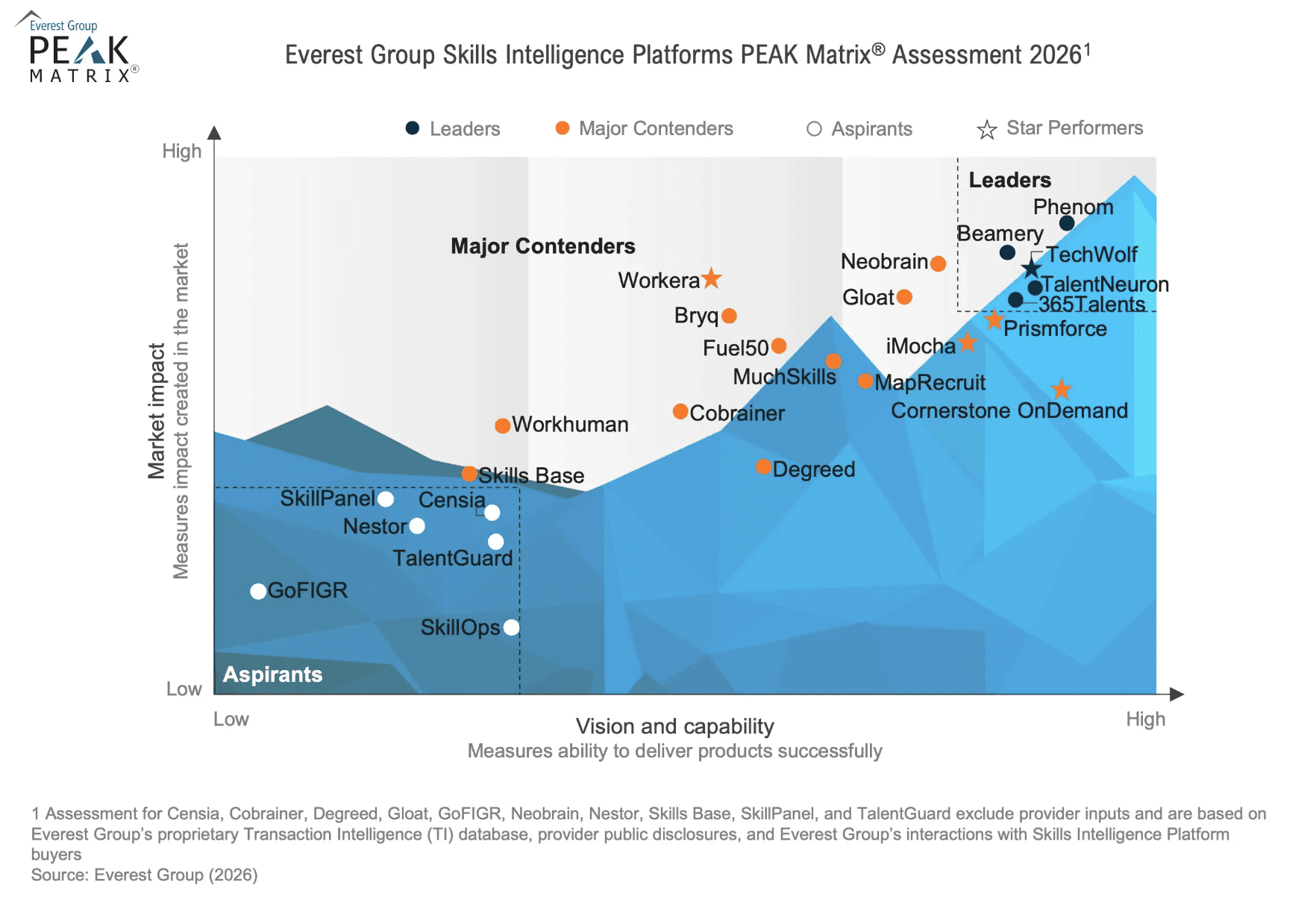
Everest Group published its Skills Intelligence Platforms PEAK Matrix® Assessment 2026 in April 2026, evaluating 25 providers. Bryq was positioned as a Major Contender, one of three tiers (Leaders, Major Contenders, Aspirants) in the assessment.
This is the second year running that Bryq has been named a Major Contender on Everest Group's Skills Intelligence PEAK Matrix. We're proud to be back on the list. The more interesting story is what changed in the report itself.
What is the Everest Group Skills Intelligence PEAK Matrix 2026?
Everest Group's PEAK Matrix is an annual analyst assessment that evaluates vendors in a category across capability, vision, and market impact. The 2026 Skills Intelligence Platforms edition assessed 25 vendors and sorted them into Leaders, Major Contenders, and Aspirants. The full report (89 pages long) is only available to Everest Group members.
According to Everest Group's 2026 assessment, the defining criterion for skills intelligence platforms is whether skills data drives hiring, mobility, or workforce-planning decisions, not whether it sits in a database.
How do skills intelligence platforms differ from skills inventories?
Skills inventories catalog what employees and candidates know. They're databases of skills with limited operational use. Skills intelligence platforms connect skills data to business decisions: hiring outcomes, internal mobility matches, learning paths, workforce planning.
Two years ago, "skills intelligence" largely meant cataloging skills. Companies built taxonomies, mapped them to roles, and stored the result in a database. The output was a map of who knew what. Useful in theory. Useless in practice. The map collected dust.
Everest Group's 2026 report makes the shift official. If your skills platform is a beautiful library that nobody walks into, you've built a museum, not a tool.
Where is Bryq positioned, and why does it matter?
Bryq holds the Major Contender tier on the 2026 PEAK Matrix. Major Contender is the middle tier of three positions. It indicates a vendor with strong capabilities aligned to the category's evolving definition of skills intelligence, sitting between Aspirants (early-stage capability) and Leaders (broadest market presence).
Bryq was first recognized in Everest Group's 2025 Skills Intelligence PEAK Matrix as a Major Contender. In 2026, Bryq retained its Major Contender position, which signals consistent execution on the core differentiators Everest assesses: measurement at the point of hire, cognitive and behavioral assessment alongside hard skills, and integration into hiring workflows.
Why was Bryq named a Major Contender for the second year running?
Bryq has never sold itself as a skills inventory. Bryq sells skills intelligence that drives a hiring decision. That distinction matters.
When we say we measure capability, we mean four things, in one assessment experience:
Cognitive ability: how someone thinks and learns
Behavioral traits: how they show up at work
Hard skills: what they can actually do
AI fluency: how they work with AI in real scenarios, not what they know about AI
The result: hiring teams use it to make a call, not collect it like a museum piece. That's what skills intelligence looks like when it's pointed at a decision.
"Being named a Major Contender on Everest Group's Skills Intelligence Platforms PEAK Matrix for the second year running means a lot. It comes down to two things. A team that's refused to cut corners, and customers who keep pushing us to sharpen the platform. Their feedback built what Everest evaluated. The same feedback is shaping what we ship next."
George Kalyvas, CEO, Bryq
What does skills intelligence look like in practice?
Two patterns we see with customers map directly to what Everest's report describes.
Skills connected to real work. Customers don't ask us to confirm that a candidate "has Python." They ask whether this candidate will perform in this role, on this team, under this kind of pressure. The Bryq Ideal Candidate Profile answers that question by combining cognitive, behavioral, and hard-skill signals into one fit score. Skills data turned into a decision.
Inside the workflow, not next to it. Customers run Bryq from inside their ATS. The assessment fires when a candidate applies. Results land where recruiters already spend their day. There's no separate "skills product" to log into. The platform is the workflow.
Where is the category heading next?
Everest Group identifies agentic AI as a key differentiator emerging in 2026. Bryq's approach prioritizes agentic capabilities that compress the distance between skills data and a hiring action.
In practice, that looks like a recruiter asking a question about a role's ideal candidate profile and getting a useful answer back, with sourcing implications attached. A hiring manager flagging a top-of-funnel candidate and seeing what to probe in the interview, based on their fluency profile. A talent leader asking where the company has gaps for a strategic priority and getting an honest, data-grounded answer instead of a slide.
That's what skills intelligence looks like when it actually drives the work.
What should you evaluate in a skills intelligence platform in 2026?
If you're building a buyer's checklist, the criteria Everest's 2026 report points to are a useful starting point.
Decision-readiness. Does the platform produce outputs that change a hiring or mobility decision, or does it stop at a database row?
Workflow integration. Does it live inside the ATS, HRIS, and TA tools your team already uses, or does it sit beside them?
Breadth of capability dimensions. Does it measure cognitive ability, behavioral traits, hard skills, and AI fluency together, or only one?
Validation rigor. Is the assessment science backed by I/O psychologists and continuously validated, or is it a question bank with no published research?
Time to value. Can you go live in a week, or is it a six-month implementation?
Bias and compliance. Is the platform validated for adverse impact across demographics? Is it compliant with EEOC, OFCCP, GDPR, and the EU AI Act?
The 2026 PEAK Matrix evaluates vendors against criteria like these. The full Everest report contains the detailed evaluation framework.
The category is moving. So are we.
Two years ago, the question in this space was "how complete is your skills taxonomy?" In 2026, the question is "how does your platform change a hiring decision today?"
That's a better question. It's the one Everest Group's report points to. It's the question Bryq's been answering.
If you'd like to see what skills intelligence looks like when it's pointed at a hiring decision, we'd be glad to show you.
Book a demo → | How Bryq measures capability → | Inside our AI Fluency Assessment →
Frequently asked questions
What is the Everest Group Skills Intelligence PEAK Matrix?
The Everest Group Skills Intelligence Platforms PEAK Matrix Assessment 2026 evaluated 25 vendors in the skills intelligence category and positioned them into three tiers: Leaders, Major Contenders, and Aspirants. The assessment measures capability across multiple dimensions, including whether platforms drive hiring, mobility, and workforce-planning decisions, not whether they catalog skills.
How do skills intelligence platforms differ from skills inventories?
Skills inventories catalog what employees and candidates know. They are databases of skills with limited operational use. Skills intelligence platforms connect skills data to business decisions: hiring outcomes, internal mobility matches, learning paths, workforce planning. Everest Group's 2026 report marks the shift from inventory-centric platforms to decision-centric platforms as the new category standard.
What is a Major Contender in the Everest PEAK Matrix?
Major Contender is the middle tier of three positions in the PEAK Matrix, between Aspirants and Leaders. It indicates a vendor with strong capabilities aligned with the category's evolving definition of skills intelligence. Major Contenders represent mature, viable platforms suitable for enterprise and mid-market deployment.
Why was Bryq named a Major Contender for the second year running?
Bryq was recognized for its approach to measuring candidate and employee capability across four dimensions (cognitive ability, behavioral traits, hard skills, and AI fluency) in a single assessment experience. Bryq's Major Contender position reflects its focus on delivering skills data at the point of hire, inside hiring workflows via ATS integration, and outcomes that change hiring decisions rather than cataloging skills.
What are the key criteria Everest Group used to evaluate skills intelligence platforms?
Everest Group's 2026 assessment evaluated vendors across capabilities including measurement at the point of hire, workflow integration with HR systems and applicant tracking platforms, the breadth of skill dimensions measured (including cognitive, behavioral, hard skills, and emerging dimensions like AI fluency), and whether the platform drives hiring outcomes such as quality of hire and time-to-fill. [Verify against full report for the exhaustive evaluation framework.]
Should we choose a Major Contender or a Leader platform?
It depends on the use case and implementation timeline. Leaders typically offer broader feature sets and market maturity. Major Contenders often provide more focused, innovative capabilities in specific areas. For organizations prioritizing skills assessment at the point of hire with native ATS integration, a Major Contender focused on that workflow may be the better fit than a Leader with broader but more dispersed capabilities.
What is "AI fluency" assessment, and why does it matter?
AI fluency assessment measures how candidates and employees work with AI tools in real scenarios, not their theoretical knowledge of AI concepts. It's distinct from generic AI knowledge tests. As organizations adopt AI-assisted workflows, understanding who can effectively use AI in their role has become a key hiring and skills-planning criterion. Bryq's inclusion of AI fluency in its assessment reflects this shift.
Author

George leads Bryq as CEO and writes on where hiring is headed, how AI is reshaping talent decisions, and what it actually takes to scale a B2B SaaS company.