Why AI fluency is now a hiring signal
75% of knowledge workers already use AI at work, yet almost no hiring team can tell a real multiplier from someone who pastes a prompt into ChatGPT and ships whatever comes back. That gap is expensive. Half of employers say AI skills gaps are their top barrier to AI adoption, and the skill is cheapest to get right at the hire, not months later.
AI fluency is a hard skill now, alongside Excel and data analysis in what decides whether a new hire performs. You do not have to make it a requirement. But if you are not measuring it, you are guessing on a skill most of your people use every day.
5 Dimensions of AI Fluency
Our assessment evaluates the complete lifecycle of working with AI, from knowing when to use it, through getting results, to delivering work you can stand behind.
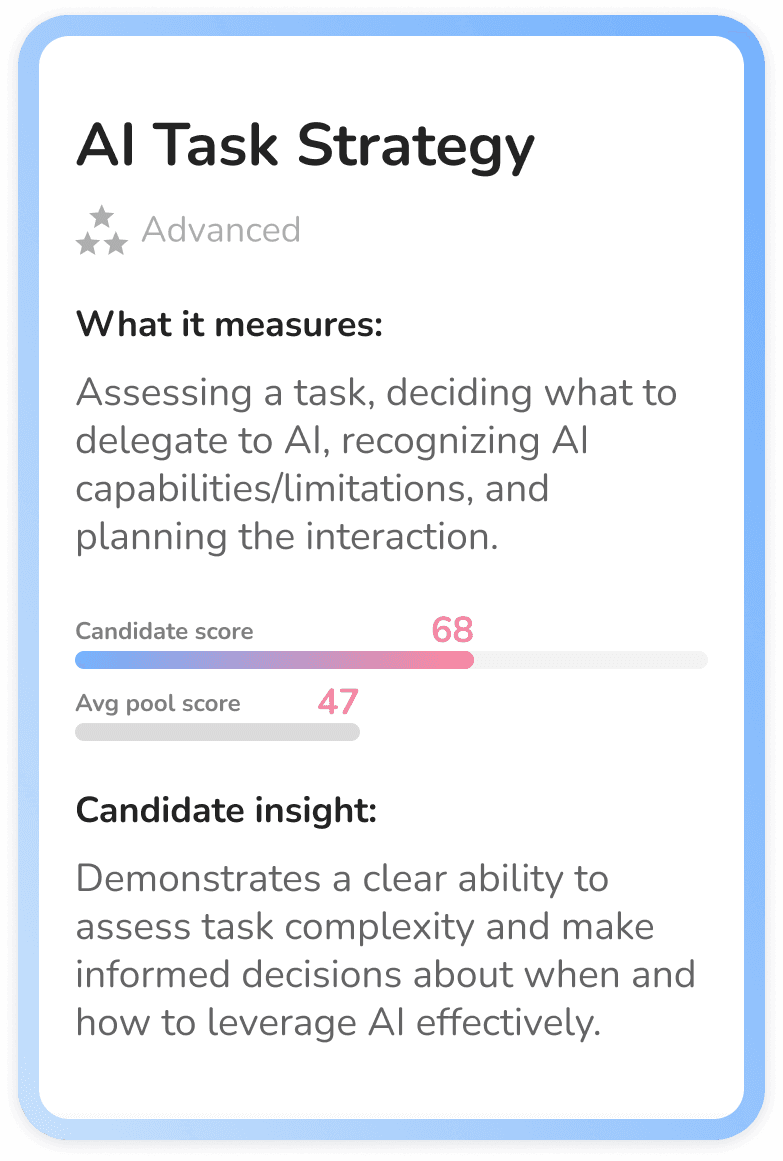
AI Task Strategy
Knowing when to use AI — and when not to. Can they assess a task and decide what to delegate versus keep human?
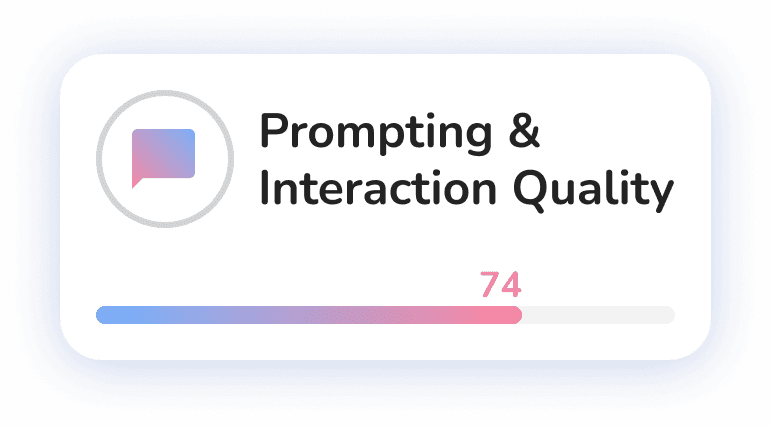
Prompting & Interaction Quality
Getting results from AI tools. Can they write effective prompts and iterate when the first attempt doesn't land?
Critical Evaluation & Validation
Spotting what AI gets wrong. Can they catch errors, hallucinations, and gaps before those reach real work?
Ethical & Responsible Use
Using AI without creating risk. Do they understand privacy, bias, IP, and regulatory boundaries?
Workflow Integration & Output Quality
Turning AI output into professional work. Can they edit, synthesise, and combine AI content with original thinking?
Three fluency levels, matched to the role
Not every role needs the same level. An admin hire and a strategy hire face different AI demands, so the assessment reads against three levels.

Aware
Admin, entry-level, support
Basic AI awareness, simple tasks, avoids the common traps

Functional
Marketing, finance, ops, HR
Prompts well, evaluates output critically, fits AI into the workflow

Advanced
Strategy, leadership, AI-adjacent roles
Runs complex workflows, handles governance, guides others in responsible use
You set the level the role needs. The profile tells you where the candidate actually lands.
AI fluency versus AI knowledge tests
Most "AI assessments" on the market test what a candidate knows. They ask for definitions. What is a hallucination, what is a token, name three prompt techniques. Someone can ace that and still produce sloppy, unchecked work the moment they open a real tool.
Bryq measures what a candidate does. Simulation-based, on realistic tasks, tool-agnostic. Knowing what a hallucination is and catching one in a client deliverable before it goes out are two different skills. We test the second one.
AI knowledge quiz
Bryq AI Fluency Assessment
What it tests
Recall of terms and facts
Behavior on realistic tasks
Format
Multiple choice
Simulation-based, five scored dimensions
Tool dependence
Often tied to one tool
Tool-agnostic, measures transferable skill
Output
A single score or pass/fail
A 0 to 100 profile across five dimensions
What it predicts
Whether they studied
Whether they can actually do the work
COMPETITORS
Developer-focused tools
Test ML engineering, model deployment, and coding skills. Great for hiring data scientists. Irrelevant for 95% of your workforce.
AI literacy quizzes
Test whether someone can define "hallucination." Knowing the vocabulary doesn't mean they can do the work.
Tool-specific assessments
Test proficiency with one product. That product updates next quarter. The skills become obsolete.
BRYQ
Bryq AI Fluency Assessment
Measures how people actually work with AI in a realistic simulation. Tool-agnostic. Role-universal. Built on peer-reviewed research.

The assessment is built on six peer-reviewed research frameworks, including UNESCO, SFIA, and OECD competency models. That matters for two reasons. Defensibility, because a hiring signal you cannot explain is a legal risk. And durability, because tools change and the underlying skills do not. We test critical evaluation, task delegation, ethical judgment, and output quality. Those hold whether the tool is ChatGPT, Claude, Gemini, or whatever ships next quarter. We update the simulation. The framework stays put.
The AI Fluency Assessment is one hard-skills module inside the wider Bryq platform, which measures cognitive ability, personality traits, and hard skills in one integrated candidate profile, validated by I/O psychologists. Teams that hire on measured fit instead of gut feel see a 3x improvement in quality of hire, 47% lower attrition, and 2x faster hiring.
Built on Science,
Not Guesswork
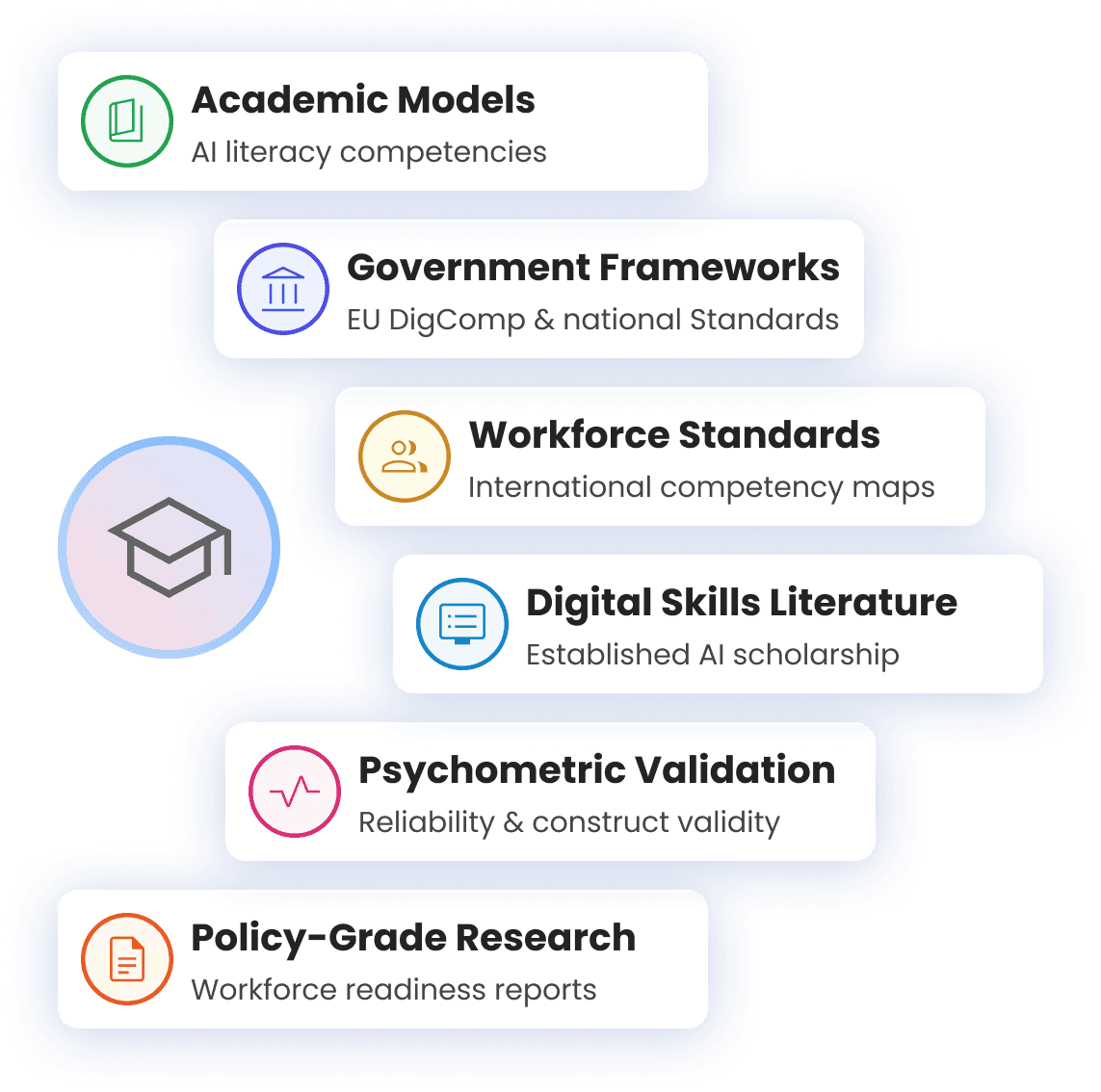
Our competency framework synthesises six peer-reviewed research sources spanning international government frameworks, academic competency models, and policy-grade workforce research.
Each dimension is grounded in established AI literacy and digital skills scholarship — not invented in a product sprint.
The result: a measurement instrument built on the most rigorous AI fluency research available, validated through established psychometric methods.
How it works for your team
You do not run a separate tool. If you already use Bryq, the AI Fluency Assessment turns on from your dashboard and works inside your existing ATS integration. Add it to a role in a couple of clicks.
About 15 minutes for the candidate. Thorough, but it respects their time.
Dimension-level scores, 0 to 100, no pass or fail.
Tool-agnostic, so the result travels across roles and tools.
Included in your Bryq plan. No add-on, no premium tier.
Live inside your current ATS workflow, not a new system to roll out.
For TA leaders, the practical win is simple. Your best candidates get snapped up in about 10 days, so every interview slot has to count. When AI fluency is on the profile before the interview, you stop spending cycles finding out in person what a 15-minute assessment could have told you upfront.
Built for Talent Decisions. Designed by Science.



Step 1: Choose the fluency level
Pick the fluency level the role requires: Aware, Functional, or Advanced. Each level has its own simulation matched to the AI competency expected, whether you're screening a new hire or benchmarking a current employee.
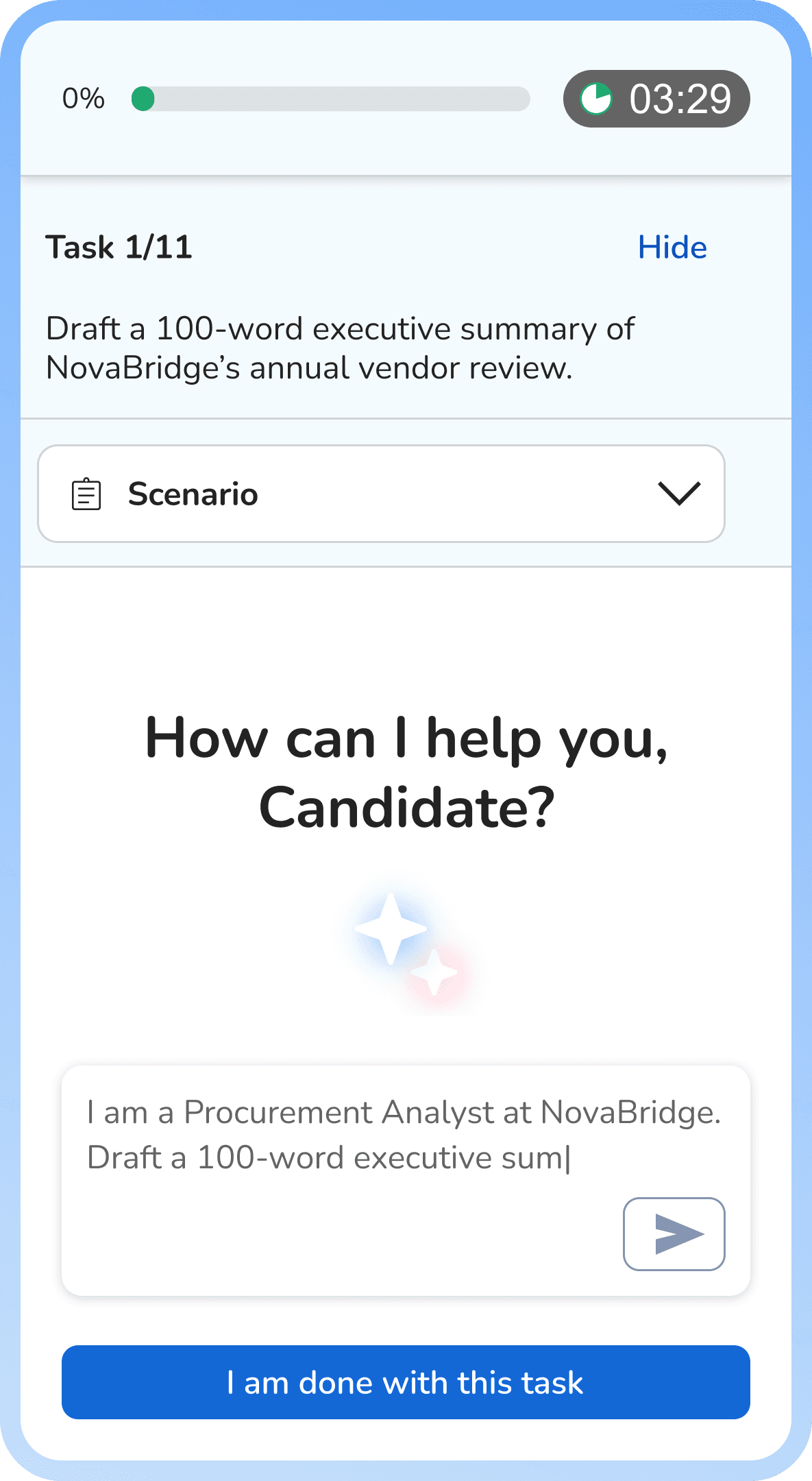
Step 2: Candidates work through a simulation
No trivia. No textbook definitions. Candidates work through a realistic, simulation-based task and use AI the way they would on the job. Bryq scores what they actually do, not what they can define. About 15 minutes.


Step 3: Get dimension-level insights
Get a detailed fluency profile with scores across all five dimensions, 0 to 100. See exactly where each person excels and where the gaps are. No pass/fail binary. Use it to make a hiring call, plan targeted upskilling, or both.
Ready to see Bryq in action?
Start making talent decisions based on real data.
FAQ
Find answers to the most frequently asked questions about Bryq