10 Best Talent Assessment Platforms in 2026
Updated June 2026. Reviewed against current pricing pages, G2 data, and feature releases.
The best talent assessment platform for most hiring teams in 2026 measures cognitive ability, behavioral traits, and hard skills in one validated, ATS-integrated profile and proves its impact on quality of hire. Ten platforms, including Bryq, clear parts of that bar; this guide ranks them on test depth, scientific validation, candidate experience, integrations, and pricing transparency. This guide ranks ten platforms on test depth, scientific validation, candidate experience, ATS integrations, and pricing transparency, using the same criteria for every tool, including Bryq.
At a glance: top talent assessment platforms for 2026
Bryq. Best all-in-one skills-based hiring platform for quality of hire, predictive hiring, and internal mobility. Flat subscription, unlimited assessments, strong ATS integration.
Sova. Best enterprise assessment platform for high-volume hiring across multiple countries with deep ATS integration, dashboards, and compliance reporting.
Harver. Best for high-volume hiring of frontline roles where time-to-hire and attrition are the key metrics. Excels at volume operations hiring.
TestGorilla. Best assessment tools for SMBs and smaller teams that want a broad test library of skills tests and self-serve setup.
Criteria Corp. Best psychometric standard for mid-market, with strong onboarding and development use cases.
iMocha. Excels as a skills intelligence layer for enterprises on Workday or SAP, especially for technical hiring, skills assessment at workforce scale, and compliance roles.
HackerRank and Codility. Best technical hiring specialists for coding tests, coding challenges, and live technical interviews.
Bryq vs Maki People comparison →
Bryq vs The Predictive Index →
What changed in 2026
Three shifts pushed the market forward this year.
First, skills-based hiring stopped being a slogan and started showing up in budget lines. Recruiters and hiring teams don't trust keyword-matched resumes anymore. They want proof of competencies, validated against actual job performance data. Assessment tools moved from optional pre-hire layer to core step in the hiring process, and the best assessment platforms now act as workflows engines that automate invitations, scoring, and shortlist ranking.
Second, AI got baked into almost every serious product. AI-powered matching, AI-driven scoring of essay responses, conversational interviewers, adaptive testing, and real-time plagiarism flags are table stakes now. The question isn't whether a vendor has AI. It's whether their AI is grounded in real psychometric science or slapped on for marketing.
Third, candidate experience turned into a selection criterion. Applicants are savvier. They ghost bad processes. 45-minute assessment marathons are out. Short, conversational formats are winning. Talent acquisition leaders have figured out that candidate experience is part of the employer brand, not an afterthought. The platforms that treat candidates like humans are pulling ahead of the ones that treat them like data.
What to look for in assessment platforms
Before picking anything, decide what matters most for your hiring managers and your business. The strongest assessment platforms in 2026 compete on seven dimensions:
Scientific validity. Does the platform publish validation studies? Is it grounded in industrial-organizational psychology? Are constructs like cognitive ability, personality, and situational judgment tests backed by real research? If a vendor dodges this question, walk away.
Depth of content. Cognitive assessments, behavioral assessments, personality assessments, situational judgment tests, coding tests, simulations, and role-specific skills tests should all live inside one product. The strongest talent assessment tools also include work style indicators, a structured interview module, and technical assessments so hiring managers get a consistent evaluation. Switching between five assessment tools is a workflow tax your recruiters will eventually resent.
Workflow and ATS integration. Applicant tracking system integration matters more than most buyers admit. Score write-back into Greenhouse, Workday, Lever, SmartRecruiters, or iCIMS is what turns assessments from an extra step into an automatic part of the funnel. Without ATS integration, adoption quietly dies and your workflows collapse back into spreadsheets.
Candidate experience. Short, mobile-first, transparent. If your process feels like a final exam, your best candidates will drop off. A strong candidate experience builds the employer brand and keeps talent pools warm for future roles. The right tool feels closer to a conversation than a test.
Automation, dashboards, and intelligence. Good platforms automate invitations, reminders, scoring, and shortlist ranking, and give recruiters dashboards that actually tell them what to do next. Great platforms connect assessment data to quality of hire, retention, internal mobility, and succession planning. That's the difference between a one-shot test and a predictive hiring system that drives real hiring decisions.
Sourcing and outreach. A handful of modern tools now pair assessments with sourcing, letting recruiters tap pre-verified talent pools of skills-tested candidates and run targeted outreach campaigns from the same platform. For SMBs where one person owns both sourcing and selection, that kind of consolidation matters.
Pricing that fits your usage. This is where buyers get burned. Per-credit pricing feels cheap until you hit high-volume hiring season and your invoice triples. Subscription-based pricing with unlimited assessments is usually the better long-term call once you're past a few hundred hires a year. We'll get into specific pricing models below.
With those criteria in mind, here's how the leading assessment platforms stack up.
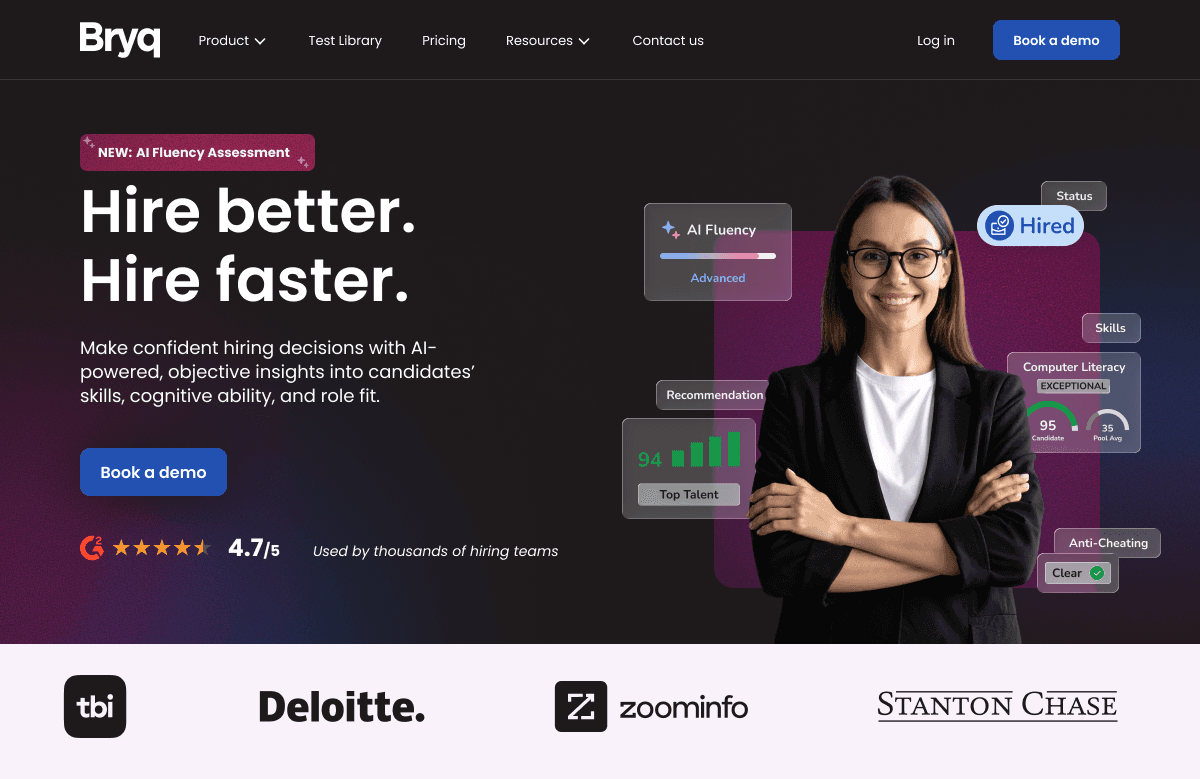
Bryq: the skills-based hiring platform built for quality of hire
Bryq is an AI-driven, skills-based hiring platform rooted in industrial-organizational psychology. It measures what actually predicts performance, which is cognitive ability, personality, and role-specific competencies, and matches candidates to the roles where they'll succeed. The same science also powers internal mobility and development once they're hired.
The assessment is short compared to the 40-minute batteries that are still common across the market. Candidates answer a mix of cognitive ability questions, personality items, and hands-on competency prompts inside a conversational, messaging-style interface. It's available in 23 languages. Completion rates are high, which matters more than people realize: drop-off at the assessment stage is one of the most preventable causes of bad top-of-funnel economics.
Under the hood, Bryq is rooted in I-O psychology. The model pulls from the Big Five (OCEAN) and 16PF frameworks, maps them against a role profile calibrated on your top performers, and produces a Fit Score. You're not ranking candidates on arbitrary scores. You're ranking them against the behavioral and cognitive DNA of people who already succeed in that role at your company. That's how you get real benchmarking, not synthetic norms.
A few things separate Bryq from the rest of the field:
A single assessment that spans everything. Cognitive assessments, personality assessments, behavioral assessments, and competency prompts all sit inside one 10-to-15-minute experience. No stacking of tools. No bolt-on vendors. An all-in-one design that most competitors haven't matched.
The AI Fluency Assessment. Gartner expects three in four hiring processes to include an AI fluency test by 2027. Bryq already ships one, and it's tool-agnostic, meaning it tests how candidates actually apply AI to real-world problem-solving rather than whether they've memorized a specific chatbot.
Built-in bias mitigation. Bryq monitors adverse impact across demographics and produces the kind of reporting that legal and compliance teams actually accept. For EU-aligned organizations dealing with AI Act expectations, this isn't optional anymore.
Talent intelligence that lives past the offer letter. The same assessment data powers internal mobility, succession planning, and onboarding. You're not paying for a one-shot test. You're building a workforce map that appreciates over time.
Pricing that doesn't punish growth. Bryq uses a flat subscription with unlimited assessments and all integrations included. A typical mid-market deployment runs $6,000 to $11,000 a year. Compared to credit-based platforms where the same volume can hit $20,000 to $75,000, the math usually favors Bryq the moment hiring scales. See pricing.
Customer-reported outcomes include around 47% faster time-to-hire, 40% lower early attrition, and a meaningful lift in quality of hire and job performance. Vendor-sourced numbers, so treat them as directional, but they line up with independent research on structured interview data and validated assessments replacing gut-feel decisions.
Who it's best for: HR teams running skills-based hiring across knowledge-worker roles, mid-market and upper-mid-market companies that want one platform for hiring and internal mobility, and any organization operating under EU compliance pressure that needs explainable, defensible scoring. Among the talent assessment platforms reviewed here, Bryq is the one that most consistently answers "what happens to this data after the hire?"
Sova: the enterprise workflow engine
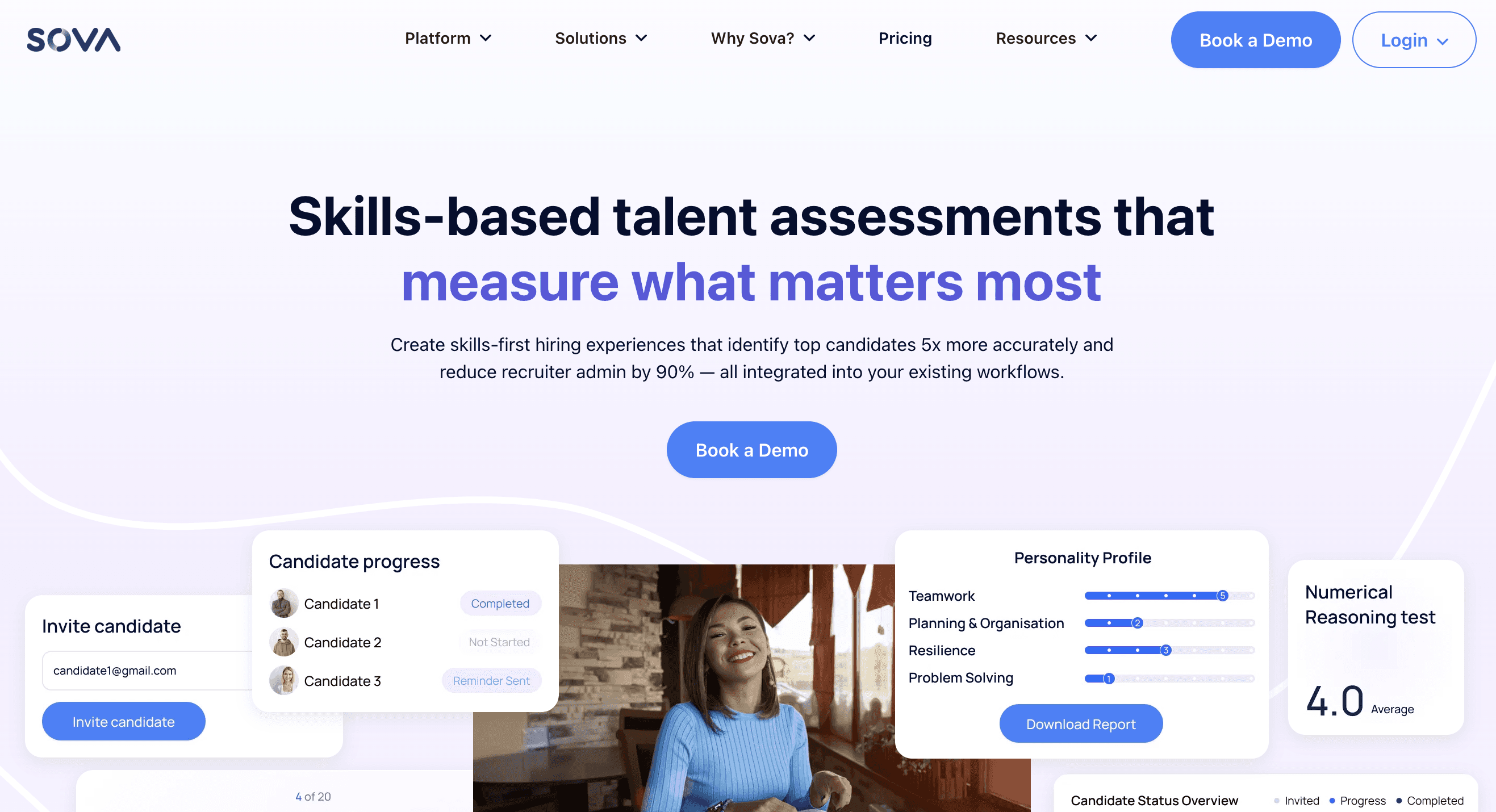
Sova plays in a different weight class. It's built for enterprise recruiting teams running tens of thousands of applicants a year across multiple countries.
The platform bundles psychometric assessments, situational judgment tests, game-based tasks, structured interview scripts, video interviews, and virtual assessment centers into one candidate journey. ATS integration with Workday and Greenhouse is deep. Automation handles invitations, reminders, and rules-based candidate progression. Legal and compliance teams get adverse-impact metrics and dashboards they can actually use during audits.
Sova's strength is orchestration at scale. Its weakness is overhead. For smaller teams, the configuration and implementation work is more than most want to take on. Pricing is unlimited-use but enterprise-tier, meaning real commitment and real services involvement.
Best for: large UK and European enterprises running high-volume hiring where legal sign-off on fairness and a single end-to-end workflow matter more than time to deploy.
Harver: the high-volume hiring specialist
Harver is the tool you call when you're hiring thousands of frontline workers a year: retail, hospitality, contact centers, logistics. It ships with 450+ assessments and 900+ pre-built job postings and templates, which means hiring managers can stand up a new role in hours instead of weeks.
Candidates get mobile-first, gamified, simulation-based assessments. Recruiters get automated matching and real-time dashboards. Harver reports time-to-hire reductions around 40% and early attrition drops north of 25% when the full workflow is adopted. If your goal is to optimize time-to-fill and quality of shortlist across thousands of applicants, this is the right kind of skills assessment engine for that job.
For knowledge-worker roles, Harver is usable but not ideal. The content catalog skews toward operational work. Companies hiring engineers, analysts, or managers usually pair Harver with something deeper or pick a different tool entirely.
Best for: high-volume, frontline, candidate-experience-sensitive hiring where reducing time-to-hire and early churn is the top KPI.
TestGorilla: skills-first testing at self-serve pricing
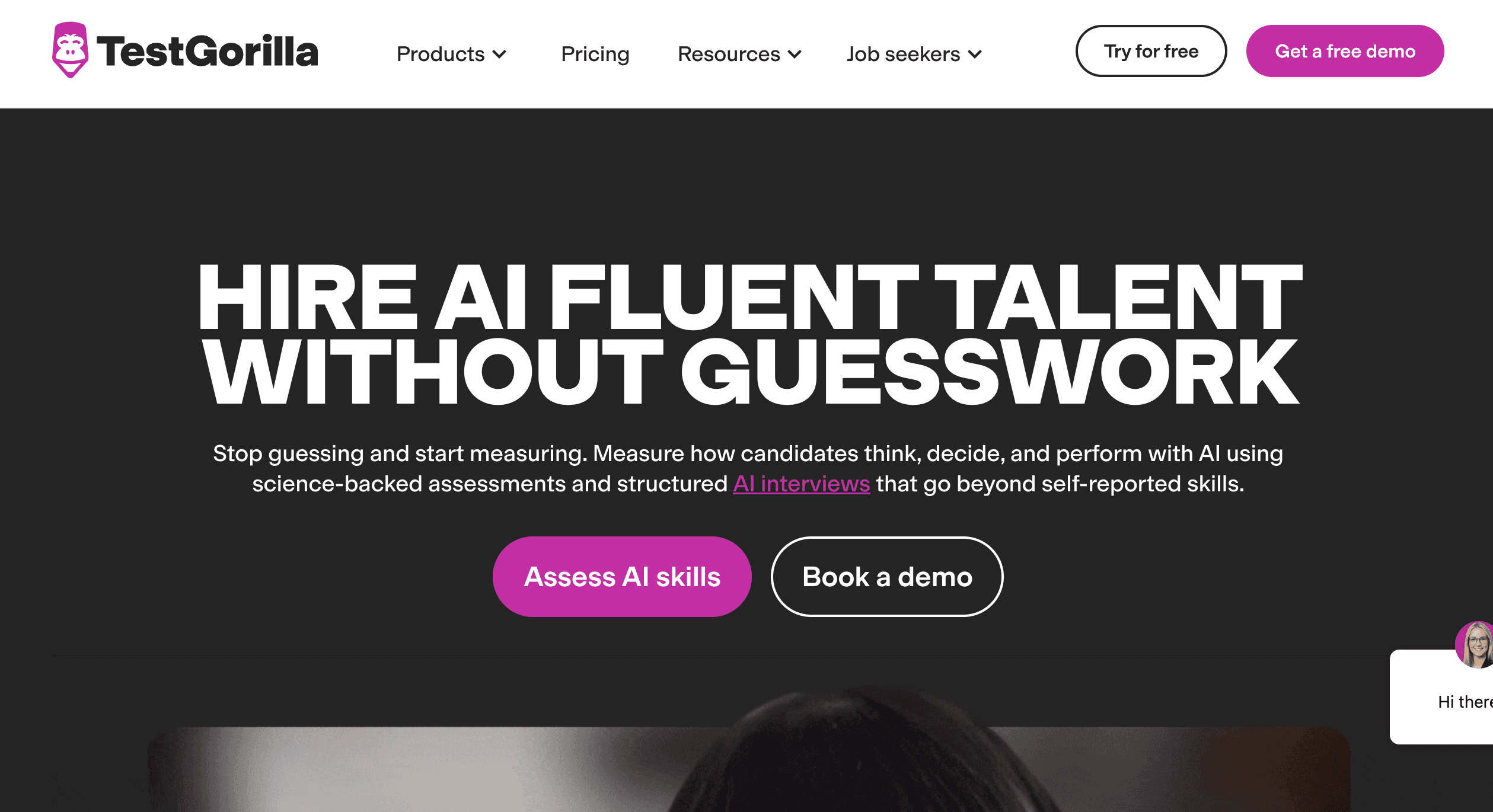
TestGorilla is probably the most recognizable name in the skills-first camp. It offers a test library of 350+ validated skills tests spanning cognitive ability, personality, coding tests, job-specific and role-specific skills, and custom questions. For SMBs and fast-moving mid-market hiring teams, it's the definition of a sensible starting point. User-friendly setup and clear templates help smaller teams get moving fast.
New in 2026: AI video interviews with an avatar interviewer that auto-scores responses, AI resume scoring as an alternative to keyword matching, and a sourcing module that lets recruiters tap talent pools of pre-verified, skills-tested candidates for targeted outreach. The sourcing play is smart. It turns TestGorilla from a test vendor into something closer to a combined sourcing and assessment platform, which is where most modern recruiting teams want to live.
Where it stumbles is pricing transparency. The model is credit-based. Small teams love it. Bigger teams hit pricing surprises once they run 2,000 or 3,000 candidates through a standard battery. Independent buyer reviews also flag rigid timers and occasional disconnects between test content and actual job relevance. Plagiarism detection is present but lighter than enterprise-grade proctoring in platforms like iMocha.
Best for: SMBs and mid-market teams that want broad test library functionality, don't need enterprise-level psychometric depth, and are comfortable managing credit usage.
For a deeper comparison, see Bryq vs. TestGorilla.
Criteria Corp: the psychometric standard for mid-market
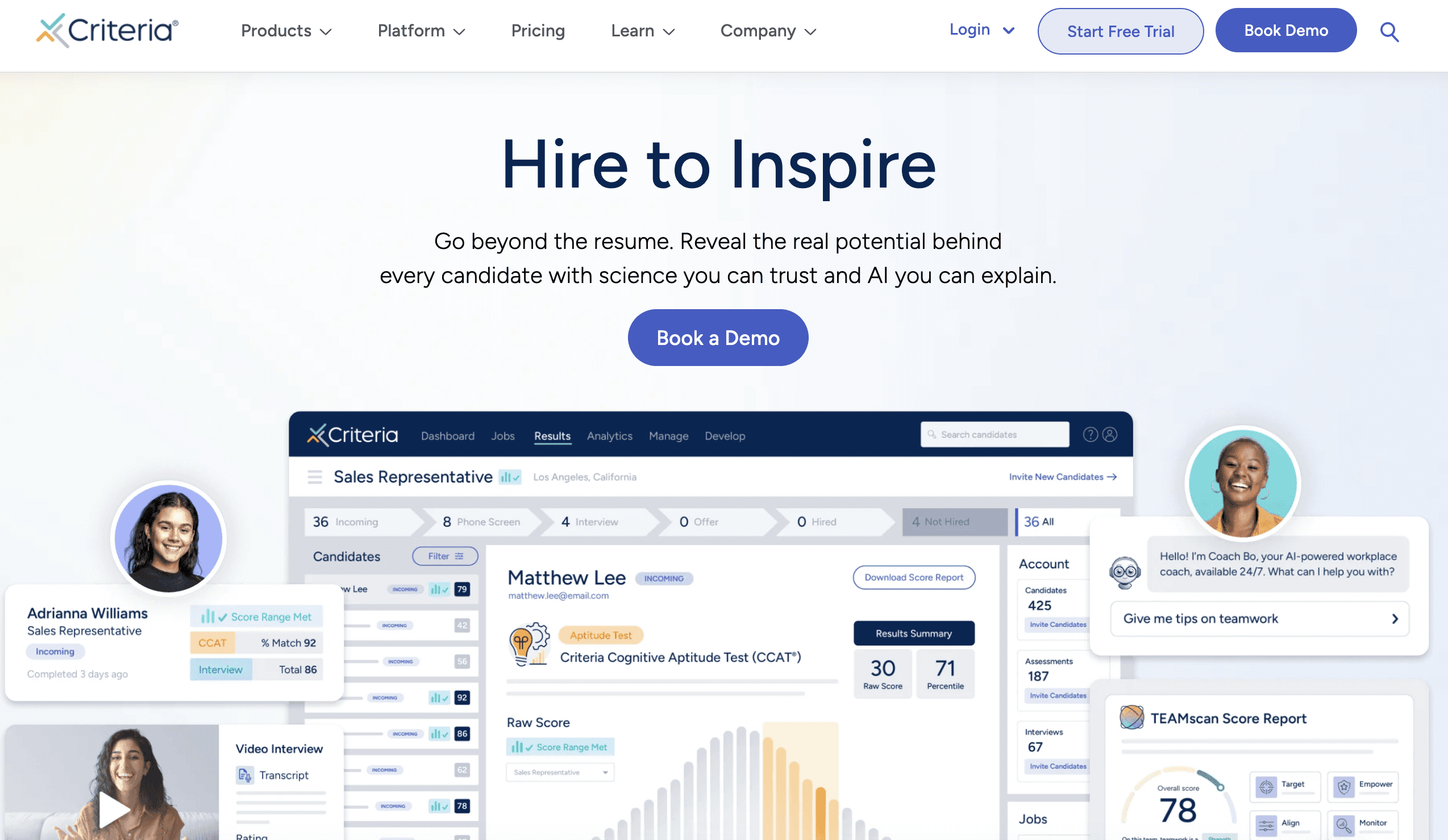
Criteria Corp has built a reputation on scientific credibility. The Criteria Cognitive Aptitude Test is one of the most widely cited cognitive ability tests in hiring research, and the broader catalog now includes Emotify for emotional intelligence, the Employee Personality Profile for behavioral assessments, and game-based assessments that cut test anxiety for younger applicants.
What makes Criteria Corp interesting in 2026 is the Develop product line. Assessment data doesn't stop at the hire. It flows into personalized coaching guides and an AI coaching bot called Coach Bo, turning pre-employment data into an onboarding and development asset. That's a smart answer to the question every CHRO eventually asks: "we paid for this test, what happens to the data after the offer?"
Pricing is tiered subscription with a 12-month minimum and uncapped usage inside each tier. ATS integration is extensive: Workday, SAP SuccessFactors, Greenhouse, iCIMS, Lever, and many others.
Best for: mid-market organizations that value psychometric credibility, want budget predictability, and care about connecting assessment data to decision-making after the hire.
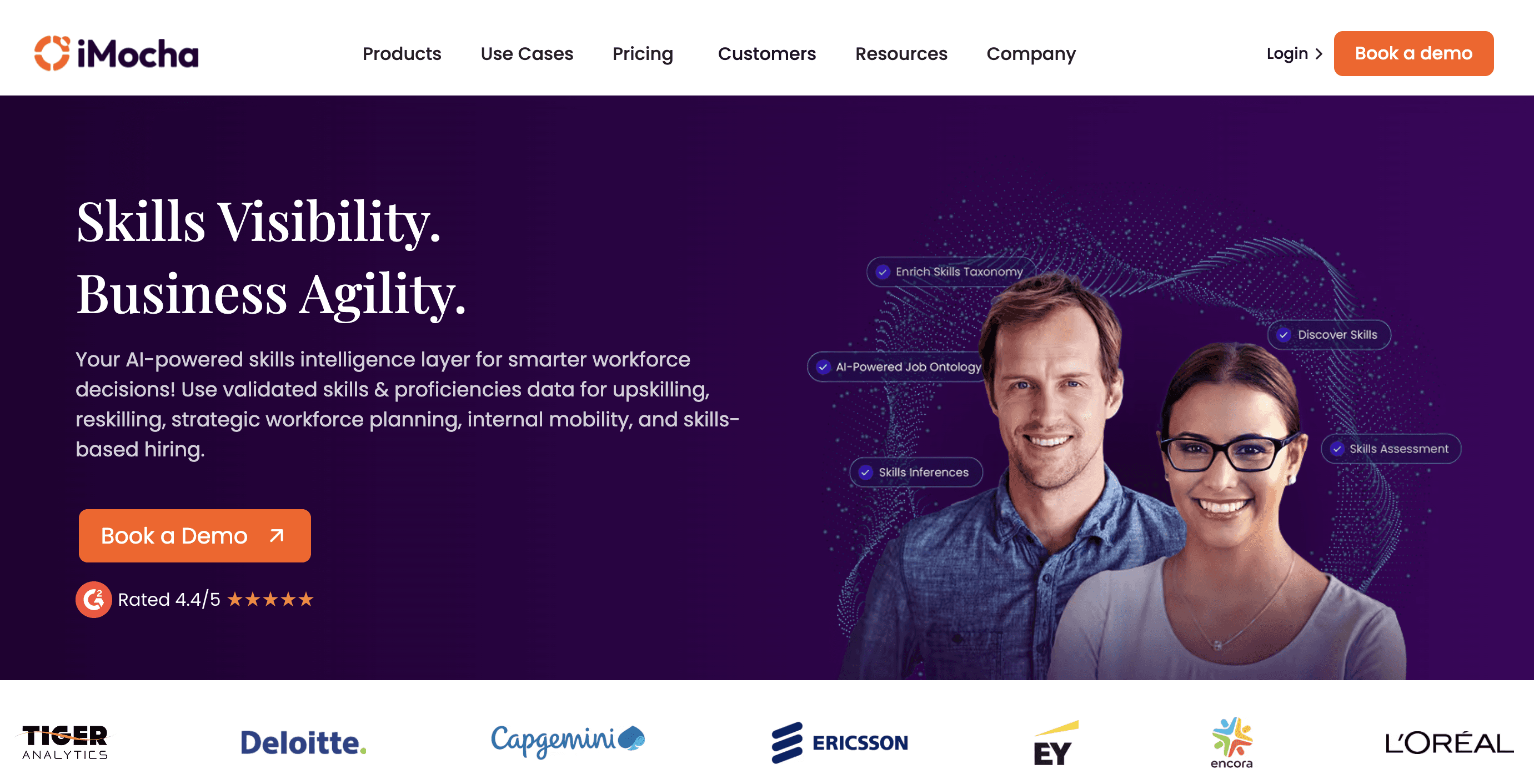
iMocha: the skills intelligence layer for enterprise
iMocha is the deepest technical catalog on this list. It offers 2,500+ skills tests and technical assessments across IT, finance, and business domains, plus specialized assessments for ISO 27001 and SOC 2 compliance hiring. For large-scale digital transformations, it's often the tool of choice.
Its real differentiator is the skills intelligence layer on top of Workday and SAP SuccessFactors. iMocha reads employee data from the HCM, enriches it with validated proficiency levels on specific skills and technical skills, and writes the results back into the company's Skills Cloud. That turns assessment scores from a siloed data point into the source of truth for internal talent marketplaces.
For technical hiring specifically, iMocha ships Tara (an AI interviewer for conversational technical interviews), AI-LogicBox (a coding simulator for languages without standard compilers), and Code Replay (so hiring managers can watch how a candidate actually solved the problem). Proctoring is enterprise-grade: browser lockdown, ChatGPT detection, three-tier risk scoring, and strong anti-plagiarism signals.
The tradeoff is price. iMocha is not an SMB product. Implementation fees, per-connector integration fees, and longer contracts are the norm.
Best for: enterprises running workforce-wide skills intelligence programs, or any organization hiring for heavily technical, regulated, or compliance-sensitive roles.
HackerRank and Codility: the technical hiring specialists
For engineering-only pipelines, two tools still dominate: HackerRank and Codility.
HackerRank supports coding challenges across 35+ languages, has an AI-powered interviewer for live sessions, and is the default choice at many large tech employers. Its library of coding tests, real-world problem-solving prompts, and hands-on coding assessments is broad and well maintained.
Codility competes on polish. CodeLive, its collaborative coding environment, is widely considered the best pair-programming interface in the category. The IDE is clean, the reporting and dashboards are tight, and technical interviews feel less like a panopticon than on most competitors.
Both tools are strong at what they do. Neither tries to measure personality, behavioral traits, or cultural fit. Use them for hands-on technical validation, and pair them with a psychometric platform (Bryq, Criteria Corp, or Sova) if you want a full picture of the candidate beyond the code.
Best for: engineering-heavy hiring where the primary question is "can they actually write the code?"
How to pick the right tool
Pricing, platform depth, and workflow fit all pull in different directions. A few rules of thumb for recruiting teams weighing the options:
If you're running skills-based hiring across knowledge-worker roles and care about quality of hire, retention, and internal mobility, start with Bryq. It's the one platform on this list that treats assessment data as infrastructure rather than a one-time test, and the flat-rate pricing is easier to defend to finance when volumes grow. For companies that want one scalable, all-in-one system rather than a bolt-on stack, Bryq is the most obvious fit.
If you're hiring thousands of frontline workers a year, look at Harver. High-volume hiring is a different sport, and Harver's profile library and automation model are built for it.
If you're an enterprise with legal, compliance, and multi-geography requirements, Sova is probably where you land. Be ready for the implementation footprint.
If you're an SMB or a lean mid-market team that wants a broad test library without a consulting engagement, TestGorilla works well. Just watch the credit usage.
If you want psychometric depth and a path into development, Criteria Corp is strong. The Develop module is underrated.
If you're building a skills cloud on top of Workday or SAP and hiring heavily technical roles, iMocha is hard to beat.
For pure coding assessments and technical interviews, pick HackerRank or Codility and pair them with one of the psychometric platforms above.
Most recruiters over-index on test content and under-index on workflow. That's backwards. The right tool is the one your team will actually use every week, that your hiring managers will trust, that your candidates will finish, and that your ATS will talk to without a three-month integration project.
A quick note on pricing and total cost
Pricing varies wildly in this market, and the sticker isn't the story.
Bryq: flat subscription, roughly $6K to $11K a year for mid-market, unlimited assessments and integrations included. Predictable. See plans.
Criteria Corp: tiered subscription, 12-month minimum, uncapped inside the tier. Predictable.
Sova: enterprise unlimited model. Strong for scale, heavy for smaller teams.
Harver: custom enterprise pricing based on volume.
TestGorilla: credit-based. Starts cheap. Scales expensively. High-volume hiring teams have reported annual spend of £60K to £120K once video interviews and full test batteries are added.
iMocha: enterprise, modular, with implementation fees. Powerful but pricey.
HackerRank and Codility: per-seat and per-usage, mid-to-high range for established engineering teams.
The hidden costs that bite buyers are almost always the same: ATS integration add-ons, per-connector fees, implementation services, and credit top-ups during peak hiring. Ask every vendor for a realistic annual estimate based on your actual hire volume, not the brochure price.
The bottom line
The talent assessment market in 2026 isn't short on options. It's short on teams who pick the right tool for their specific hiring problem.
If you care mostly about speed and skills breadth, there are solid picks. If you care about psychometric validity, there are more. If you need global scale and compliance, there are a couple of serious enterprise plays.
But if you're trying to do the thing every CHRO says they want and almost no one actually does, which is to build a hiring process that improves quality of hire, cuts early attrition, measures cultural fit honestly, supports internal mobility, and stands up to a compliance review, the shortlist narrows fast. Bryq is built for exactly that combination, and the pricing rewards you for scaling rather than punishing you for it.
Talk to a few vendors. Run a pilot against your own turnover and performance data. Watch how candidates react. Then pick the right tool for your team's next three years, not just this quarter.
Because the cost of the wrong assessment platform isn't the subscription. It's the 46% of new hires you're going to lose anyway if nothing changes.
FAQs about talent assessment platforms in 2026
What is a talent assessment platform?
A talent assessment platform is software that measures a candidate's cognitive ability, personality, behavioral traits, work style, and job-specific skills to predict how well they'll perform in a role. Modern platforms combine psychometric tests, simulations, coding tests, video interviews, and sourcing in one hiring workflow, usually with ATS integration so scores flow into the applicant tracking system and shortlist recommendations surface automatically.
Which talent assessment platform is best for 2026?
The best choice depends on hiring volume, role type, and budget. Bryq is the strongest pick for mid-market skills-based hiring, quality of hire, and internal mobility. Sova fits enterprise high-volume hiring. Harver wins for frontline roles. TestGorilla is a user-friendly fit for SMBs. Criteria Corp offers deep psychometric validity. iMocha is the skills intelligence leader for enterprises. HackerRank and Codility dominate technical hiring with coding challenges and real-world coding tests.
How much do assessment tools cost in 2026?
Pricing ranges widely. SMB assessment tools start around $40 to $100 per month. Mid-market platforms like Bryq run $6,000 to $11,000 a year on a flat subscription with unlimited assessments. Credit-based tools can scale to $60,000 or more once high-volume hiring kicks in. Enterprise platforms like Sova, iMocha, and SHL typically start in the low five figures and scale from there.
What's the difference between skills tests and predictive hiring?
Skills tests measure what a candidate can do today. Predictive hiring connects assessment data to future performance, retention, internal mobility, and succession planning over time. Tools like Bryq focus on predicting success in a specific role, while TestGorilla, HackerRank, and Codility focus primarily on skills tests and technical assessments of current ability.
Do assessment platforms reduce hiring bias?
Validated psychometric assessments reduce bias compared to unstructured interviews and resume screening, as long as the vendor monitors adverse impact and publishes validity evidence. Look for platforms that ship adverse-impact metrics by default, use established frameworks like the Big Five for personality assessments, and avoid opaque AI scoring you can't explain to a compliance team.
How do AI-powered assessment platforms handle cheating?
Proctoring in 2026 ranges from basic webcam monitoring to full browser lockdown, copy-paste blocking, ChatGPT detection, and three-tier risk scoring. iMocha and Mercer Mettl sit at the strong end of this spectrum. Bryq uses built-in plagiarism detection and behavior logs. TestGorilla offers webcam snapshots and focus-loss detection but lighter hardware-level controls. For high-stakes technical hiring, combine assessment proctoring with live technical interviews.
Can assessment platforms integrate with my ATS?
Yes. Greenhouse, Workday, SAP SuccessFactors, Lever, SmartRecruiters, iCIMS, JazzHR, and BambooHR are the most commonly supported. Check whether integrations are native or require a Zapier workaround, and whether score write-back is bidirectional. Bryq, Criteria Corp, and Sova have especially strong ATS integration coverage.
What assessment platforms help with sourcing and outreach?
A handful of platforms now combine sourcing with assessments. TestGorilla offers a pool of pre-verified, skills-tested candidates recruiters can invite into outreach sequences. iMocha and Bryq focus more on deepening the sourcing signal through talent pools of past applicants and validated internal profiles. LinkedIn remains the default sourcing surface for most recruiting teams, but pairing it with an assessment platform turns LinkedIn outreach from "spray and pray" into a process that generates qualified candidates instead of resumes.
Ready to see how Bryq stacks up for your team?
If you're comparing assessment tools for 2026 and skills-based hiring, quality of hire, and a fair candidate experience are what matter most, it's worth running a short pilot against your own data. Book a Bryq demo and we'll walk through what the Ideal Candidate Profile would look like for your most critical roles, the dashboards your hiring managers will use daily, and the metrics your leadership team will want to track.
Author

Manto leads product at Bryq, writing on talent intelligence tools, product innovation in hiring, and how the right software choices reshape how teams find, assess, and grow their people.