We gave four leading AI models one candidate's assessment data and the job description, then asked each to score her fit, ten times over. They couldn't agree with each other. They couldn't even agree with themselves. Here is why the judgment of a person cannot be handed to a chatbot.
By George Kalyvas, CEO, Bryq
We ran an experiment that we think every talent leader should see.
We took one real candidate for a marketing manager role. We anonymized her Bryq assessment results and paired them with the job description. Then we handed that exact packet to four of the most capable AI chatbots on the market and asked each a plain question: score this person from 0 to 10 for this job. To be fair to the models, we did not ask once. We asked each to run ten independent agents, ten separate attempts, on identical input.
Same candidate. Same data. Same question. Forty answers. The scores ran from 6 to 10.
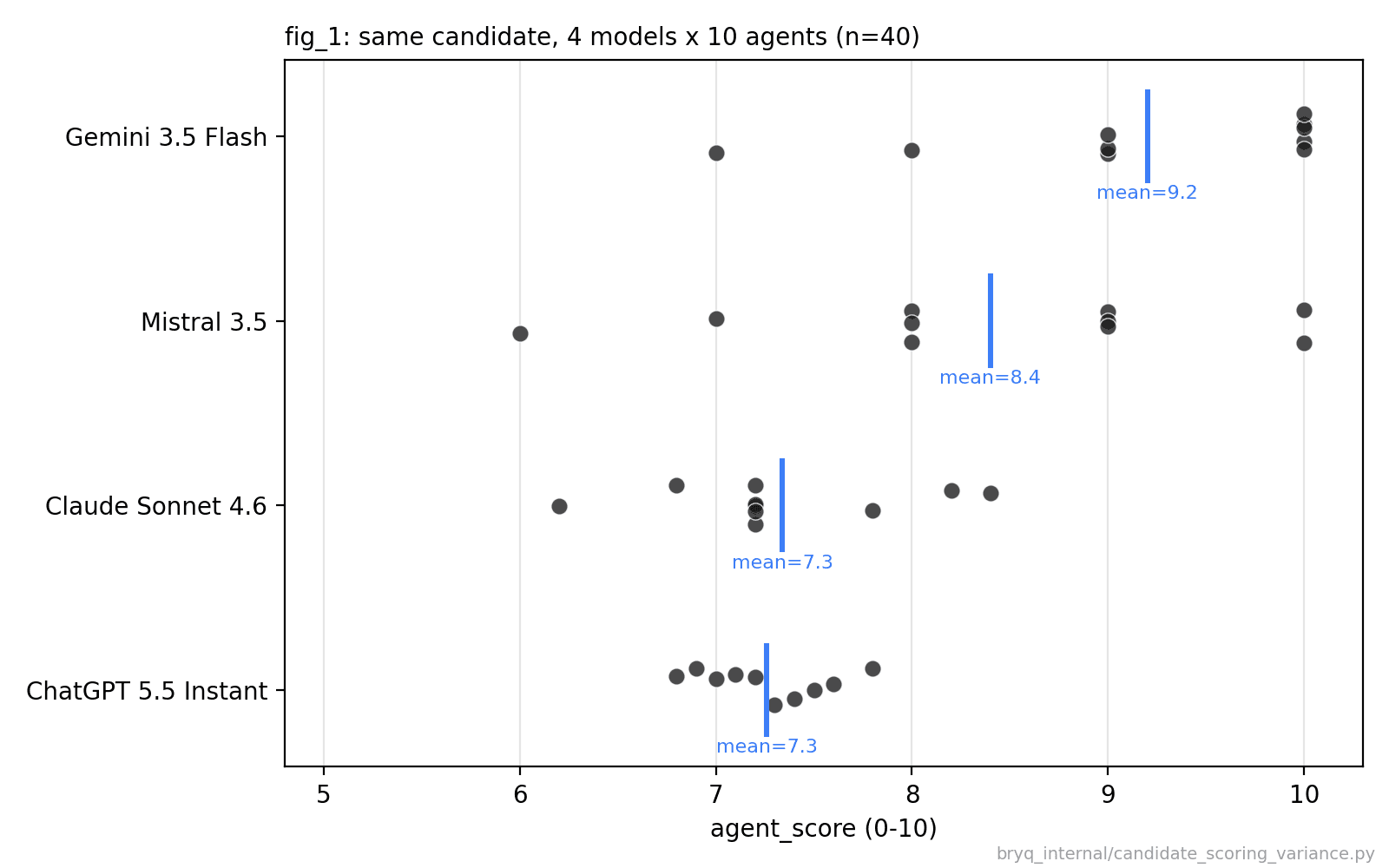
One candidate. Forty AI judgments. A four-point spread. Gemini 3.5 Flash averaged 9.2 and called her a near-perfect hire. ChatGPT 5.5 Instant and Claude Sonnet 4.6 both landed at 7.3, a solid maybe. Mistral 3.5 swung from a 6 to a 10 across its own ten runs. Same person, same file, and the verdict changed anyway. The same model, on the same input, rarely returned the same number twice. Source: Bryq internal experiment, June 2026, n=40.
We are an assessment company, so let us say the uncomfortable part plainly. We are not anti-AI. We are against one specific thing: outsourcing the judgment of a person to a chatbot. That is what scoring a candidate is, and it is the one job you cannot hand off. A model that calls the same person "average" on one run and "outstanding" on the next is not making a judgment. It is generating one. And a generated judgment of a human being is not a judgment you can stand behind, to that person, to your team, or to a regulator.
The setup
We kept the method simple, and ran the models the way any team would, straight out of the box.
The role: Marketing Manager, a real open position.
The input: one candidate's anonymized Bryq assessment data, paired with the job description. Identical for every run.
The task: score the candidate's fit for the role, 0 to 10.
The models: Gemini 3.5 Flash, Mistral 3.5, Claude Sonnet 4.6, ChatGPT 5.5 Instant, in default public configuration.
The runs: ten independent runs per model. No system prompts, no personas, no special settings. 40 scores in total.
The one job you can't hand off
A large language model is a probability engine. It predicts the next most plausible word given everything before it. That is useful for drafting and summarizing. It is also why a decision about a human being is the one thing it cannot be handed.
Assessing a person is measurement. Measurement has rules. We have spent seventy years building those rules into employment science, and they are not optional folklore. They are the difference between a number that means something and a number that just sounds confident.
So when you ask a chatbot to score a candidate, you have not delegated a measurement. You have outsourced a judgment about a person to a machine that produces a fluent guess, and a fresh one every time. That is the part you cannot give away.
The standard that already exists
Before we show why the models fail, it helps to know the bar they have to clear. Two words carry the whole thing: reliability and validity.
Reliability is consistency. Measure the same person twice under the same conditions and you should get the same answer. A bathroom scale that reads 150, then 162, then 148 in the space of a minute is not "a little off." It is broken, because it is unreliable.
Validity is whether the score measures the thing you care about and predicts performance on the job.
An instrument that is not reliable cannot be valid. Not less valid. Cannot be valid at all.
Here is the point most executives miss, and the one that matters most. Reliability is a precondition for validity. You cannot measure the right thing if you cannot measure the same thing twice.
This is not Bryq's opinion. It is the consensus written into the Standards for Educational and Psychological Testing, published jointly by the American Psychological Association, AERA, and NCME, and into the validation principles maintained by the Society for Industrial and Organizational Psychology (SIOP). In the United States, the EEOC's Uniform Guidelines on Employee Selection Procedures (29 CFR Part 1607) have required evidence of validity for selection tools for decades. In 2023, SIOP published specific guidance saying AI-based assessments must meet the same standards as any other test.
So look again at our results. A tool that scores the same candidate anywhere from 6 to 10 has near-zero reliability. Which means the question of validity never even opens. The model fails at step one. It never earns the right to be asked whether it predicts job performance.
Failure one: the inconsistency is built in
The natural reaction is to assume we caught the models on a bad day, or that a sharper prompt would settle them down. It would not. The variance is structural.
These systems sample their output from a probability distribution, so the same input can produce different results by design. Researchers studying ChatGPT on code generation found it returned materially different answers to identical prompts often enough to break reproducibility (ACM Transactions on Software Engineering and Methodology, 2024). And the usual fix, setting the temperature to zero, does not save you. Even at zero, hosted models drift, because of how the hardware batches and processes requests. Engineers at Thinking Machines Lab showed in 2025 that true determinism is achievable, but it costs real performance, so providers do not prioritize it. The inconsistency is a choice the market has made, not a bug waiting on a patch.
It gets worse when you ask a model to act as a judge, which is exactly what scoring a candidate is. A widely cited study with the flat title Large Language Models are not Fair Evaluators showed you can flip a model's verdict just by changing the order in which options appear. Reordering alone let a weaker model "beat" a stronger one on 66 of 80 questions. More recent work named the pattern we saw in our own test "Rating Roulette," documenting that LLM scorers give different scores to the same input across runs, low enough in consistency to be "almost arbitrary in the worst case." Even the wording of the prompt moves the result. One study found that formatting changes alone shifted model performance by up to 76 accuracy points (Sclar et al., ICLR 2024).
The chatbot does not hold a stable opinion of your candidate. It forms a fresh one every time, shaped by phrasing, order, and chance.
Failure two: when it is consistent, it is consistently unfair
Suppose a model were perfectly stable. You would still face the second problem, which is in some ways worse.
These systems are trained to produce text that sounds right, not text that is true. They hallucinate by design, and recent research from OpenAI itself argues this happens because training and evaluation reward confident guessing over admitting uncertainty. They also flatter. Reinforcement learning from human feedback makes models sycophantic, prone to agreeing with the framing they are given. A judge that tells you what sounds good and bends toward the way a question is asked is close to the worst possible judge of a person.
And the errors are patterned, not random. In the largest study of its kind, University of Washington researchers ran more than three million resume comparisons through production language models, changing only the names. The models favored white-associated names 85 percent of the time, female-associated names just 11 percent, and never once preferred a Black-male-associated name over a white-male one. A separate Bloomberg investigation found GPT ranked identical resumes differently by perceived race and gender. This is exactly the risk that bias auditing and ethical AI practices exist to catch.
Inconsistent, and when it is consistent, often consistently biased. That is not a measurement instrument. That is a liability with a friendly interface.
You cannot prompt your way out of this
We know the objections, because we tried them. Better prompts. Tighter rubrics. Ask the model to "be objective." Average several runs. Treat the score as "one input among many."
None of it fixes a structural property. Noise is in the sampling. Sycophancy is in the training. Bias is in the data the model learned from. You can sand the edges, but you cannot prompt a generation tool into being a measurement tool. Asking it nicely does not change what it is doing underneath, which is guessing. Averaging forty unreliable scores gives you a more stable wrong answer, not a valid one.
The clock is already running
This stopped being academic in 2026. Under the EU AI Act, AI used to recruit, filter, or evaluate candidates is classified as high-risk (Annex III), with obligations for risk management, bias testing, human oversight, and documented transparency. Those obligations apply from 2 August 2026. Some practices are already banned outright, including emotion recognition in the workplace, in force since February 2025. In the United States, GDPR-style limits on automated decisions and New York City's Local Law 144, which requires bias audits for automated hiring tools, point the same direction.
Our prediction is simple. Through 2027, any organization that leans on a general-purpose chatbot to score or rank candidates will struggle to defend a single adverse-impact challenge, because a non-deterministic model cannot produce the documented reliability the law and the science both demand. "The AI gave her a 6" is not a defense anyone wants to give to a regulator, or to the candidate's lawyer.
By 2028, we think the market will have learned the lesson the hard way. The decision about whether to hire a person is not something you outsource to a chatbot. Not because AI has no place in hiring, but because a judgment about a human being has to be one you can repeat, audit, and defend, and a chatbot cannot give you that. The organizations that internalize this early will hire better and sleep better.
What good looks like: five principles
This is the standard we hold ourselves to, and the one we think every buyer should demand of every vendor, including us.
Demand reliability before anything else. If a tool cannot return the same result for the same person twice, reject it. Ask for test-retest reliability, in writing.
Never outsource the decision about a person. A chatbot can help you draft and summarize around a hiring process. It cannot be the thing that scores, ranks, or decides who gets the job. The moment a model's output becomes the judgment of a candidate, you have handed off the one decision that has to stay accountable, repeatable, and yours.
Require evidence, not eloquence. A fluent paragraph explaining a score is not validity. Ask for documented validity and adverse-impact studies tied to the actual role. Current professional reviews place structured, job-relevant assessments among the strongest predictors of performance (Sackett et al., 2022).
Keep a human accountable for every decision about a human. AI can inform. A named person should decide and be able to explain why. The regulations are about to require exactly this.
Audit for fairness on a schedule, not once. Bias is patterned and it drifts. Measure adverse impact on every deployment, and be willing to switch a system off.
See Bryq on your own roles
The fastest way to compare tools is to run one. Bryq integrates with your ATS in under a week and scores candidates against your actual roles, with a result you can repeat, audit, and defend. Customers report 3x improvement in quality of hire, 47% lower attrition, and 2x faster hiring.
Results measured across Bryq customer engagements. Individual outcomes vary by role, industry, and baseline hiring maturity. Methodology and customer case studies available on request.
At Bryq, this is the whole reason we exist. We measure cognitive ability, behavioral traits, and hard skills, including AI fluency, in one profile validated by I/O psychologists. And yes, we are an AI-era company, so people ask: don't you use AI? We do. The difference is the one this whole piece is about. We do not outsource the judgment of a candidate to a chatbot and hope. We do skills-based assessment as a discipline: validated, accountable, and repeatable, so the same person gets the same read, and we can show our work. Our AI Fluency Assessment is a scenario-based simulation, not a multiple-choice quiz, because we would rather watch how someone actually works with AI than ask them to describe it.
Customers who measure this way see 3x improvement in quality of hire, 47% lower attrition, and 2x faster hiring. Those are outcomes you can audit, repeat, and defend.
So, should you use AI to assess people? When the question is who this person is and whether they will succeed, you are not looking for a fluent answer. You are looking for one you can repeat, audit, and defend. A chatbot cannot give you that, and it gives a different answer every time you ask. The judgment of a person is the one thing you cannot outsource.
Measure. Don't guess.
We built this instrument for humans. Run it on yours.
The Bryq assessment behind this study is the same one our customers use to evaluate real candidates for 140+ roles: cognitive ability, behavioral traits, hard skills, and AI fluency in one profile, scored against the role and validated by I/O psychologists. Want to run it on your own roles and the candidates you are actually hiring?
Frequently asked questions
Q: Can AI assess job candidates reliably? A: Not in its raw, general-purpose form. Large language models are non-deterministic, so they can return different scores for the same candidate on the same input, as our 40-run experiment showed. Reliability is a precondition for validity, so an inconsistent tool cannot be a valid measure of a person.
Q: Why do AI chatbots give different scores to the same candidate? A: Because they generate text by sampling from a probability distribution. The same prompt can take a different path each time, and the result is also sensitive to wording, the order of information, and how requests are processed on the hardware. Peer-reviewed studies document this across code generation, evaluation, and scoring tasks.
Q: Is AI biased in hiring? A: Independent research says yes. A University of Washington study of more than three million resume comparisons found large preferences by perceived race and gender, including an 85 percent preference for white-associated names. Models also tend to flatter the framing of a prompt rather than judge neutrally.
Q: What is the difference between reliability and validity? A: Reliability is consistency: the same person measured twice gets the same score. Validity is accuracy: the score measures the trait you care about and predicts job performance. A measure cannot be valid unless it is first reliable.
Q: What does the EU AI Act say about AI in hiring? A: It classifies AI used for recruitment and candidate evaluation as high-risk under Annex III, with obligations for bias testing, human oversight, and transparency applying from 2 August 2026. Some uses, such as workplace emotion recognition, are already prohibited.
Q: What is Bryq? A: Bryq is the talent assessment platform that helps HR teams improve quality of hire and reduce early attrition. We measure cognitive ability, behavioral traits, and hard skills including AI fluency in one integrated candidate profile, validated by I/O psychologists. 3x improvement in quality of hire. 47% lower attrition. 2x faster hiring. ATS integrated in under a week.
Related posts
Sources
Ouyang et al., An Empirical Study of the Non-determinism of ChatGPT in Code Generation, ACM TOSEM 2024 — https://dl.acm.org/doi/10.1145/3697010
Thinking Machines Lab, Defeating Nondeterminism in LLM Inference, 2025 — https://thinkingmachines.ai/blog/defeating-nondeterminism-in-llm-inference/
Wang et al., Large Language Models are not Fair Evaluators, 2023 — https://arxiv.org/abs/2305.17926
Haldar & Hockenmaier, Rating Roulette: Self-Inconsistency in LLM-As-A-Judge Frameworks, EMNLP 2025 — https://arxiv.org/abs/2510.27106
Sclar et al., Quantifying Language Models' Sensitivity to Spurious Features in Prompt Design, ICLR 2024 — https://arxiv.org/abs/2310.11324
OpenAI, Why Language Models Hallucinate, 2025 — https://openai.com/index/why-language-models-hallucinate/
Sharma et al., Towards Understanding Sycophancy in Language Models, ICLR 2024 — https://arxiv.org/abs/2310.13548
Wilson & Caliskan, Gender, Race, and Intersectional Bias in Resume Screening via Language Model Retrieval, AIES 2024 — https://arxiv.org/abs/2407.20371
Bloomberg, OpenAI's GPT Sorts Resumes With Bias, 2024 — https://www.bloomberg.com/graphics/2024-openai-gpt-hiring-racial-discrimination/
AERA/APA/NCME, Standards for Educational and Psychological Testing (2014); SIOP Principles (2018); SIOP Considerations for AI-Based Assessments (2023) — https://www.siop.org/wp-content/uploads/legacy/SIOP-AI%20Guidelines-Final-010323.pdf
EEOC, Uniform Guidelines on Employee Selection Procedures, 29 CFR Part 1607 — https://www.ecfr.gov/current/title-29/subtitle-B/chapter-XIV/part-1607
Sackett, Zhang, Berry & Lievens, revised validity of selection procedures, Journal of Applied Psychology 2022 — https://pubmed.ncbi.nlm.nih.gov/34968080/
EU AI Act, Regulation (EU) 2024/1689, Annex III and Article 5 — https://artificialintelligenceact.eu/annex/3/
Author

George leads Bryq as CEO and writes on where hiring is headed, how AI is reshaping talent decisions, and what it actually takes to scale a B2B SaaS company.