Spatial Reasoning Assessment: Sample Questions | Bryq
Mental Rotation
Spatial Orientation
Spatial Visualization
These are three sample questions from Bryq’s Spatial Reasoning assessment, a cognitive ability test for hiring engineers, designers, architects, technicians and other roles that work with shapes, layouts and physical objects. The full assessment covers three skills: mental rotation, spatial orientation and spatial visualization. Every question is image-based: candidates compare figures, read maps and picture 3D objects, then choose the correct image from four options.
Mental Rotation
Intermediate
Question
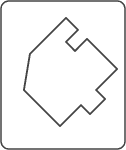
Which of the following is the same object shown from a different angle?

Select your answer

A
B

C

D

WHY IS THIS THE CORRECT ANSWER
Option A is the original figure rotated 45° clockwise, with nothing else changed. Option A is a mirror image, so the notch and the side tab end up on the wrong sides relative to each other. Option C is rotated twice as far, at 90°. Option D has the notch moved along the top edge, so one feature no longer matches.
Spatial Orientation
Intermediate
Question
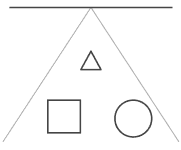
If you were standing at the position shown by the arrow, which of the following is what you would see?

Select your answer

A

B

C
D
WHY IS THIS THE CORRECT ANSWER
Facing north-east from the arrow, the triangle is straight ahead and furthest away, the circle is ahead to the left and the square is closer, to the right. Option C shows exactly this. Option A flips everything left to right, as if facing the opposite way. Option B moves the triangle close and pushes the square into the distance, and option D swaps how near the circle and square appear.
Spatial Visualization
Intermediate
Question
A cube is cut along the shaded plane, which passes through three corners next to one vertex. Which of the following shows the shape of the cut surface?

Select your answer

A

B

C

D