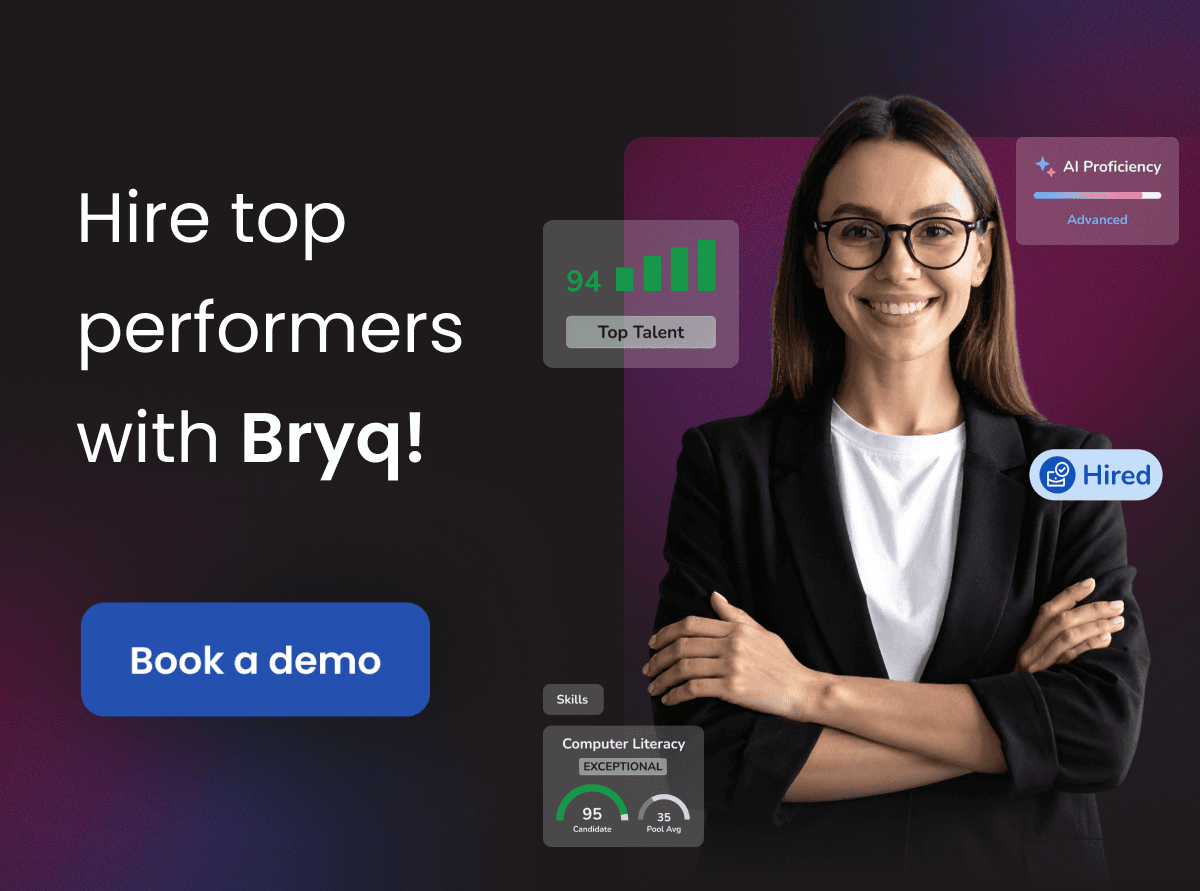
To assess AI skills in hiring, measure how a candidate actually works with AI on real tasks, not what they know about AI. The strongest approach is a simulation-based assessment scored across five dimensions: AI task strategy, prompting and interaction quality, critical evaluation and validation, ethical and responsible use, and workflow integration and output quality. Bryq's AI Fluency Assessment measures exactly these, in about 15 minutes, built on six peer-reviewed research sources.
The five dimensions of AI fluency
Score AI fluency across five dimensions, not as a single pass or fail number:
AI Task Strategy. Whether a candidate chooses to use AI at all for a given task, and picks the right tool and approach for the job in front of them.
Prompting & Interaction Quality. How clearly and effectively they instruct an AI system, and how well they refine that instruction across a back-and-forth exchange.
Critical Evaluation & Validation. Whether they check AI output for accuracy and relevance before acting on it, rather than accepting it at face value.
Ethical & Responsible Use. Whether they apply AI within reasonable limits around accuracy, privacy, and appropriate use for the task at hand.
Workflow Integration & Output Quality. Whether the AI-assisted output is good enough to use, and whether AI use fits naturally into how they actually get the work done.
Each dimension gets its own signal. A candidate can be strong on prompting and weak on critical evaluation, and that gap matters more than an averaged score would show.
The three fluency levels
Bryq's AI Fluency Assessment reports one overall fluency level per role, picked once rather than scored separately per dimension:
Aware. Entry level. Can use AI tools with guidance.
Functional. Independent practitioner. Integrates AI into daily workflow.
Advanced. Expert practitioner. Mentors others, advances team capability.
Most roles don't need "Advanced" AI fluency to succeed. The level a role actually requires should come from a role analysis, not a default assumption that more is always better.
Why describing swimming isn't the same as swimming
Ask someone to explain the butterfly stroke and you learn whether they've read about swimming. Put them in a pool and you learn whether they can swim. Most AI skills tests on the market today are the first kind: multiple-choice questions about prompt engineering terminology, model names, or AI trivia. They test whether a candidate has read about AI.
A simulation-based assessment is the second kind. It puts a candidate in front of a real task, one they'd actually face on the job, and watches how they use AI to get through it: what they ask for, how they refine it, whether they catch a wrong answer before using it. That's the difference between describing swimming and swimming, and it's why Bryq built the AI Fluency Assessment as a simulation rather than a quiz.
Why interviews and knowledge quizzes fall short
Interviews ask a candidate to describe how they'd use AI, which rewards good storytelling more than good practice, and gives every candidate room to describe their best day rather than their typical one. Knowledge quizzes test whether someone can define terms like "chain-of-thought" or "RAG," which correlates weakly with whether they can actually get useful work out of an AI tool under normal task pressure.
Neither format observes the behavior that actually predicts performance: task selection, prompting, verification, and judgment under normal conditions, not recall under quiz conditions. A simulation is the only format that puts a candidate through the real behavior instead of asking them to report on it.
FAQ
What is an AI fluency assessment?
An AI fluency assessment measures how effectively a person works with AI tools on real tasks, scored across dimensions like task strategy, prompting quality, critical evaluation, ethical use, and workflow integration, rather than testing their knowledge of AI terminology.
How long does an AI fluency assessment take?
Bryq's AI Fluency Assessment takes about 15 minutes and is scored 0 to 100, with no pass or fail line, since it's a calibration of capability rather than a hiring gate.
Is AI fluency the same as coding ability?
No. AI fluency measures how someone directs, evaluates, and integrates AI tools into their work, which applies to marketing, operations, and finance roles as much as it does to engineering roles.
Can AI fluency be measured without a live simulation?
Multiple-choice AI knowledge tests exist, but they measure recall of AI concepts, not demonstrated ability to use AI effectively on a task, so they're a weaker predictor of on-the-job AI performance.
Can AI fluency assessments be used for current employees, not just candidates?
Yes. Bryq's AI Fluency Assessment is built for both pre-hire screening and post-hire use, including employee development, internal mobility, and identifying who's ready to mentor others on AI use.
See how Bryq's AI Fluency Assessment scores candidates across all five dimensions.
Author
Bryq is composed of a diverse team of HR experts, including I-O psychologists, data scientists, and seasoned HR professionals, all united by a shared passion for soft skills.