CodeSignal assesses what a candidate can do today. Bryq measures how well they will perform in the role and fit with your team. CodeSignal’s own positioning is to say goodbye to proxies and hello to proof: demonstrated skill, measured in simulations, across a large catalog you select from. Bryq’s predictors are cognitive ability and personality traits, measured alongside soft and hard skills including AI fluency in one profile scored against the role. Across Bryq customer engagements, teams see a 3x improvement in quality of hire, 47% lower attrition, and 2x faster hiring. Here is an honest side-by-side.
At a Glance: Bryq vs CodeSignal
Bryq | CodeSignal | |
|---|---|---|
Core approach | One integrated candidate profile: cognitive ability, personality traits, soft and hard skills including AI fluency | A catalog of assessments, AI interviewers and live technical interviews you select per role |
What it tells you | Whether a candidate will succeed in the role | How a candidate performed on the assessments you chose |
Scientific validation | Cognitive and personality assessments continuously validated by I/O psychologists; AI fluency assessments built on peer-reviewed and subject-matter expert research, reviewed by I/O psychologists | Validated by I/O psychologists, informed by 13 million skill evaluations |
AI fluency | A core AI Fluency Assessment for every role, through a simulation and scenario-based questions, with five scored dimensions on a 0-100 scale, built on six peer-reviewed research frameworks, plus role-specific assessments for product managers, account managers, sales development, and managers driving AI adoption (AI Change Leadership) | Agentic AI assessments selected per role, from AI literacy to model development |
AI fluency availability | Core AI Fluency Assessment included in every plan | Assessment access varies by plan tier |
Assessment length | AI fluency: about 10 to 15 minutes | 20 to 30 minutes for AI literacy, 60 to 90 for advanced technical |
Pricing model | Flat-rate subscription, unlimited invitations, published from $69 per month | Credit-based. Build from $79 per month with 60 annual credits, Grow from $479 per month with 420, Pro custom. Additional credits $20 each |
ATS integration | Included from the entry plan, live in under a week | Basic integrations from the Grow tier, enterprise connectors on Pro |
Compliance posture | SOC 2 Type II, ISO 27001, GDPR, EU AI Act Article 4 ready | SOC 2 Type II, GDPR, CCPA |
What Is CodeSignal?
CodeSignal is a skills assessment and development platform. It began in technical hiring and now spans three products: Hire for assessments and interviews, Learn for practice-based upskilling, and Education for academic career-readiness programs. The hiring side covers technical assessments, business assessments, a cognitive reasoning assessment, behavioral assessments, agentic AI assessments, AI interviewers, AI phone screens, and live technical interviews in a shared IDE.
The catalog is the product. Hundreds of assessments are organized by skill, role and function, with an Assessment Explorer for finding the right one. AI interviewer agents come pre-built for sales, finance, marketing, accounting, recruiting, BDR and product roles, and you can build your own. Anti-cheating coverage includes AI proctoring, ID verification, a suspicion score, plagiarism and leak prevention.
CodeSignal’s agentic AI assessments measure AI proficiency through simulations that mirror real work, including AI chat, AI-assisted coding and task-based scenarios, spanning foundational AI literacy through model development and fine-tuning. You choose which large language model powers the assessment, which matters for teams with internal security or governance requirements. The assessments are designed by AI experts, validated by I/O psychologists, and informed by more than 13 million skill evaluations.
The question CodeSignal answers is what a candidate can already do, and how well.
What Is Bryq?
Bryq is the talent assessment platform for HR teams that need defensible hiring decisions, not gut-feel ones. We measure cognitive ability, personality traits, soft and hard skills including AI fluency in one integrated candidate profile, scored against the role and validated by I/O psychologists. 3x improvement in quality of hire. 47% lower attrition. 2x faster hiring. ATS-integrated. SOC 2 Type II certified. EU AI Act Article 4 ready.
Hiring is still mostly guesswork. Companies scan resumes for keywords, run unstructured interviews, and hope for the best. That is a measurement problem.
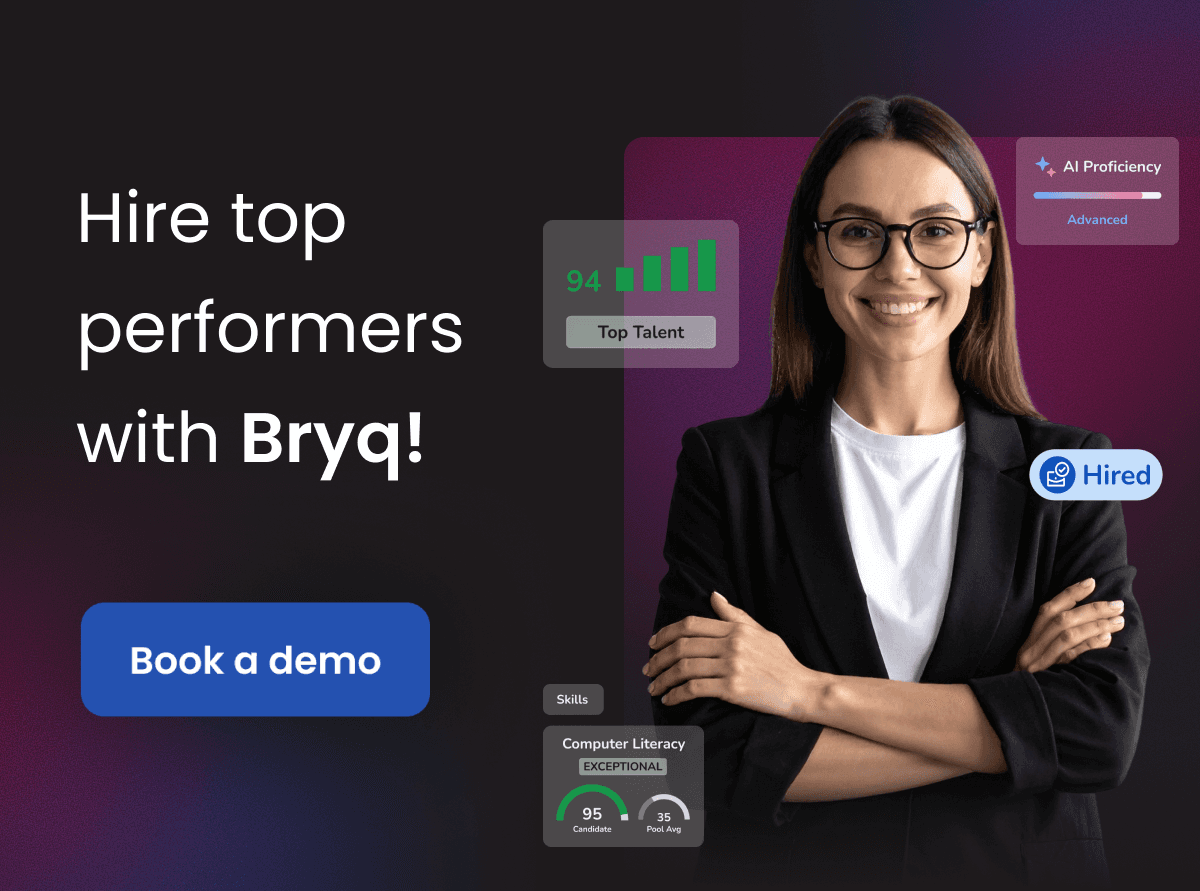
Most hiring tools filter. Bryq measures. The AI builds an Ideal Candidate Profile for every role and scores candidates on actual job fit. A hiring manager opens one profile and sees where a person lands on cognitive ability, on the personality traits the role demands, on the hard skills it requires, and on how effectively they work with AI. Every candidate for every role takes the same cognitive and personality assessment, so those scores mean the same thing in a marketing role as they do in an operations one.
The AI Fluency Assessment measures how people actually work with AI, through a simulation with a live AI assistant and scenario-based questions. The simulation takes about 15 minutes, returns five dimension-level scores on a 0-100 scale with no pass/fail binary, and is built on six peer-reviewed research frameworks including UNESCO, SFIA and OECD. It is tool-agnostic, works across any role in any industry, covers candidates and current employees with the same instrument, and is included in every Bryq plan.
Proof of Skill vs Prediction of Fit
CodeSignal’s homepage promises proof instead of proxies. Bryq measures the predictors that proof leaves out.
CodeSignal measures demonstrated skill. Its assessments show what a candidate can already do in a job-relevant simulation. CodeSignal validates those assessments as predictive of performance, and the prediction rests on the skill already being there. For a given role you pick an assessment, perhaps add an AI interviewer, perhaps add a live technical interview, and read the results together. That is the right approach when the role has a defined skill set, you know what it is, and you have the recruiting operations to maintain those choices across every role.
Bryq predicts how well someone will perform in a new role, even one they have never done before. Cognitive ability and personality traits are two of the most studied predictors of job performance in the I/O psychology literature, and they do not depend on the candidate having done the job before. Soft and hard skills including AI fluency sit in the same profile, so what someone can do today and how they are likely to perform tomorrow arrive together.
Proof and prediction answer different buying questions. If you need to confirm a candidate can ship production code, proof is what you want. If you need to know whether a candidate will succeed in a role, grow into the next one, and still be there in two years, demonstrated skill on its own cannot tell you.
CodeSignal does aggregate the results of the assessments you select. Its Skills Intelligence layer benchmarks proficiency by skill across candidates and teams, and the platform describes a single verified view of skill readiness spanning more than 3,000 skills. What varies is the composition. Because you choose which assessments run for each role, including whether cognitive or behavioral assessments are part of it at all, two candidates for two different roles have been measured on different things, and the profile that comes back reflects what you selected. Choosing well is ongoing work, and it usually sits with whoever is hiring for the role rather than with a psychometrician.
Bryq works from the other direction. Every candidate takes the same cognitive and personality assessment, and the hard skills and AI assessments are matched to the role. The AI builds a role profile from the job description and scores the whole profile against it. Because the cognitive and personality layer is the same for everyone, candidates for different roles can be compared on the traits that predict performance, and that layer carries continuous validation by I/O psychologists.
Hires rarely fail only because they could not do a task. They fail on role fit, on motivation, or on friction with how the team operates. Skill-level measurement catches the first problem well. The rest need cognitive ability and personality traits in the same profile.
Personality Traits vs Work Styles
CodeSignal’s behavioral assessment scores ten work styles. It avoids personality traits on purpose.
The model covers five domains: Pursuing Goals, Working with Others, Creating Solutions, Approaching Tasks and Reacting to Pressure. Within them sit ten style indicators, such as collaborative, enterprising, flexible and structured. You set a fit range for each role, and the result shows alignment or mismatch. CodeSignal designed the model with I/O psychologists. Its published FAQ says behavioral assessments focus on observable workplace behaviors and predict job performance. Personality tests, it says, measure broad, unchanging traits, and its own assessments go beyond personality labels.
CodeSignal also lists a Cognitive Reasoning Assessment in its library, alongside the Behavioral Profile Assessment. Bryq measures personality traits, on the Big Five and the 16PF, and cognitive ability on the CHC model of intelligence. Those are models the I/O psychology literature has validated over decades, with published research behind them. A work-style result describes how someone tends to operate. A trait profile scored against the role tells you how well the role suits them, which is the question behind quality of hire and early attrition.
CodeSignal’s own behavioral page is headed “Skills only tell half the story.” Bryq shares that premise, and fills the other half with validated personality traits and cognitive ability.
AI Fluency: Role Decisions vs a Catalog of AI Skills
CodeSignal’s AI literacy test takes 20 to 30 minutes and reports on three areas. Bryq’s core AI Fluency Assessment takes about 15 and reports on five.
CodeSignal covers a wide span of AI skills across separate, simulation-based assessments. Its AI Literacy Assessment reports on GenAI capability awareness, GenAI proficiency and use, and GenAI limitation awareness. Beyond that the catalog runs deep into technical territory: AI researcher, machine learning engineering, MCP and agentic systems, AI-assisted coding. You select the assessment that matches the role. Advanced technical assessments run 60 to 90 minutes.
Bryq’s core AI Fluency Assessment works for every role. It returns five dimension-level scores on a 0-100 scale: AI Task Strategy, Prompting & Interaction Quality, Critical Evaluation & Validation, Ethical & Responsible Use, and Workflow Integration & Output Quality. Three levels match the result to what the role requires, from Aware through Functional to Advanced. Because it is the same assessment each time, an operations manager’s AI fluency can be read against a marketing manager’s, and both can be read against the level their roles call for.
Those five dimensions measure decisions. AI Task Strategy tests what a person hands to AI and what they keep for their own judgment. Critical Evaluation & Validation checks whether they catch the errors. And Workflow Integration & Output Quality shows whether a draft turns into work that ships. A general aptitude score tells you someone reasons well. It does not tell you what they would delegate, or whether they would notice when the model was confidently wrong.
Where a role’s AI decisions are specific enough to need their own measure, Bryq builds a role-specific assessment. Assessments are live for product managers, account managers, sales development (SDR and BDR) and managers driving AI adoption (AI Change Leadership). The one for product managers includes delegating to AI agents when building features. That is a decision only product managers make, and the assessment is written around it.
Bryq’s AI fluency assessments are built on peer-reviewed research and subject-matter expert research, and reviewed by I/O psychologists. The sources are open and the framework is documented.
Bryq is also tool-agnostic. CodeSignal lets you select which large language model powers an assessment, which is useful for governance, and the result reflects work with that model. Bryq measures the five skills that carry over whichever model ships next quarter. Scenarios inside the simulation are updated as AI practice evolves. The framework stays stable, which is what makes a score from last quarter comparable to one from this quarter.
What Reaches Your Hiring Manager
CodeSignal and Bryq hand the hiring manager different things.
From CodeSignal, the hiring manager gets results from the assessments that were selected: skill-level scores, an AI interview summary, a suspicion score from the proctoring layer. Reading those together and deciding what they mean for this role is the manager’s job. Two managers reading the same set can reach different conclusions.
From Bryq, the hiring manager gets one profile scored against the role: cognitive ability, the personality traits that role calls for, the hard skills it requires, and AI fluency across five dimensions. The human still makes the decision. Bryq provides the data, not the verdict. But the data arrives already interpreted against the role.
That difference compounds. A recruiter triages fit scores instead of reading separate reports, and interviews can focus on what each profile leaves open.
Pricing: Credits vs Flat Rate
CodeSignal publishes its hiring pricing, and the model is credit-based. Build starts at $79 per month billed annually and includes 60 credits a year. Grow starts at $479 per month billed annually and includes 420. Pro is custom-priced. A credit is consumed when a candidate starts an assessment, an AI interview or a live interview, rather than when you send an invitation, and credits beyond the included allowance cost $20 each.
Two details follow from that. A candidate who takes an assessment and then an AI interview consumes two credits. And a team assessing 100 candidates a year on Build would use its 60 included credits and 40 on-demand credits at $20 each, for $1,748 a year. Bryq’s entry plan is $828 a year with unlimited invitations.
Bryq charges a flat-rate subscription with unlimited invitations, published from $69 per month on the Pro plan. Cost does not change whether you assess 200 candidates or 2,000, and the AI Fluency Assessment is included in your plan rather than sitting behind a tier.
The models diverge as volume grows. A credit structure asks you to forecast hiring volume a year ahead and buy more when a growth year or a mass-hiring project arrives. A flat rate does not, which also means high-volume screening carries no marginal cost. You can assess everyone in the funnel rather than rationing assessments to the shortlist.
Tier gating matters too. On CodeSignal’s published plan comparison, the universal, cognitive and behavioral library is core-level on Build and Grow, and full only on Pro. Go-to-market and human resources assessments start at Grow. Finance and operations assessments are listed on Pro. Bryq includes the whole integrated assessment in every plan.
ATS Integration and Time to Live
CodeSignal integrates with the major applicant tracking systems, including Greenhouse, Lever, Workday, iCIMS and SmartRecruiters. On the published plan comparison, core ATS integrations begin at Grow with Gem and Ashby, and enterprise connectors such as Workday, iCIMS and Oracle sit on Pro. The entry plan does not list ATS integration.
Bryq is ATS-integrated in under a week, and integration is included from the entry plan. Self-service connectors cover Workable, Greenhouse, Lever, Teamtailor, BreezyHR, Recruitee, Pinpoint, Ashby, JazzHR, SmartCV, Zoho Recruit and Comeet, with guided and custom integrations available on Enterprise. There is no IT project and no vendor-management workstream. It activates from your dashboard.
The deeper difference is what flows through the pipe. One platform sends a set of assessment results into your ATS. The other sends a fit profile.
Assessment Science and Comparability
CodeSignal cites 13 million skill evaluations. Bryq cites the Big Five, the 16PF and the CHC model of intelligence.
CodeSignal’s case is about scale. Its assessments are validated by I/O psychologists, and a data set that size is a large base for benchmarking how candidates perform relative to one another on a given assessment. On the published plan comparison, local I/O validation studies are listed on the Pro tier.
Bryq’s case is about instruments. Our cognitive and personality assessments are built on those three models and continuously validated by I/O psychologists, on every plan. Because the instrument is stable, a profile built for a hire remains readable two years later for internal mobility, succession, or L&D planning.
Bryq’s cognitive and personality assessments are reviewed by I/O psychologists for adverse impact across demographic groups. Adverse-impact analysis attaches to a stable instrument. A hiring process assembled from a different combination of assessments for each role has to be examined for it in each combination.
For organizations operating in the EU, there is a regulatory dimension. EU AI Act Article 4 has required organizations to ensure staff AI literacy since February 2025. This is an obligation already in force. The AI Fluency Assessment provides documented, auditable evidence of evaluation, for candidates and for current staff.
Assessing Your Existing Workforce
Both platforms cover this. CodeSignal Learn adds practice-based upskilling with an AI tutor, learning academies, skills analytics and benchmarking, plus talent mobility and interviewer training. It suits organizations buying assessment and structured development from one vendor.
Bryq’s difference is the instrument, not the use case. The same validated assessment serves a candidate and an employee of six years, which means the scores sit on one scale. You can compare a team’s AI fluency against the level the role requires, against another function, and against the candidates you are about to interview, because all of it came out of the same instrument. A baseline assembled from different assessments per team describes each team on the skills you chose for it.
That matters most when someone senior asks what your people can actually do with AI. Right now most organizations can answer that only with a survey. A validated, dimension-level baseline is a different kind of answer.
Security and Regulatory Position
CodeSignal publishes SOC 2 Type II, GDPR and CCPA compliance on every plan, with custom DPA, SSO, audit logs and data retention controls on enterprise plans. Its platform overview also cites automated scoring, validation and adverse impact studies for EEOC and OFCCP compliance.
Bryq is SOC 2 Type II certified, ISO 27001 certified, and GDPR compliant, with published positions on EEOC, UGESP, and the NYC AI Bias Regulation, and a public Trust Center. Both platforms clear a standard security questionnaire, and both publish a fairness position. Bryq’s attaches to one instrument that every candidate takes. CodeSignal’s attaches to the assessments you selected for each role.
Who Should Choose CodeSignal
Engineering hiring is a large share of your volume and you need coding, machine learning or AI-assisted development assessed in depth
You want a live technical interview environment with a shared IDE alongside your assessments
You want AI interviewers to run first-round screens across multiple functions
You want assessment and structured upskilling from the same vendor, with learning paths and an AI tutor
You run university recruiting or career-readiness programs at institutional scale
You have the recruiting operations to select and maintain the right assessments per role
Confirming demonstrated skill matters more to you than predicting how someone will perform in a role that is new to them
Who Should Choose Bryq
You need to predict performance and retention, not only confirm what a candidate can already do
You want cognitive ability, personality traits, soft and hard skills including AI fluency in one integrated assessment, on the Big Five, 16PF and CHC models
You need scores that are comparable across every role you hire for, not only within one role
You need to know how candidates and current employees actually work with AI, on a stable framework rather than tied to one model
You want AI fluency measurement included in every plan
You want a flat rate that does not penalize you for hiring more people
You are a mid-market or enterprise HR team that needs assessments continuously validated by I/O psychologists
You want assessment data that stays useful for internal mobility, succession and L&D after the hire
See the Difference for Yourself
Feature lists only go so far. The fastest way to understand how Bryq works is to see your own role profile in action.
Book a 30-minute demo and we will build one together on a live requisition. You will see the AI Fluency Assessment in the same session.
Measurable impact on hiring outcomes
2x Faster hiring · 47% Lower attrition · 3x Quality of hire
FAQ
What is CodeSignal used for?
CodeSignal is used to assess and interview candidates and to develop skills in existing teams. Hiring teams select from a catalog of assessments covering technical, business, cognitive, behavioral and AI skills, then add AI interviewers or live technical interviews in a shared IDE. A separate product, CodeSignal Learn, provides practice-based upskilling. Bryq measures cognitive ability, personality traits, soft and hard skills including AI fluency in one integrated profile scored against the role.
What is the biggest difference between Bryq and CodeSignal?
CodeSignal assesses what a candidate can do today, through demonstrated skill in simulations you select per role. Bryq predicts how well a candidate will perform in the role, even if they have never done that job before. It measures cognitive ability and personality traits alongside soft and hard skills including AI fluency, in one integrated profile scored against the role and validated by I/O psychologists. Customers report 3x improvement in quality of hire, 47% lower attrition, and 2x faster hiring. Results measured across Bryq customer engagements. Individual outcomes vary by role, industry, and baseline hiring maturity. Methodology and case studies available on request.
Does CodeSignal measure personality and cognitive ability?
CodeSignal offers a Cognitive Reasoning Assessment and a Behavioral Profile Assessment. The behavioral assessment measures work styles across five domains: pursuing goals, working with others, creating solutions, approaching tasks and reacting to pressure. CodeSignal states that these go beyond personality labels and that its approach differs from personality tests, which it describes as measuring broad, unchanging traits. Bryq measures personality traits on the Big Five and 16PF and cognitive ability on the CHC model of intelligence, in every profile, on every plan.
Does CodeSignal measure AI fluency?
Yes. CodeSignal’s agentic AI assessments measure AI proficiency through simulations, spanning AI literacy through advanced technical work such as model development and AI-assisted coding, and you select which large language model powers the assessment. You choose the assessment that fits each role. Bryq’s core AI Fluency Assessment is one tool-agnostic instrument for every role. It returns five dimension-level scores on a 0-100 scale, across three levels matched to role requirements: Aware, Functional and Advanced. It uses a simulation and scenario-based questions, is built on six peer-reviewed research frameworks, and is included in every plan. Bryq also offers role-specific AI assessments for product managers, account managers, sales development, and managers driving AI adoption (AI Change Leadership).
How does CodeSignal pricing work?
CodeSignal’s hiring plans are credit-based. Build starts at $79 per month billed annually with 60 annual credits, Grow at $479 per month with 420, and Pro is custom-priced. A credit is used when a candidate starts an assessment or interview, and additional credits cost $20 each. Bryq is a flat-rate subscription with unlimited invitations, published from $69 per month.
Which platform has the bigger test library?
CodeSignal advertises hundreds of assessments across technical, business, behavioral and AI categories, browsable in its Assessment Explorer. Bryq’s library covers 140+ validated tests across technical, business and trade roles, plus the integrated cognitive, personality and AI fluency profile. Bryq’s approach is profile depth and comparability over library breadth.
Does CodeSignal include ATS integration on every plan?
CodeSignal’s published plan comparison lists core ATS integrations from the Grow tier and enterprise connectors on Pro. Bryq includes ATS integration from the entry plan and connects in under a week.
Can I assess current employees with either platform?
Yes, both support this. CodeSignal supports it through CodeSignal Learn with upskilling paths, academies and skills analytics. Bryq uses the same validated instrument for candidates and current employees, so scores sit on one comparable scale across hiring, internal mobility and workforce planning.
Are CodeSignal’s assessments validated?
CodeSignal’s assessments are validated by I/O psychologists and informed by more than 13 million skill evaluations, and its published plan comparison lists local I/O validation studies on the Pro tier. Bryq’s cognitive and personality assessments are built on the Big Five, 16PF and CHC models and continuously validated by I/O psychologists on every plan. The AI Fluency Assessment is built on six peer-reviewed research frameworks, including UNESCO, SFIA and OECD, and on subject-matter expert research, reviewed by I/O psychologists.
Is CodeSignal a good way to hire?
For technical roles, yes. CodeSignal is strong at assessing engineering skill in depth, and its live interview environment and AI interviewers are built for high-volume recruiting. The limits are composition and cost at volume. What a candidate is measured on depends on which assessments you selected for that role, and credit pricing rises with the number of candidates you assess. Teams that need one score comparable across every role usually look for a CodeSignal alternative that measures the whole profile, which is what Bryq is built for.
Can I migrate from CodeSignal to Bryq without disrupting live hiring?
Yes. Bryq integrates with your ATS in under a week, and existing roles can be mapped to Bryq’s role-scored profiles during onboarding.
Which should I pick if my hiring is mostly engineering?
If verifying that someone can ship code, build a model or work inside an agentic system is the primary filter, a purpose-built technical assessment is the right tool and CodeSignal is strong there. You may also need to know whether that engineer will fit the team, stay past 18 months, and work well with AI outside a coding context. That is a different measurement, and it is what Bryq is built for.
Ready to see Bryq in action?
Start hiring based on real data.
Author
Bryq is composed of a diverse team of HR experts, including I-O psychologists, data scientists, and seasoned HR professionals, all united by a shared passion for soft skills.