Psychometric testing is the use of validated, standardised assessments to measure a candidate's cognitive ability and personality during recruitment. UK employers use it to make hiring fairer and more predictive than CVs and interviews alone. The strongest psychometric tests are validated by occupational (I/O) psychologists and measure the traits that predict performance in the role. This guide explains the main types of psychometric test, how they are used in UK recruitment, how to keep them fair and compliant, and how to choose a provider.
What is psychometric testing?
Psychometric testing is the use of validated, standardised assessments to measure a candidate's cognitive ability, personality, and, increasingly, job-specific skills during recruitment, rather than relying on a CV and interview alone. The term comes from "psychometrics", the branch of psychology concerned with measuring mental traits and abilities. UK employers use psychometric tests at different stages: as an early screening step for high-volume graduate and apprenticeship schemes, or later in the process alongside interviews for senior hires.
A test only counts as psychometric if it has been through formal validation: shown, through research, to measure what it claims to measure (validity), and to produce consistent results across candidates and sittings (reliability). Without that validation, a "test" is a structured questionnaire with no proven link to job performance, whatever a supplier's marketing claims.
The two core types, plus a modern third dimension
Aptitude, or cognitive ability, tests measure reasoning: numerical, verbal, logical, and inductive reasoning are the most common in UK recruitment. They're timed, have a right answer, and predict how quickly and accurately someone processes new information, which research consistently links to performance across almost every role. See worked cognitive test example questions and what aptitude testing covers for a closer look at format.
Personality questionnaires measure behavioural preferences and working style, not ability, so there's no pass or fail. Most UK providers build these on established trait models, including Holland Codes, and Big Five-derived frameworks, to describe how a candidate tends to approach teamwork, decision-making, and pressure.
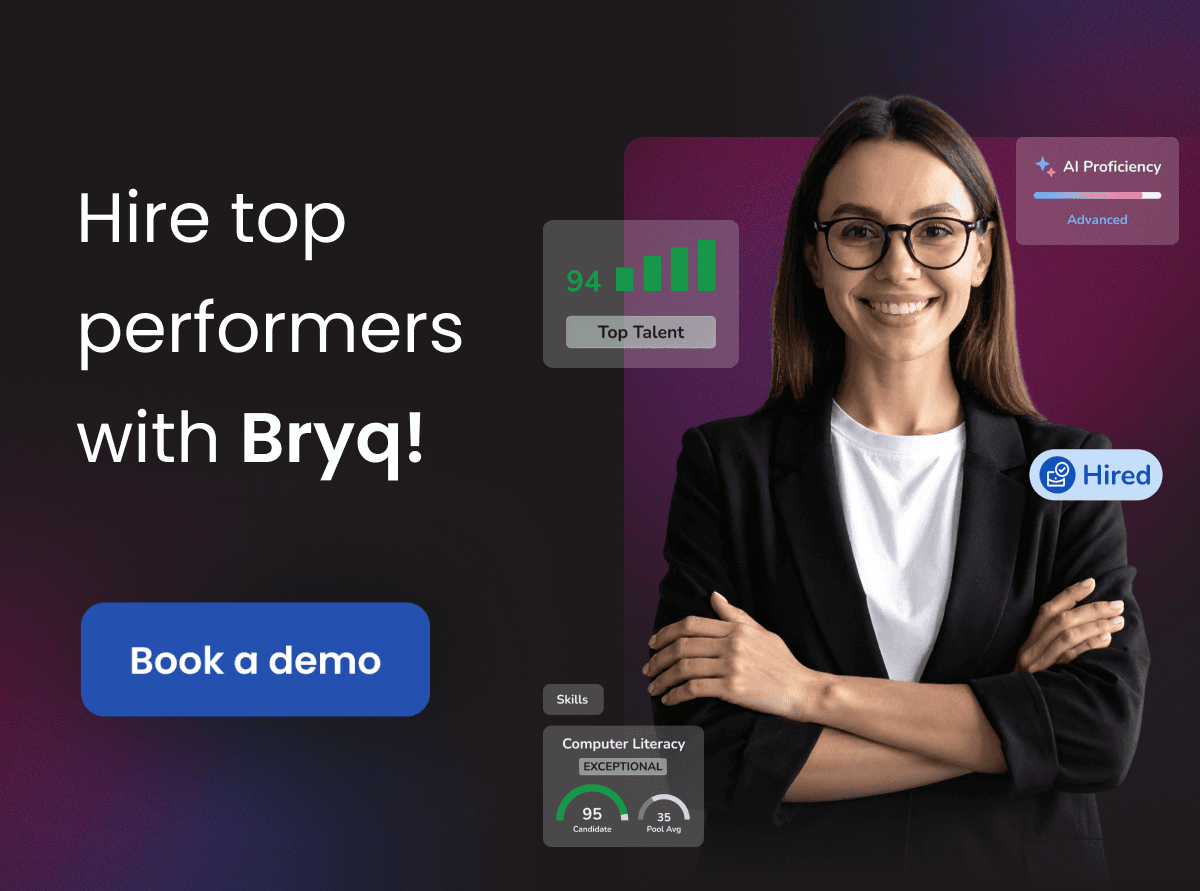
A third dimension has emerged alongside these two: AI fluency, how effectively a candidate works with AI tools in real workflows. Bryq's AI Fluency Assessment measures this as a 15-minute calibration, not a knowledge quiz, reported alongside cognitive and personality data in one profile.
How UK employers use psychometric testing in recruitment
Most UK hiring processes use psychometric testing at one of two points. High-volume schemes (graduate programmes, apprenticeships, contact centre, and retail hiring) use aptitude tests early as an objective filter before CVs are reviewed in detail, since they screen large candidate pools consistently and without the bias that creeps into unstructured CV screening. For senior, technical, or leadership roles, tests more often run alongside structured interviews and assessment centres, adding a data point that interviewers weigh against their own impressions rather than replacing judgement.
Sectors with FCA or other regulatory oversight (financial services, insurance, parts of the public sector) increasingly treat validated testing as part of a defensible, auditable hiring process, not a nice-to-have extra. Whichever stage it's used at, the result should feed directly into the hiring decision through the applicant tracking system (ATS), not sit in a separate report nobody reads.
Fairness, validity, and data protection under UK GDPR
A psychometric test can only be called fair if it has been checked for adverse impact, meaning it doesn't systematically disadvantage candidates based on protected characteristics such as sex, ethnicity, age, or disability. Reputable providers publish, or can produce on request, this adverse impact data. If a supplier can't, that's a reason to look elsewhere.
Because psychometric test data is personal data, and in some cases special category data where it touches health or disability-related adjustments, UK GDPR applies in full. Employers need a lawful basis for processing, a clear retention policy, and a data processing agreement with any third-party provider. Reasonable adjustments (extra time, alternative formats) must be offered to candidates who need them under the Equality Act 2010, and a good provider builds this in as standard, not as an afterthought.
How to choose a psychometric testing provider
Four things separate a good provider from a risky one. Validation: ask whether tests are built and checked by occupational (I/O) psychologists, and whether that validation is documented rather than just asserted. An integrated profile: separate cognitive, personality, and skills tests from different suppliers create a fragmented candidate experience and make it harder to see one clear picture of job fit, whereas a single validated profile is easier to defend and easier for candidates to complete. Candidate experience: shorter, well-designed assessments keep completion rates high and don't put strong candidates off applying. ATS integration: results should flow directly into your existing hiring workflow, not sit in a standalone portal.
Bryq brings cognitive ability, personality, and hard skills, including AI fluency, into one integrated profile validated by occupational psychologists, backed by a 140+ test Skills Assessments Library. Customers report a 3x improvement in quality of hire, 47% lower attrition, and 2x faster hiring,* with results live in your ATS within a week.
*Outcomes reflect results reported by Bryq customers; individual results vary by role, industry, and baseline hiring process.
Frequently asked questions
What does a psychometric test measure?
A psychometric test typically measures cognitive ability (reasoning speed and accuracy) and personality (behavioural style and working preferences). Some newer assessments, including Bryq's, also measure AI fluency, how well a candidate works with AI tools in practice.
Are psychometric tests accurate?
Validated tests, built and checked by occupational psychologists, are among the most accurate predictors of job performance available, more accurate than unstructured interviews alone. Accuracy depends entirely on whether the specific test a provider uses has actually been through that validation process.
How long do they take?
Aptitude tests typically take 15 to 30 minutes and personality questionnaires 15 to 25 minutes. An integrated profile covering cognitive ability, personality, and skills can usually be completed in under 30 minutes in total.
Can you fail a psychometric test?
You can't fail a personality questionnaire, since there's no right answer, only fit. Aptitude and cognitive tests do have a score, but most employers use that score as one input weighed against a role benchmark, not a strict pass or fail cut-off.
Are psychometric tests legal in UK recruitment?
Yes, provided they're applied consistently, checked for adverse impact against protected characteristics under the Equality Act 2010, and administered with reasonable adjustments available. Employers also need a lawful basis for processing candidate data under UK GDPR.
Do they reduce bias?
Well-validated psychometric tests reduce bias compared with unstructured interviews and CV screening, because every candidate is measured against the same standardised benchmark rather than a recruiter's subjective impression. They don't remove bias entirely, which is why adverse impact testing and human oversight of final decisions still matter.
See Bryq's validated assessments
A psychometric test is only as good as its validation and how well it fits into your hiring process. Book a demo to see Bryq's integrated cognitive, personality, and AI fluency profile on your own roles.
Author
Bryq is composed of a diverse team of HR experts, including I-O psychologists, data scientists, and seasoned HR professionals, all united by a shared passion for soft skills.