About the role
A Recruiter job description covers sourcing, attracting, screening, and hiring candidates for open positions and documenting what each job requires. The role protects the speed and quality of hiring, which shapes how well teams deliver their work. Hiring managers should assess selection process knowledge, interpersonal skills, strategic communication, and AI fluency.
Recruiters find, attract, screen, and hire candidates, and they document what each job requires. Job descriptions also use the titles in-house recruiter and staffing agency recruiter. Their work directly affects quality of hire and how quickly teams can start delivering. Typical duties include:
Strategy. Design and implement the overall recruiting strategy.
Sourcing. Source and attract candidates through databases, social media, and other channels.
Screening. Conduct interviews and filter candidates for open positions.
What are the essential Recruiter skills?
The essential Recruiter skills are human resources and selection processes, interpersonal skills, relationship building, strategic communication, and AI fluency.
Skill | Why it matters | Bryq assessment and level |
|---|---|---|
Human resources and selection processes | Recruiters run interviews, screening, and selection every day. | |
Interpersonal skills for interviewing and candidate engagement | Good conversations draw out candidate motivations and build trust. | Interpersonal Skills (intermediate) |
Relationship building with candidates and hiring managers | Strong relationships keep candidates and managers engaged in the process. | Relationship Building (intermediate) |
Strategic communication for employer branding and outreach | Clear messaging attracts talent and promotes the company as an employer. | Strategic Communication (intermediate) |
AI Fluency | AI tools now shape sourcing, screening, and candidate communication. | AI Fluency Assessment (functional) |
Recruiters spend their days interviewing, screening, and running selection processes. HR knowledge, interpersonal skill, and relationship building are therefore required. Employer branding and outreach depend on strategic communication, and AI tools now shape sourcing and screening.
Levels are a starting point. Bryq lets you set the level each role needs.
Which nice-to-have skills help a Recruiter stand out?
Applicant tracking and candidate relationship systems, strategic and critical thinking, ethical judgment, and time management add value but are not needed on day one.
Applicant tracking and candidate relationship systems. Speeds up daily pipeline work.
Strategic and critical thinking. Supports recruiting strategy and job analysis.
Ethical judgment. Supports fair and unbiased selection.
Time management. Helps balance many open requisitions.
Use these skills as tie-breakers between candidates who are equally strong on the essentials. Never screen out candidates who can learn them on the job.
Which competencies predict success as a Recruiter?
The essential competencies for a Recruiter are Communication and Empathy.
Communication. Recruiters interview, write outreach, and explain roles and decisions.
Empathy. Understanding candidate motivations creates a respectful hiring experience.
The optional competencies are Leadership Potential, which helps influence hiring managers, and Learning Agility, which helps with evolving hiring tools.
What AI skills does a Recruiter need?
A Recruiter should use AI fluency daily for sourcing, drafting, and screening support, so hiring moves faster and candidates get timely communication.
AI matters here because it now shapes sourcing and screening. Using AI output without checking it risks errors and bias, so recruiters must review it for accuracy and fairness. Everyday use is enough for most of the work, and recruiters do not need to build AI workflows.
Job documents. Draft and refine job descriptions and task analyses from hiring manager notes.
Sourcing. Generate Boolean search strings and personalized outreach messages for candidates.
Interview review. Summarize interview notes and structure comparisons of candidates against role requirements, with human review for bias.
How do you assess Recruiter candidates with Bryq?
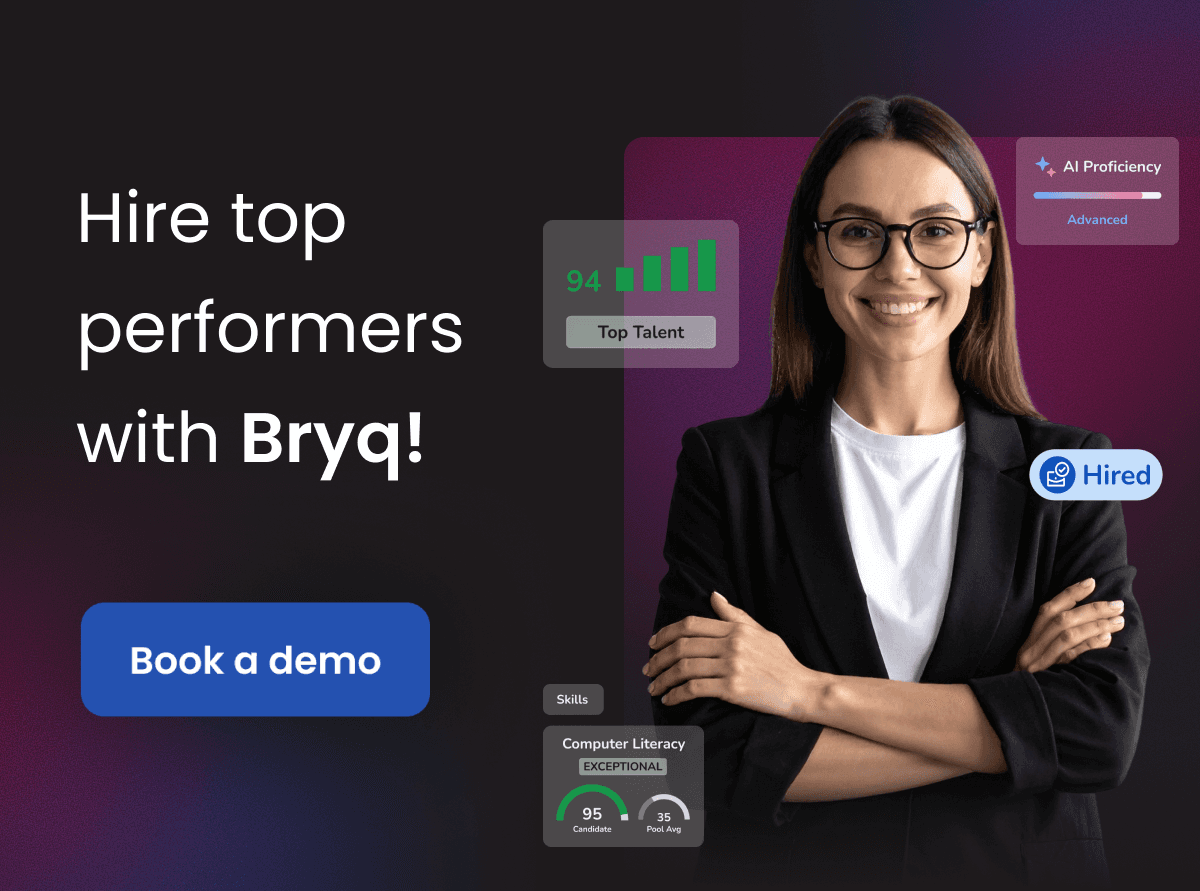
Bryq measures all the essential skills and traits for a Recruiter in one integrated candidate profile: cognitive ability, personality traits, soft and hard skills, including AI fluency. Bryq builds an ideal profile for the role and matches candidates against it.
Profile Fit. Profile Fit measures cognitive ability and personality traits, matched against the ideal profile for the role.
Human Resources Roles. Human Resources Roles tests knowledge of human resources and selection processes.
Interpersonal Skills. Interpersonal Skills tests skills for interviewing and candidate engagement.
Relationship Building. Relationship Building tests how candidates build relationships with candidates and hiring managers.
Strategic Communication. Strategic Communication tests communication for employer branding and outreach.
AI Fluency Assessment. The AI Fluency Assessment measures how well candidates use AI for sourcing, screening, and candidate communication.
Optional add-ons. Add interview guides to structure conversations with shortlisted candidates.
Competency profile. Use competency mapping for Communication and Empathy, with Leadership Potential and Learning Agility as additions.
Recruiter job description template
Copy and paste this template, then replace the text in square brackets. To write or rewrite your own, use Bryq’s free job description AI skill, which works in Claude, ChatGPT and Copilot.
Copy template
Copied
Recruiter |
|---|
About [Company name][Add a short description of your company.] About the roleAs a Recruiter, you will source, attract, and hire talent for open positions in our Human Resources team. You will help us document what each job requires and promote us as an employer of choice. Your work supports the growth and success of the organization. Responsibilities
Qualifications
Skills and competencies we look for
Working with AI
What we offer
Equal opportunity[Add your equal opportunity statement.] |
Frequently asked questions
You can explore more job profiles on Bryq.
Assess your next Recruiter with Bryq
Book a demo to see how Bryq helps you assess Recruiter candidates on the skills and competencies that matter.
Author
The Bryq I/O Team
Bryq’s I/O Psychology Team is a group of industrial-organizational psychologists who design and validate the science behind our assessments. They write about what research says on hiring, skills, personality, and performance, and how HR leaders can apply it to make fairer, evidence-based decisions.